
Endeavor and EERC brief committee on commercialization, federal awards and ‘Polar Bear’ flare‑gas work
Get AI-powered insights, summaries, and transcripts
Sign Up Free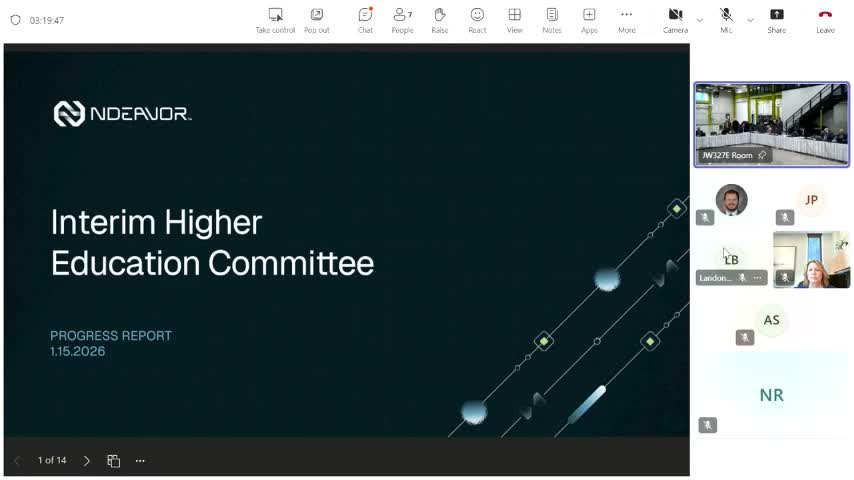
Summary
Endeavor (tech park) described early prototype demos and military exercises while the EERC outlined its competitive funding model and State Energy Research Center (SERC) investments that leveraged state dollars into larger federal and private awards (example: Polar Bear flare‑gas capture pilot).
Brenda Weiland (Endeavor CEO) reported rapid establishment and scaling since the legislature’s SB 2256: an innovation studio and prototyping labs are online, the organization has participated in multiple military demonstrations and plans additional exercises, and the team has grown from five to 11 FTEs in months. She described partnerships with UND, NDSU, the National Guard, and ongoing conversations with Carnegie Mellon; she reiterated the goal to translate university research to market‑ready prototypes.
Tom Erickson (COO, EERC) summarized EERC’s history and operating model: the center competes for federal and private research contracts (FY25 revenues ~$85M, FY26 budgeted ~$62M) and uses the State Energy Research Center (SERC) funding to seed early‑stage projects. Erickson highlighted 'Polar Bear' — a small‑scale compressor and packaged system to reduce flaring — as a SERC‑seeded project now in field demos with industry partners. He explained that EERC facilities have been financed through a mix of federal contracts and foundation financing and that the EERC Foundation manages IP and patenting; revenues from commercialization flow back to the foundation and then support EERC work.
Committee members asked about federal funding timing and IP revenue flows; Erickson said most federal funds have been DOE‑sourced and that the EERC is awaiting promised federal opportunities while private sector work has been an important recent revenue source. On IP, revenues return to the foundation to cover patenting costs and to reinvest in new research.