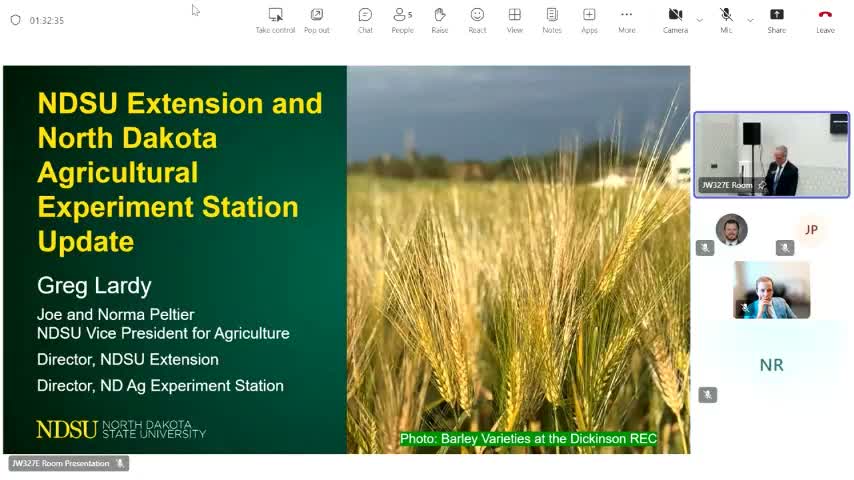
NDSU Extension and Experiment Station outline statewide research, extension and budgets
Loading...
Summary
NDSU’s vice president for agriculture, Greg Lardy, briefed the committee on the Experiment Station and Extension: the REC network, county presence, program highlights (variety releases, NDON weather network, virtual fencing), and FY25 budget splits (Extension ~54% state funds; Experiment Station ~49% state funds).
Greg Lardy, vice president for agriculture at North Dakota State University, told the committee that NDSU Extension and the Agricultural Experiment Station are critical statewide networks that combine campus‑based science with seven Research Extension Centers located across the state. He emphasized recent research outputs (20 public crop varieties in recent years, including the Dakota Russet potato), new capabilities in precision ag and AI for pest control, and outreach programs that reach 1 in 4 youth through 4‑H programming.
Lardy summarized finances and staffing: NDSU Extension’s FY25 budget included roughly $17 million (about 54% state appropriation in that year), while the Experiment Station reported roughly $30 million in state appropriations (~49% of its budget), plus grants, contracts and sales and services. He noted branch stations and the Agronomy Seed Farm have distinct revenue mixes and that the Bali Agricultural Laboratory capital project (Waldron Hall replacement) will open in 2026 with ongoing operating costs borne by the Experiment Station.
Committee members asked about R1 research contribution and FTE treatment; Lardy said research expenditures (grants/contracts) contribute to NDSU's R1 metrics and confirmed branch station and extension staffing. Members asked about matching requirements on grants; Lardy said matches are frequently demonstrated as effort (scientists’ time) rather than mandatory cash matches for many programs.
The committee discussed extension’s readiness to assist rural health efforts and the value of the REC network at local scale. Lardy said extension and experiment station activities are designed to be locally responsive and to translate research into farmer/rancher practice.