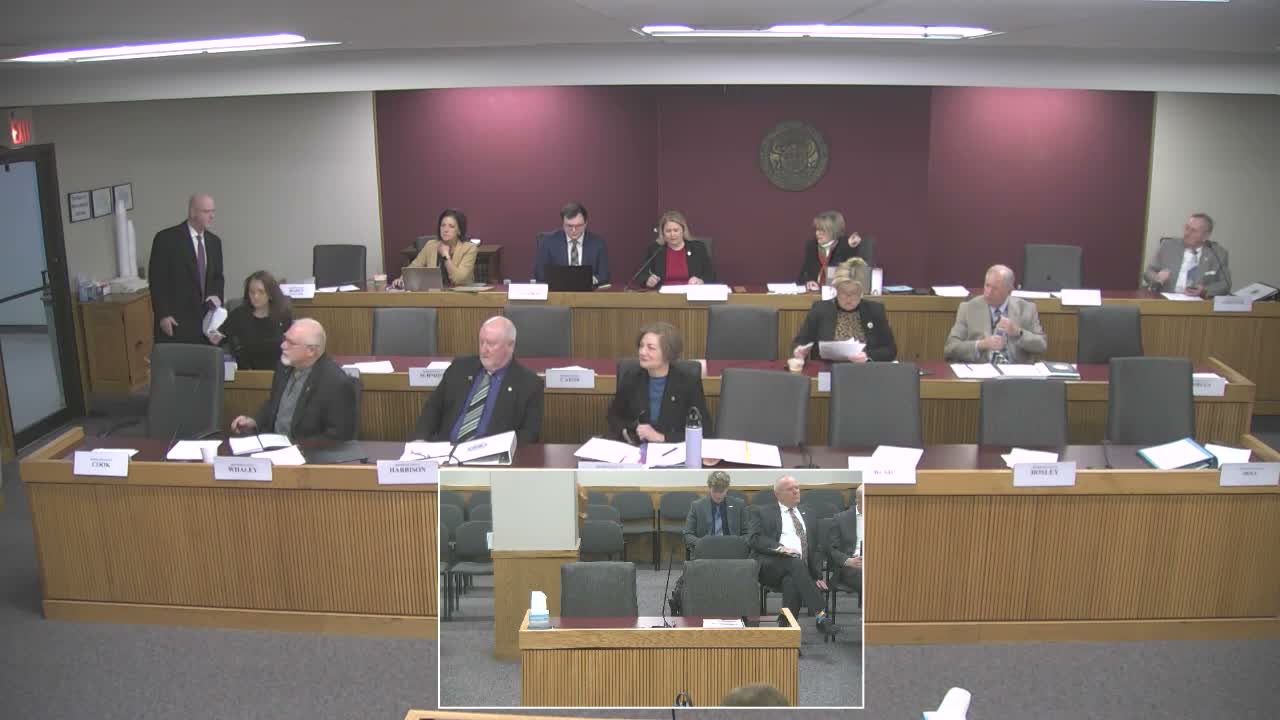
Committee hears bill to remove notary requirement for short civil mental‑health holds
Loading...
Summary
House Bill 1977 would remove a notary requirement for affidavits that can begin a 96‑hour civil mental‑health hold and allow designated professionals — including peace officers, licensed physicians, mental‑health professionals and registered nurses — to complete the affidavit to speed access to care in rural settings.
The Missouri House Health and Mental Health Committee heard House Bill 1977 on a proposal to remove a notary requirement for affidavits used to initiate 96‑hour civil mental‑health holds and to specify who may complete the paperwork.
Representative Cook, presenting the bill, said the change is meant to shorten delays in rural hospitals where a notary may not be available late at night. "If there's not a notary at 2:00 in the morning, that creates a problem and additional hospital time for that patient," the sponsor said, arguing the bill protects patient safety by getting people connected to services faster.
Under the bill as presented, the notary step would be removed and the affidavit could be completed by a peace officer, a law enforcement officer, a licensed physician, a mental‑health professional, a registered nurse or an employee acting on behalf of a hospital as defined in section 197.02. The bill preserves the current clinical standard for admission: doctors make the final evaluation, and holds can last up to 96 hours, with release allowed earlier if medical staff deem it appropriate.
Jamie Murphy of the Missouri Hospital Association testified in support, saying the proposal "is just meant to streamline the process" and that some judges are still requiring notaries even though the law does not. Murphy said the standard preserved by the bill is a "reasonable belief" that self‑harm or harm to others is possible, which can be based on observation rather than a single verbal statement from the patient.
Jacob Scott, speaking for informational purposes for the Missouri State Medical Association and the Missouri Association of Osteopathic Physicians and Surgeons, thanked the sponsor and said physicians retain the ultimate sign‑off on an admission and suggested clarifying language to make that explicit.
No committee vote was recorded during the hearing; the chair closed the public testimony and moved to the next item on the agenda. The committee adjourned after the second bill hearing.