Missouri committee hears bill to join interstate athletic‑trainer compact to ease cross‑state practice
Loading...
Summary
Supporters told the House Committee on Professional Registration and Licensing that House Bill 1844 would let athletic trainers practice across state lines more easily while preserving Missouri’s regulatory authority; witnesses said the compact would aid military families, rural schools and telehealth access.
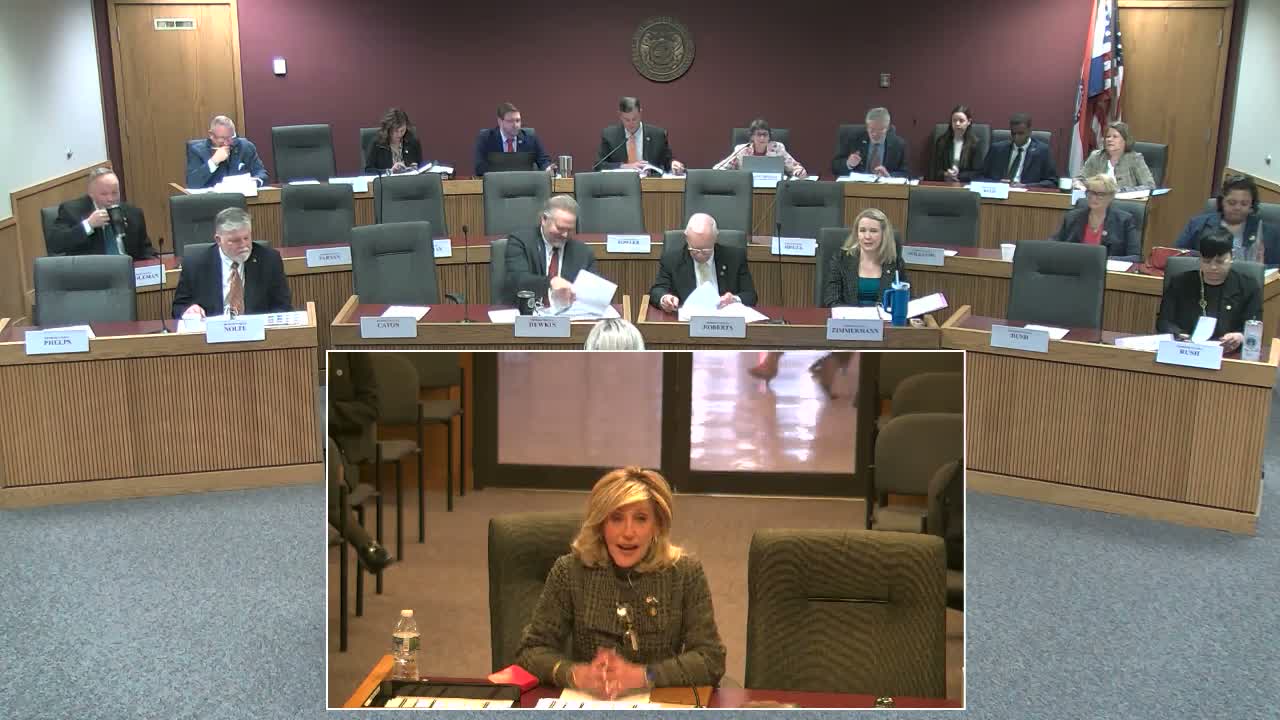
Representative Sherry Gallick introduced House Bill 1844 on behalf of an interstate athletic‑trainer licensure compact, telling the House Committee on Professional Registration and Licensing that the measure would preserve state regulatory authority while reducing administrative burdens for mobile health professionals. “The compact preserves the state's authority … to regulate and discipline licensees and to follow a proven model that's already used across health care,” Gallick said.
The bill would allow athletic trainers who hold an eligible home‑state license to obtain a practice privilege to serve in Missouri without duplicative testing, while continuing to require payment of state license fees and adherence to Missouri law, Gallick said. She listed entry requirements that states must meet to join the compact, including Board of Certification (BOC) credentialing, a Commission on Accreditation of Athletic Training Education (CAATE)‑accredited degree, continuing education and a clean, active license.
Proponents told the committee the compact would expand workforce mobility for short‑term and seasonal events and ease access to care in rural schools. Brent Hemphill of the Missouri Athletic Trainers Association said the compact allows Missouri practitioners “to go to other states and practice” and supports telehealth and reimbursement coordination across jurisdictions. Jay Hoffman, a practicing athletic trainer and program director at Culver‑Stockton College, testified the bill “does not change the scope of practice of athletic training” and would help military families and student athletes who travel across state lines.
Committee members asked how Missouri would retain oversight of rules adopted under a compact and how disciplinary data would be protected. A witness described the practical necessity that state statutes mirror compact obligations to avoid conflicts and suggested that disciplinary data protections would be handled in a non‑identifiable manner, “similar to HIPAA,” while deferring technical details to subject‑matter experts. The chair also noted the bill text states that “any law, statutes, regulations, or legal requirements will supersede, the compact,” addressing conflict concerns.
Supporters from higher education and policy organizations also spoke: David Pierce of the University of Central Missouri cited proximity to Whiteman Air Force Base and the benefits for transient military‑adjacent populations, and Keith Buckout of the Council of State Governments provided informational context, referencing the federal Sports Medicine Clarity Act for team settings. No formal motions or votes were taken during the hearing; the committee concluded after public testimony and moved on to the next bill.