
Humboldt planning panel adopts mitigated negative declaration and approves four cannabis cultivation permits
Get AI-powered insights, summaries, and transcripts
Subscribe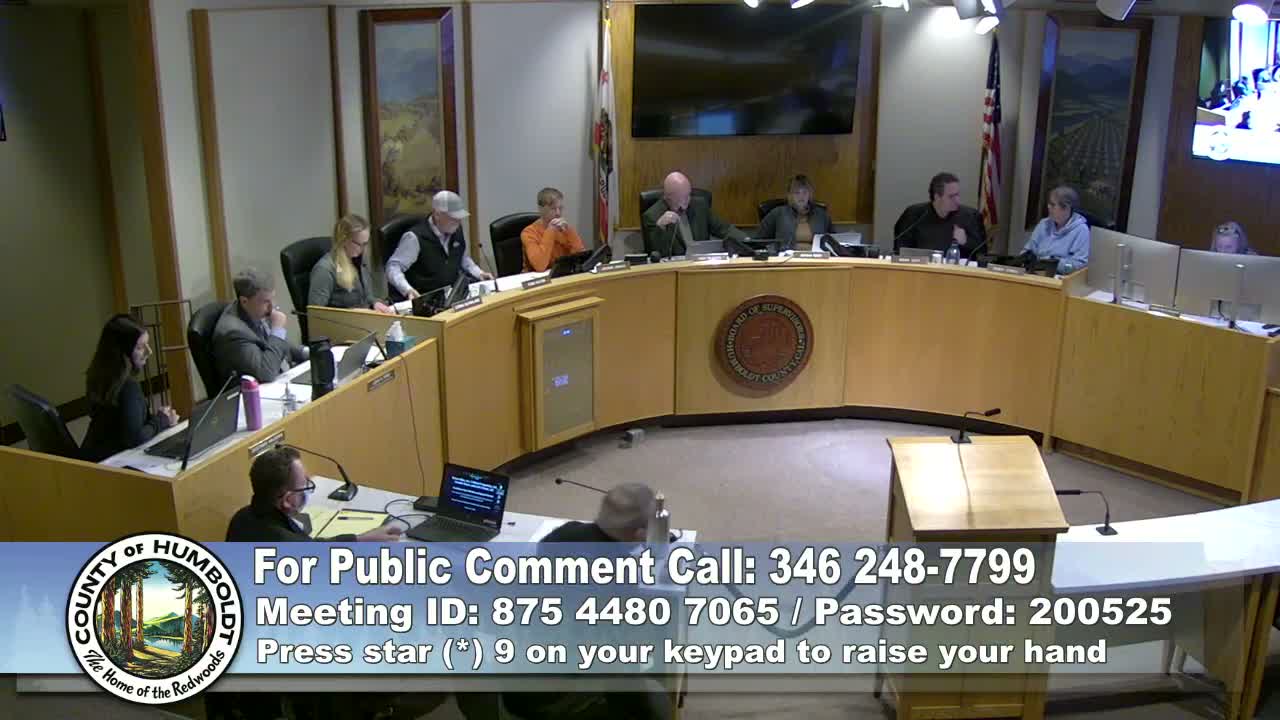
Summary
The Humboldt County Planning Commission adopted a mitigated negative declaration and approved four cannabis conditional use permits covering existing and new outdoor cultivation after staff addressed water sourcing, biological and cultural mitigations, and a Bureau of Land Management letter raising proximity and access concerns.
The Humboldt County Planning Commission on an evening vote adopted a mitigated negative declaration (ISMND) and approved four separate cannabis-related land use actions covering multiple conditional-use permits and one special permit across a single legal parcel in Larrabee Valley east of Bridgeville. Staff said the combined projects involve about 56,000 square feet of existing outdoor cultivation and roughly 4 acres of new cultivation, with total estimated annual water demand of about 4,600,000 gallons drawn from three ponds, one proposed rainwater catchment pond and five existing permitted groundwater wells.
Senior planner Steven Santos told the commission the projects would rely on a mix of pond storage (about 4.3 million gallons) and tanks (about 402,000 gallons) and described standard mitigations for agriculture and forestry conversion, dust control, nesting-bird surveys, bullfrog management, invasive plant restoration and generator noise attenuation. "Total estimated annual water is 4,600,000 gallons, sourced from 3 existing ponds and 1 proposed rainwater catchment pond, as well as 5 existing and permitted groundwater wells," Santos said during his presentation.
Santos also summarized cultural-resource work and tribal consultation for the legal parcel, saying investigations identified a previously recorded site (P12001107) and isolated areas WRA 1–3. He said the Bear River Tribal Historic Preservation Officer agreed to reduce a typical 600-foot setback to 100 feet from the resource boundary and permitted continued agricultural use of a barn so long as there is no ground disturbance. "The tribe granted a setback reduction ... to 100 feet from the resource boundary," Santos said.
The Bureau of Land Management had submitted a letter raising four topics — a boundary survey request, proximity to Northern Spotted Owl (NSO) habitat, concerns about use of BLM access easements, and a reminder that cannabis remains federally prohibited under the Controlled Substances Act. Santos replied that existing cultivation areas are about 1,700 feet from the BLM boundary and would be farther once consolidated, that NSO surveys were negative, and that conditions already address noise, light, rodenticide and runoff concerns. "No cultivation, no facilities, no access or transportation occurs on or through federal lands," he said in response to the federal statute reminder.
Applicants and authorized agents were present. Eric Sortell, agent for 4 Wheel Properties, Cali's Finest and representing Jennifer Dunn, said required hydrologic and well-completion reports were completed prior to bringing wells online and that the wells were not previously overpumped. "The well completion report gets done as soon as they drill the well ... the geologist comes through and puts it all together," Sortell said.
Commissioners asked staff questions about whether geologic analyses examine historic drawdown or overpumping; staff said geologists rely on depth, distance and subsurface conditions to judge hydrologic connectivity and that a specific drawdown study could be requested but would be costly. Commissioners also pressed on light-deprivation practices and dark-sky standards; staff said dark-sky restrictions apply to visible artificial light during the hours noted in the conditions.
After public comment and discussion, the commission approved the Natural Blue conditional-use permit, the 4 Wheel Properties CUP and special permit, the Jennifer Dunn CUPs and the Cali's Finest CUPs. Each motion included adoption of the mitigation monitoring and reporting program and a finding that the projects comply with the general plan and zoning regulations. Votes were taken by voice and each motion passed without recorded opposition.
The commission noted that many mitigation measures have already been prepared or partially implemented by applicants and that site-specific restoration has been proposed for some historic cultivation areas. Several commissioners declined to add a condition explicitly barring use of Larrabee Road or Butte Creek Road for project access after staff and the applicant explained that access will be from Highway 36 and internal parcel roads and that there is no practical use of the BLM easements for project access.
The commission's actions mean staff will finalize resolutions and mitigation monitoring reporting plans for each approved permit. The decisions are procedural land-use approvals; any future enforcement, monitoring, or appeals would follow county procedures and applicable state law.