Get Full Government Meeting Transcripts, Videos, & Alerts Forever!
Get email alerts on the Land Use topic
No spam. Unsubscribe anytime.
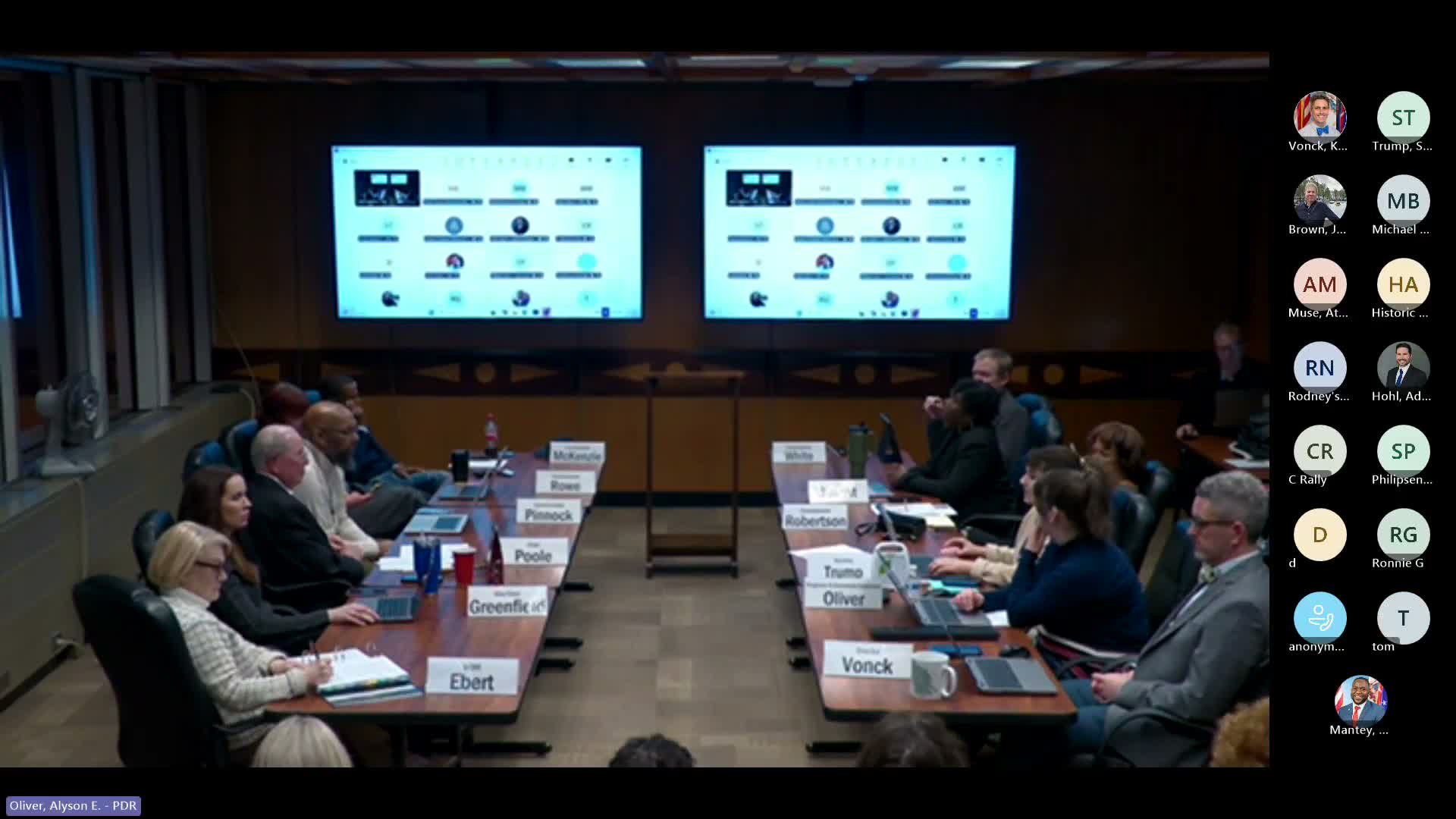
Richmond Planning Commission recommends denial of Lavender Hill outdoor-events permit over noise and safety concerns
Summary
After hours of testimony from neighbors and proponents, the Planning Commission voted to recommend denial of a special-use permit for Lavender Hill at 1705 Commonwealth Ave., citing likely noise, parking, and enforcement problems if up to 120 attendees and 52 annual outdoor events were allowed; the item will go to City Council Jan. 12.
The Richmond Planning Commission on a split vote recommended denial of a special‑use permit (SUP) that would have authorized outdoor events at Lavender Hill, a privately operated event space at 1705 Commonwealth Avenue.
Staff presented a revised SUP that included conditions the applicant had accepted: a maximum of 52 outdoor event days per year (not to exceed five in any month), hours of operation between 9 a.m. and 10 p.m., no more than 120 attendees on site during outdoor events, at least two off‑street parking spaces, one staff member per 50 attendees, and a requirement that amplified music conclude by 9 p.m. Staff recommended approval after the applicant agreed to those enforceable conditions (staff presentation concluded at the commission meeting).
“We worked with the applicant to arrive at enforceable conditions,” the staff presenter said during the meeting, noting the adjustments that led staff to shift from a recommendation of denial to one of approval earlier in the review process.
Applicant Nadia Anderson, who owns Lavender Hill and runs an event management business, told the commission she has held mostly small gatherings since acquiring the property and had stopped staging bands after noise complaints in 2024. Anderson said 70% of recent gatherings had fewer than 50 guests, only two events exceeded 100 attendees, and she intended to operate inside the limits of the city’s noise ordinance. “I am a woman of integrity,” Anderson told the commission, adding she was willing to continue dialogue with neighbors and comply with enforceable limits.
Neighbors and other residents urged rejection. Dozens of nearby homeowners described past unpermitted amplified events that, they said, caused house windows and pictures to vibrate, disrupted sleep for children, and created parking and safety problems on narrow residential streets and alleyways. “You can’t escape it,” one resident said, describing being able to hear amplified music inside a closed house. Multiple speakers emphasized that TOD‑1 zoning prohibits outdoor entertainment within 100 feet of residences and warned that an SUP tied to the property would carry forward to any future owner.
Residents also criticized the practical enforcement mechanism: measurement and enforcement of the city’s sound standard are complaint‑driven and reactive, they said, leaving neighbors to call police or zoning enforcement after the disturbance has occurred. Several speakers argued that the proposed crowd size and frequency—120 people up to 52 times a year—were incompatible with the small residential lots directly abutting the property.
Commissioners repeatedly returned to two questions: whether the SUP’s conditions could be reliably enforced and whether the six charter criteria for special uses (including protection of health, safety and the general welfare and avoiding congestion of streets and alleys) could be met for this parcel. After extended discussion, one commissioner moved to deny and another seconded the motion.
A roll‑call vote produced a majority in favor of denying the SUP; commissioners cited likely congestion in the alleys and streets, risk to residential peace and safety, and the difficulty of enforcing the noise standard. The commission’s recommendation of denial will be forwarded to Richmond City Council for final action at its January 12 meeting.
What’s next: City Council will consider the Planning Commission’s recommendation on Jan. 12. If Council approves the SUP despite the commission’s recommendation, the conditions the commission reviewed would be the operative limitations unless Council changes them.