Missouri lawmakers press DOC and Centurion over staffing, penalties and mortality in prison health contract
Loading...
Summary
At an informational hearing, DOC Director Trevor Foley outlined the Centurion contract, projected FY26 spending of $212.6 million and a per‑offender daily rate of $22.67; community advocates and committee members raised staffing shortfalls, recurring penalties exceeding $3 million and called for greater oversight and mortality tracking.
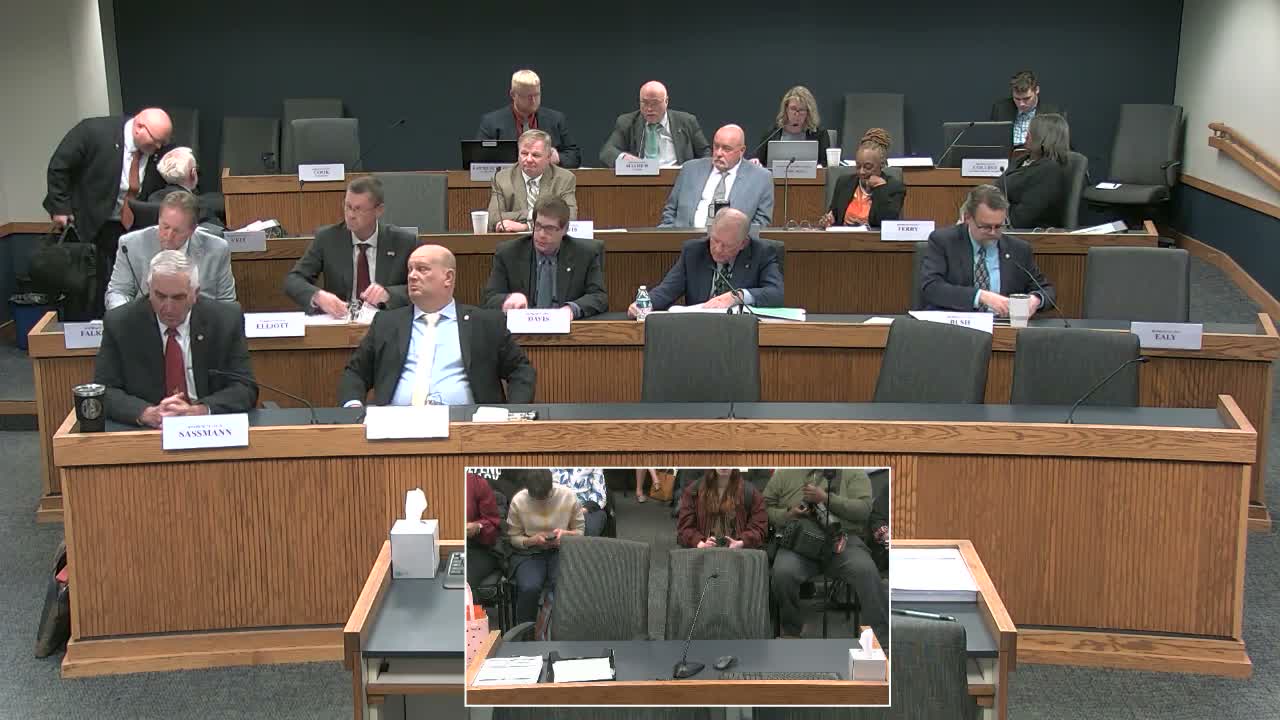
Chairman Mayhew convened an informational hearing after the committee advanced two bills, inviting Department of Corrections officials to explain the state's health services contract with Centurion Health and answer questions about recent coverage and operational concerns.
Trevor Foley, director of the Missouri Department of Corrections, told the committee the state has contracted for comprehensive offender health care since 1992 and the current contract, awarded to Centurion in 2020, began November 15, 2021 and expires June 30, 2028. Foley said the contract is paid on a per‑offender‑per‑day basis and the current rate is $22.67 per offender per day; the department projects FY26 spending on the contract at $212,600,000.
The department has expanded contractual performance measures since a 2024 amendment, Foley said, increasing them from five to 14 and using those measures to assess financial penalties when the vendor fails to meet required service timelines. "Every instance of noncompliance with a required performance measure has a dollar amount penalty attached to it," Foley said, and the committee was told the vendor has paid penalties quarterly and that liquidated damages total more than $3 million over the life of the contract.
Foley and deputy director Valerie Mosley described steps Centurion took at Jefferson City Correctional Center (JCCC) — a high‑acuity facility with a large infirmary, an enhanced care unit and a special unit for severe mental health issues — after staffing shortfalls: bringing in clinical strike teams from other states, mandated leadership coverage on evening shifts, higher compensation and contracted agency nursing. Foley said some compliance statistics are strong (for example, high compliance rates for annual/triannual physicals and dental procedures in many measures) while other measures showed overdue items and backlog that the department and vendor are addressing.
Committee members pressed DOC on the contract structure, rebid timeline and remedies. Foley said the four single one‑year extensions originally contemplated were rolled into a single four‑year extension with a levelized rate of increase (and a $2 million reduction versus the previous extension structure) and that DOC aims to release the next RFP on or about June 1, 2027. "We will be working on that beginning this summer," Foley said, adding DOC will examine service‑delivery models including full contracting, hybrid partnerships and self‑operation and will hire a health care actuary to model costs.
Several representatives underscored staffing concerns as a key driver of service delays. Representative Terry asked whether overdue referrals and long sick‑call waits are driven by staffing; Foley responded that staffing is the primary contributor: "It's probably safe to say... 99.9 percent of the problems at some point or another come back to staffing levels." Members requested site‑by‑site staffing matrices, vacancy counts and start‑date histories to better understand local conditions; Foley agreed to provide that data.
Community witnesses provided pointed testimony. Jerica White, criminal justice policy manager at Empower Missouri, told the committee she had spoken with more than 20 current and former nurses and staff who described unsafe caseloads, medication delays and difficulties meeting the contract's minimum staffing requirements at JCCC. White cited contract provisions (including sections she cited to the committee) that require minimum staffing and permit DOC to increase monitoring or seek credits when performance standards are not met, and she urged DOC to implement enhanced monitoring and enforcement.
Veil Smith, founder of the Missouri Justice Coalition, argued for greater transparency and more aggressive use of contract remedies. Smith urged that mortality be tracked as a vendor metric and supplied the committee with counts she said were drawn from DOC death records: "In 2024, 139 people died in Missouri prisons. In 2023, 137. As of November 2025, 108 had died this year," Smith said, and she said families sometimes must sue to obtain autopsy reports. She also cited the contract's termination clause (section 5.4.1) and asked the committee to consider whether the state should begin the procurement process now to avoid being left short of options when the contract ends.
DOC and witnesses committed to share documents requested by the committee: the full contract plus amendments and addenda, the list of the 14 performance measures and the quarterly penalty breakouts, site‑by‑site staffing matrices and vacancy histories, and any research on alternative vendors. Members repeatedly emphasized the need to begin evaluating procurement options and to ensure contract language and enforcement mechanisms are sufficient to protect incarcerated people's care.
The hearing ended with the committee thanking presenters and witnesses, reminders that public testimony remains open online until midnight and a commitment to follow up on documents and data requests. The committee adjourned without taking formal action on the contract at this meeting.