Get Full Government Meeting Transcripts, Videos, & Alerts Forever!
Get email alerts on the Transit topic
No spam. Unsubscribe anytime.
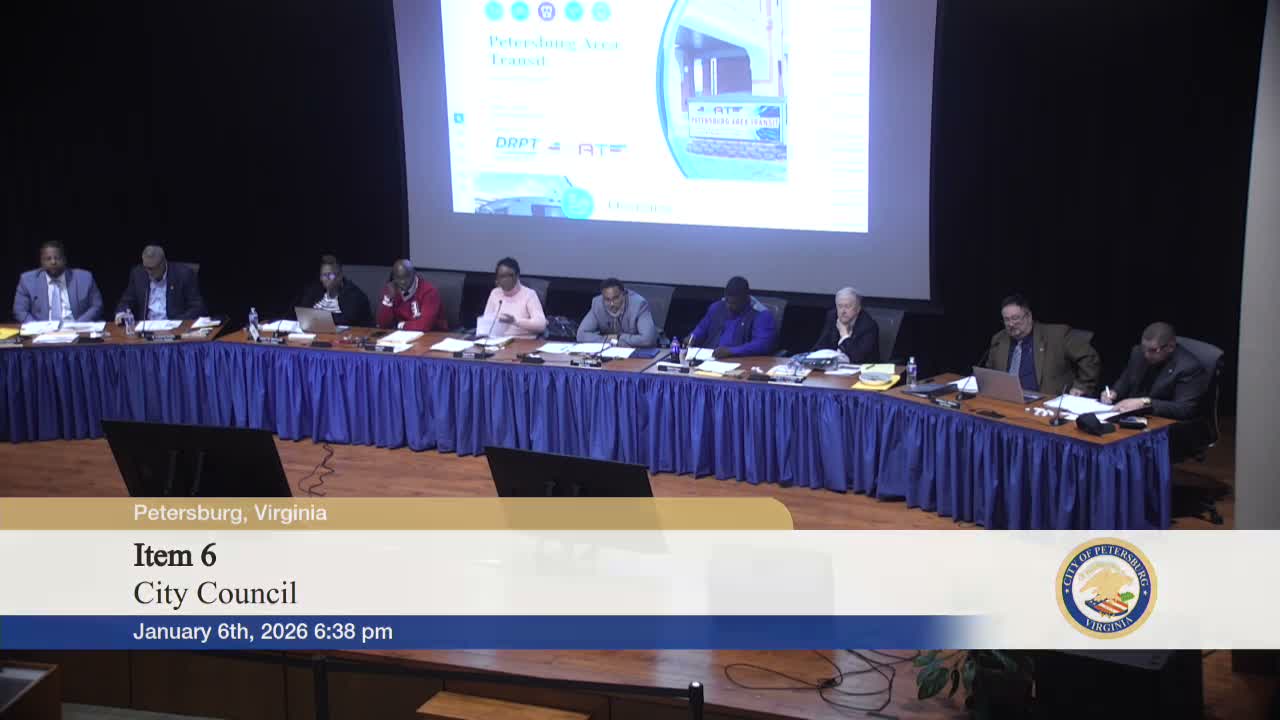
Petersburg Area Transit details fleet replacement, evening service and plans for new operations facility
Summary
Petersburg Area Transit officials told council PAT adopted new driver- and rider-facing technology, launched evening service, has 28 vehicles beyond useful life, ordered seven buses (delivery expected 2027–28) and is pursuing state merit funding and design funds for a new maintenance and operations facility at 800 Arlington St.
Petersburg Area Transit officials gave the Petersburg City Council an update on system improvements and near-term plans on Jan. 6.
Darius Mason, speaking for PAT, said the agency adopted an onboard video system and a rider-facing bus-tracking tool in 2025, added evening service that has attracted riders, and distributed new route maps and customer communication channels. ‘‘That system gives us reporting KPIs…that’ll help us improve in the future,’’ Mason said, describing technology intended to improve safety and reliability.
Lester Stevenson, PAT operations manager, highlighted the Busware passenger-tracking interface and said the website provides riders stop-to-stop tracking and direct communication with PAT staff. Mason noted partnerships expanding connections to regional institutions, including service to Brightpoint College and pending arrangements with Colonial Heights.
Katie Miller of the Virginia Department of Rail and Public Transportation told council PAT faces a fleet replacement need: 28 vehicles are past their useful life (roughly 10–12 years for large buses). PAT has ordered seven new buses; production lead times mean vehicles are likely to arrive in 2027 or early 2028. Miller said PAT will apply in FY27 for DRPT merit capital funding that prioritizes vehicles beyond useful life and can provide a state match of up to 68%.
Council members pressed for budget detail and local share information. Mayor Perrin and Councilor Cover asked for clarity on how much of PAT’s operating and capital budgets come from Petersburg taxpayers; Mason said he would provide both dollar amounts and percentages for the council meeting on Jan. 20, pending the city manager’s permission.
On facilities, consultants and PAT staff reviewed progress on a proposed maintenance and operations facility at 800 Arlington St., a city-owned site selected in the project's feasibility review. PAT began 30% design in late 2025 and has invested approximately $1,000,000 to date in environmental clearance and preliminary design. A DRPT merit funding application for final design is due Feb. 1; if awarded, those funds would be available starting July 1 and would require a local match. Staff said, if funding and match align, construction could begin in 2028 with occupancy in 2029.
Council thanked PAT for the progress; several members noted clean buses and improved service. Mason closed by thanking DRPT and consultant partners for support and said PAT would return with requested budget breakdowns.
The presentation concluded with council questions about route miles and wear on vehicles when operating outside city limits; PAT staff said vehicles incur wear regardless of location and agreed to provide route-mile figures and funding-share details at a future meeting.