
Friendship House awarded Proposition 1 funds for Village SF; Newsom highlights HAP accountability
Get AI-powered insights, summaries, and transcripts
Sign Up Free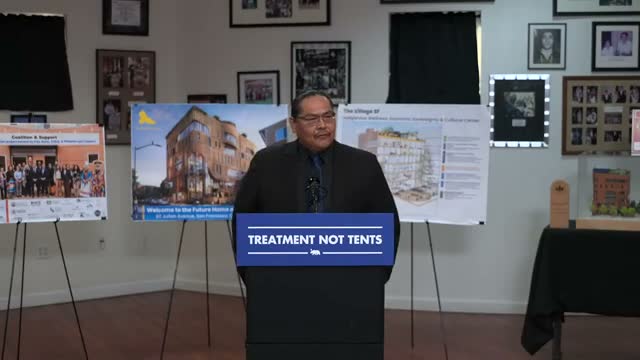
Summary
Governor Gavin Newsom and state officials announced Proposition 1 and HAP funds for Friendship House’s proposed Village SF rehabilitation and new build, describing new distribution conditions requiring encampment strategies and housing‑element compliance. Officials and the mayor framed the project as culturally specific treatment for Indigenous residents.
Friendship House will receive state funds under Proposition 1 to support a planned Village SF campus that state officials say will provide culturally focused behavioral‑health and addiction recovery services for urban American Indian and Alaska Native residents.
Emery Tahi, a house manager at Friendship House, introduced the project as a six‑story village that will serve "over 3,500 American Indian and Alaska Natives" in the Bay Area and include residential and outpatient treatment capacity. Kim Johnson, California’s health secretary, said the Friendship House award from Proposition 1’s Behavioral Health Continuum Infrastructure Program will support 60 residential substance use disorder beds, 107 mental‑health outpatient spaces and about 100 wellness spaces.
Secretary Johnson placed the local award in the context of the statewide Proposition 1 distribution, noting the program has already funded thousands of residential beds and treatment spaces. Tamika Moss, who announced the HAP grants, told the gathering the state was awarding "more than $420,000,000" to HAP program recipients and said the funding supports culturally responsive local programs and housing solutions.
Governor Gavin Newsom emphasized the combination of state and local funding behind projects like Village SF and described new conditions tied to HAP 6 distributions. Newsom said jurisdictions must present plans to address encampments and comply with their housing elements to qualify for funds, and he described a stronger auditing and transparency requirement for grantees: "We're demanding more accountability and transparency in that space." He framed that as a response to jurisdictions that previously held unspent funds without deploying them to homelessness solutions.
Why it matters: Friendship House is a long‑standing culturally specific provider of addiction and behavioral‑health services in San Francisco. State bond and grant resources like Proposition 1 and HAP are intended to expand treatment capacity; project funding and the state's new distribution requirements could affect how quickly local jurisdictions deploy those resources and how they document outcomes.
Details and context: City officials described recent local gains — Mayor Daniel Lawrie said San Francisco consolidated outreach teams, increased shelter placements by about 40%, and received nearly $187,000,000 in HAP funding that "covers almost 1,000 of our beds." State leaders cited multi‑billion‑dollar Proposition 1 distributions and other investments to build and rehabilitate behavioral‑health capacity across California.
Numbers reported at the event included multiple program and bond figures discussed by state officials; the transcript contains several values and some inconsistent renderings (see clarifying details). The state directed attendees to accountability.ca.gov for county‑level data on program compliance and progress.
The event closed with officials calling for continued intergovernmental cooperation; the announced awards are subject to the state’s distribution conditions and further administrative steps before projects open to residents.