Planning commission backs housing element amendment to incorporate countywide rezone sites, recommends board approval
Loading...
Summary
The Planning Commission voted unanimously Jan. 12 to recommend adoption of a housing element amendment and zoning code changes that incorporate countywide rezone sites and the state "use by right" definition to meet RHNA obligations and comply with HCD guidance.
The Sacramento County Planning Commission on Jan. 12 recommended that the Board of Supervisors approve an amendment to the 2021–2029 housing element and related zoning-ordinance changes intended to incorporate countywide rezone sites and align local code with state "use by right" definitions.
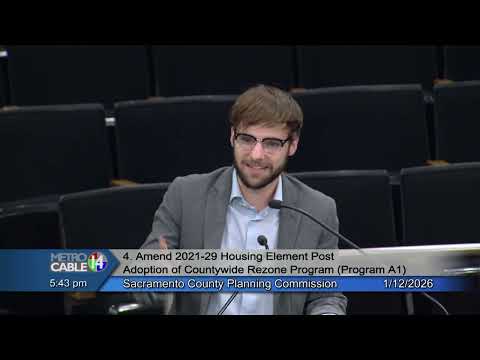
County staff lead Riley really Shoals, identified as the associate planner and lead on the application, told commissioners the amendment does not create new development rights but incorporates prior rezone actions and site-level analyses into the housing element and several appendices. Staff said Appendix E adds a site-specific suitability analysis and an Affirmatively Furthering Fair Housing (AFFH) assessment covering 59 lower-income category sites. The zoning-code changes would clarify which projects qualify as "use by right" under California Government Code, including projects that provide at least 20% lower-income units and meet specified criteria.
Shoals said the amendments respond to technical assistance from the California Department of Housing and Community Development (HCD), which requested that rezone site analyses be incorporated into the housing element. Staff described ongoing, informal coordination with HCD and said they had not received a formal certification letter but were moving the amendments forward for board consideration and subsequent submittal to HCD for final certification. Shoals warned that if the housing element were not brought into compliance in a timely way the county could face decertification and related consequences, including referral to the attorney general and potential fines, though staff said HCD had not indicated it intended to pursue those measures.
Commissioners pressed staff on numerical changes in the redlined documents, the county’s remaining shortfall of lower-income units, and how the county will ensure sites materialize as housing. Shoals explained the countywide rezone program and related reassessments produced a buffer—staff targeted at least a 20% buffer—to absorb potential losses of inventory and remain in compliance with state RHNA obligations. Planning principal Joel Inman and other staff described Program A1 and Program A2 and the county’s Affordable Housing Incentive Program (AHIP) as implementation tools; staff emphasized the county's role is to incentivize development rather than to build housing directly.
Commissioners and staff also discussed community outreach: Shoals said rezone sites were taken to community planning advisory councils (CPACs) in affected areas and engagement varied by community. Commissioners requested clearer, developer-facing resources (for example GIS layers or an online tool) to help potential applicants determine whether a site meets use-by-right criteria; staff said additional zoning-code amendments and implementation items will return to the commission throughout 2026.
Vice chair moved to recommend approval of the amendment and ordinance; Commissioner Verga seconded. The clerk recorded the motion as passing with all members present voting yes. The commission’s recommendation now moves to the Board of Supervisors for final action; staff will then submit adopted materials to HCD for certification.