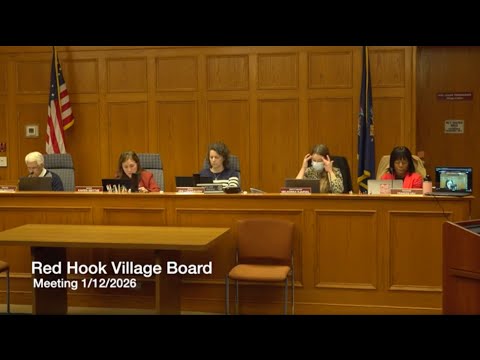
Red Hook board extends hearing on North Broadway land‑use study after residents raise traffic, scale and blasting concerns
Loading...
Summary
At a second public hearing on the North Broadway Corridor Land Use and Zoning Study, residents pressed the board on access, parking, blasting risk and pedestrian safety; the board asked the consultant for targeted edits and extended the hearing to Feb. 9, 2026 for further public review.
The Village Board opened a second public hearing on the North Broadway Corridor Land Use and Zoning Study and heard more than an hour of comment from residents and stakeholders who urged changes to traffic, sidewalk and scale language in the document.
George Beekman, a longtime village resident, warned the board the proposed zoning could "disrupt the village" and raised specific concerns about building on rock ledges that he said may require blasting near the aquifer. Ricky, a homeowner on North Broadway who identified his property as the "old Martin Homestead," described difficult driveway access, narrow shoulders and a worry that traffic calming and turn lanes will not be in place if a developer proceeds without DOT coordination. He said concepts circulating about a RUPCO project—roughly 20 multifamily units on 1.3 acres—leave questions about parking, sidewalks and how children would walk safely to school.
Bonnie Franzen, the land‑use planning consultant who prepared the study, and board members repeatedly emphasized that the study is a framework, not a project approval. Franzen said the study creates a vision and zoning framework; any specific development must come back to the planning board, which will review site plans and work with state Department of Transportation (DOT) requirements for access and turning lanes.
But residents urged clearer, stronger language in the document. Several asked the board to move walkability, traffic calming and historic‑resource protections higher in the goals and to include concrete examples—narrowed travel lanes, street trees, speed humps, continuous sidewalks and marked crosswalks—so the planning board and DOT see the village's expectations early in the process.
Board members acknowledged drafting and posting errors (figure vs. image labels, a mis‑named street) and asked Franzen to prepare a redline set of targeted amendments—emphasizing pedestrian safety, historic context for the Cherry/Graves Street neighborhood and clearer language about parking, rental demographics and economic opportunity. The board agreed to send the revised document to County Planning and to re‑post the study with corrected figures and an expanded FAQ.
The board voted to extend the public hearing to its regular meeting on Feb. 9, 2026 to allow time for the consultant to prepare edits and for the public to review the redline changes. The extension was followed by an amended motion directing the village clerk to provide the legally required public notice for the extended hearing.
What's next: the board asked the consultant to return with a redline version highlighting the suggested changes and promised to post a schedule showing how the zoning amendments and any resulting planning‑board review will proceed. The planning board and DOT reviews were repeatedly described as the technical venues where access, turning lanes and final site plans will be tested and refined.