
Board accepts OE 14 monitoring report after tense public comment over AP additions at Skyline High
Get AI-powered insights, summaries, and transcripts
Subscribe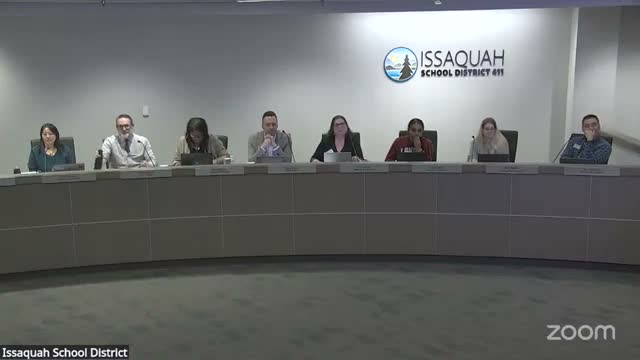
Summary
The board voted to accept the Operational Expectation 14 monitoring report despite multiple Skyline teachers and parents warning that a recent district directive to add AP courses could undermine Skyline's IB program and strain the master schedule; student reps gave an advisory vote that was split.
The Issaquah School District board voted to accept the Operational Expectation 14 monitoring report after a presentation from district leaders and a lengthy public‑comment period dominated by Skyline High School teachers and parents.
District presenters said OE 14 documents instructional program strengths and areas for continuous improvement, highlighting equity goals and multi‑tiered systems of support. Rich Melisch, Jacqueline Downey and Shireen Carver summarized the district's academic programs and an exception to OE 14.3 the administration noted in the report.
Several Skyline staff and parents urged the board to reject or revise the report because of what they described as a last‑minute directive that would add multiple AP course offerings — including AP U.S. history, AP Language and AP Literature — in ways they said would compete with or erode the school's existing International Baccalaureate (IB) programming. Molly Peterson, Skyline Humanities department co‑chair, told the board: "You cannot support this interpretation of OE 14 and say that you support IB. You cannot have it all." Teachers described master‑schedule disruption, concerns about student mental health and the disproportionate allocation of resources toward college‑credit courses while other students lose access to hands‑on and remedial options.
Student representatives asked detailed questions about scaffolding, pathway transitions between AP and IB, and implementation timing. The student advisory poll recorded 2 yes, 2 no and 3 abstain on whether the district had provided sufficient evidence to meet OE 14 (advisory poll noted in the public record). Board members repeatedly framed the vote as a monitoring decision — whether the district had demonstrated progress on OE 14 overall — rather than an immediate policy change. Several directors emphasized the intent to expand college‑bearing options and to preserve student choice.
After discussion the board moved to accept the monitoring report; the chair called for aye votes and recorded no opposition. The report was accepted as meeting the monitoring requirements for OE 14 (motion raised earlier and finalized at the vote). Board members indicated they expect continued dialogue with staff and the community about course offering details and implementation timelines.
What comes next: Directors asked for more implementation detail and for the district to work with teachers and students on scheduling and advising. The teachers and parents who opposed the course additions requested a formal review of the directive and more meaningful teacher input before any change is final.