
Board approves $8.18 million interim package for Old Greenwich School after split debate over roof
Get AI-powered insights, summaries, and transcripts
Subscribe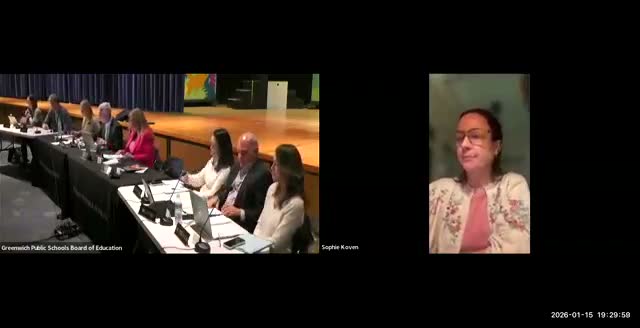
Summary
The Greenwich Board of Education approved interim funding for the Old Greenwich School project, adopting a package that raises owner contingency to 10% and includes a roof replacement alternate. The final vote was 4–3 with one abstention.
The Greenwich Board of Education on Tuesday approved interim funding for the Old Greenwich School project, adopting an amended package that raises the owner contingency and adds a roof replacement alternate.
Chairman Mercante Anthony put the recommendation from the Old Greenwich Building Committee before the board, then the board amended that motion to reflect the building committee’s favored scenario that increases owner contingency to 10% and includes the roofing alternate. The board recorded the final vote as 4 in favor, 3 opposed and 1 abstention; the request was presented as $8,177,174 in the meeting materials.
James Waters, representing the building committee, told the board the committee had prepared four scenarios and had voted 6–0–1 to recommend increasing the owner contingency to 10% to account for hidden conditions in a renovation of a 120‑year‑old building. “Owner contingency for renovation projects — the rule of thumb is you generally want your owner contingency for renovation to be twice as large as that for a new construction,” Waters said during the presentation.
The roof alternate under discussion covers the section over the gym, cafeteria, music and art spaces. Waters said adding that section would increase the interim ask by roughly $528,000 of incremental cost; the committee noted the roof section is eligible for state reimbursement. Owners’ representative Lawrence Rosati told board members trades are already on-site and that material and labor cost savings are possible if roofing work is completed during the current construction mobilization.
Board members were divided over whether to include the roof now or run it as a separate capital project. Sophie said she worried about doing extensive construction next to older roof sections and favored replacing the roof now to avoid damage during construction. Paul argued separating the roof into its own project could reduce construction‑management markup and save money over time.
Members also debated the cornice alternate, which the building committee described as an add alternate not eligible for state reimbursement and estimated at about $192,000. The committee advised rejecting the cornices alternate because the work could expand into larger, unforeseen repairs.
Following the debate, the board amended the motion on the table to the scenario that included the 10% owner contingency plus the roof alternate and then voted to approve the interim funding as amended. The presentation materials show the project also has an estimated state reimbursement share of approximately 20% and that the town had previously been approved for about $9.6 million in state reimbursement related to the project.
The board’s approval moves the project forward toward establishing a guaranteed maximum price and signing contracts; the building committee and municipal bodies (BET and RTM) will continue parallel reviews and process steps in the coming weeks.