
State issued refill permit for Wixom Lake in April 2020 despite safety questions, expert says
Get AI-powered insights, summaries, and transcripts
Subscribe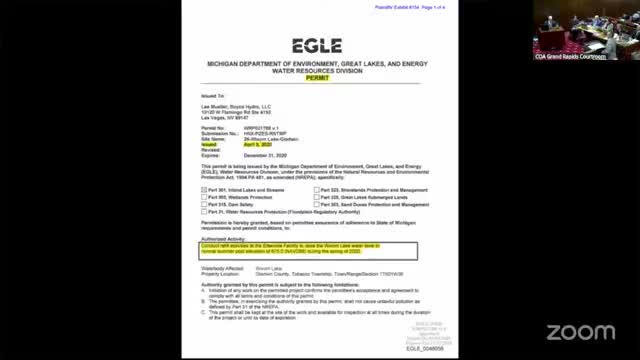
Summary
Court exhibits show EGLE issued an April 9, 2020 permit authorizing refill of Wixom Lake to elevation 675.8; expert William Sturtevant told the court that issuing that permit while half‑PMF and embankment concerns existed made operation at normal pool unsafe.
Court exhibits introduced by the plaintiffs show the Michigan permitting authority authorized Boyce Hydro (and associated parties) to refill Wixom Lake to the FERC summer pool elevation of 675.8 feet (NGVD) in April 2020.
William Sturtevant, testifying as a dam‑safety expert, described that decision in stark terms to the judge and jury. "It wasn't safe," he said when asked whether it was appropriate to raise the lake from run‑of‑river to normal summer pool given the engineering record. Sturtevant explained that raising the pool reduces available flood storage and therefore lowers the combined storage/discharge capacity the structure can rely on during larger storms.
The transcript shows multiple prior reports and FERC findings that identified insufficient spillway capacity dating back to the 1990s and continuing through more recent consultant work. Sturtevant and counsel displayed emails and internal records indicating engineers were working on half‑PMF calculations in early 2020; Sturtevant told the court he had not seen evidence these findings were fully communicated to the permit signatory or memorialized in the lake‑level permitting record beyond limited correspondence.
The permit itself includes a special condition (y.9) restricting further drawdowns below specified levels except by another order or permit from the department. Sturtevant said that condition transferred operational control over lake levels to the permitting authority and, in his view, constrained the operator’s ability to respond quickly to changing risks during a flood if the dam could not safely pass its design flows.
Plaintiffs’ counsel used the permit exhibit to argue issuing the refill authorization without clearly disclosing outstanding half‑PMF and embankment concerns was an improper exercise of regulatory discretion given the public‑safety stakes. Defense counsel signaled cross‑examination and record checks would follow; the hearing recessed with additional proceedings scheduled remotely.