
Council presses staff on 120‑day shelter limit, exemptions and whether cleanups displace people to East Portland
Get AI-powered insights, summaries, and transcripts
Subscribe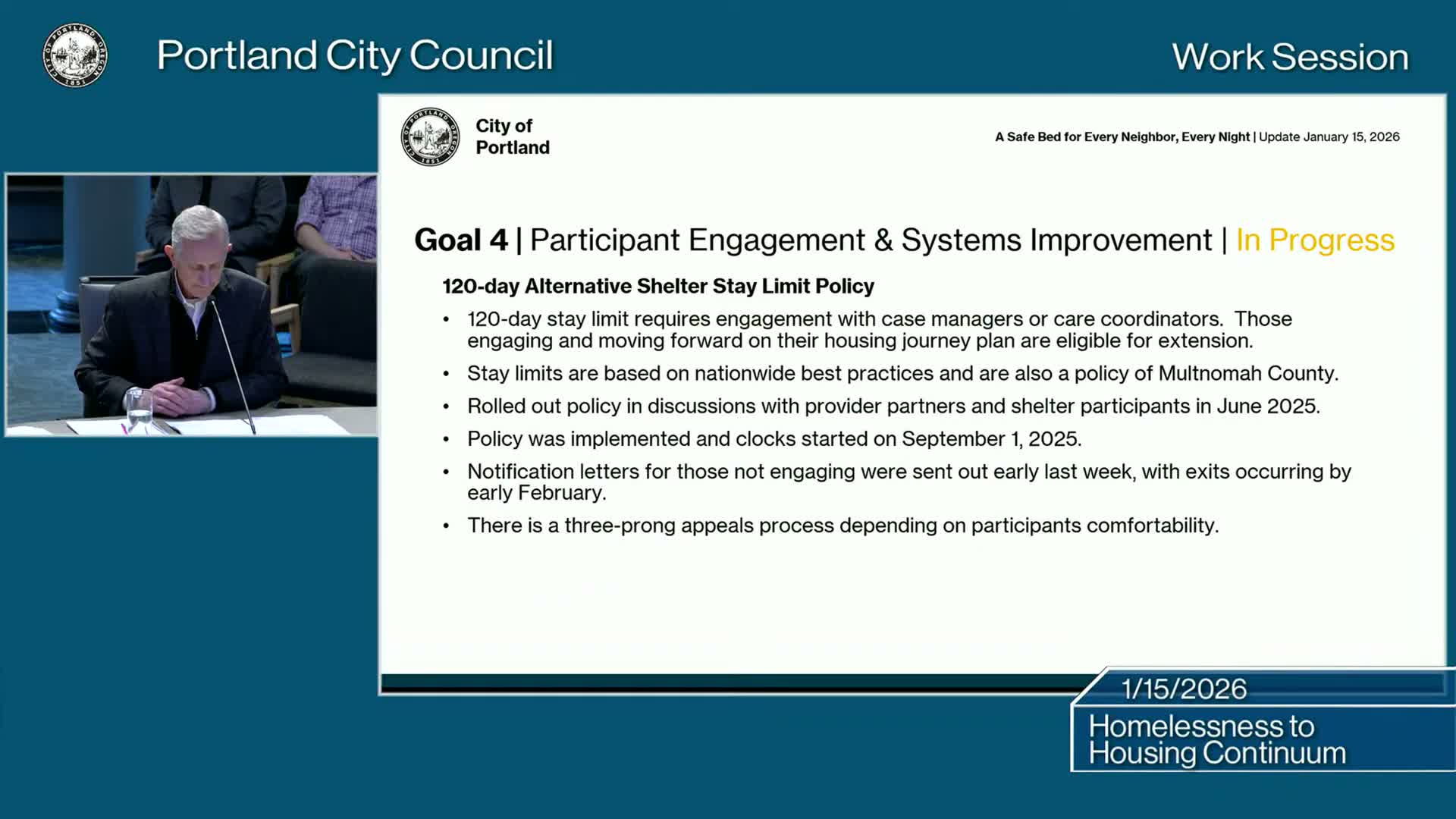
Summary
Councilors asked staff to explain how the 120‑day stay limit is applied, what counts as exemption for severe behavioral‑health conditions, and whether encampment cleanups shift unhoused residents to other neighborhoods; staff described case‑manager discretion, an appeals pathway and data caveats on camp removals and garbage tonnage.
Councilors used the work session to probe how the city's shelter rules are implemented and how enforcement and cleanup operations affect different neighborhoods.
Lede: Councilors from across the chamber pressed Portland Solutions and shelter operations staff to explain the criteria and process for exempting people from a 120‑day stay limit at alternative shelters, and to justify data showing declines in some tent counts while camp removals and trash tonnage show different trends.
Key clarifications from staff
- 120‑day policy and exemptions: Brandy Westerman, who oversees the city's sheltering system, described the 120‑day stay limit as tied to engagement requirements. She said case managers have discretion to grant extensions when individuals are unable to engage because of behavioral‑health challenges, and that people actively engaging who would be disrupted by an exit also can receive extensions. She noted a multi‑step appeals process is available.
- Data interpretation: Lucas Hillier and other staff explained why garbage tonnage and camp removal counts diverge: seasonal moisture makes garbage heavier in some months, changes in crew deployment and the lapse or renegotiation of intergovernmental agreements affected removal tonnage, and faster intervention can reduce per‑removal tonnage even as removal counts remain steady.
Quotes
Brandy Westerman, emergency humanitarian operations director: “The 120‑day stay limit policy includes engagement requirements... in cases where individuals either are unable or unwilling to engage, there is some discretion allowed to case managers to determine whether that person is unable to engage due to the behavioral‑health challenges.”
Lucas Hillier, Impact Reduction Program manager: “Part of it is seasonal, garbage that's wet, weighs more... and when it starts to dry out, the actual poundage decreases.”
Council concerns and equity questions
Several councilors pressed on potential displacement patterns: Council President Dunphy and others said encampment removals in the central city have historically been followed by increases in camps in East Portland, where outreach and services are sparser and residents are less likely to report sites. Staff acknowledged reporting gaps and said outreach teams and city employees also submit reports; they offered to provide deeper, citywide dataset analysis to address concerns about displacement and recurrence rates.
What staff will provide next
Staff agreed to follow up with more granular, written data on per‑site outcomes, extension/appeal counts and coordinated HMIS exit information so council can evaluate whether cleanups reduce overall unhoused populations or simply shift encampments geographically.
Ending
Councilors asked for written follow‑up on exemptions, appeals, and detailed IRP data as the administration works toward FY26 budget decisions.