
Mayor says Portland has met 1,500‑bed goal and lays out six‑part plan to move from homelessness to housing
Get AI-powered insights, summaries, and transcripts
Sign Up Free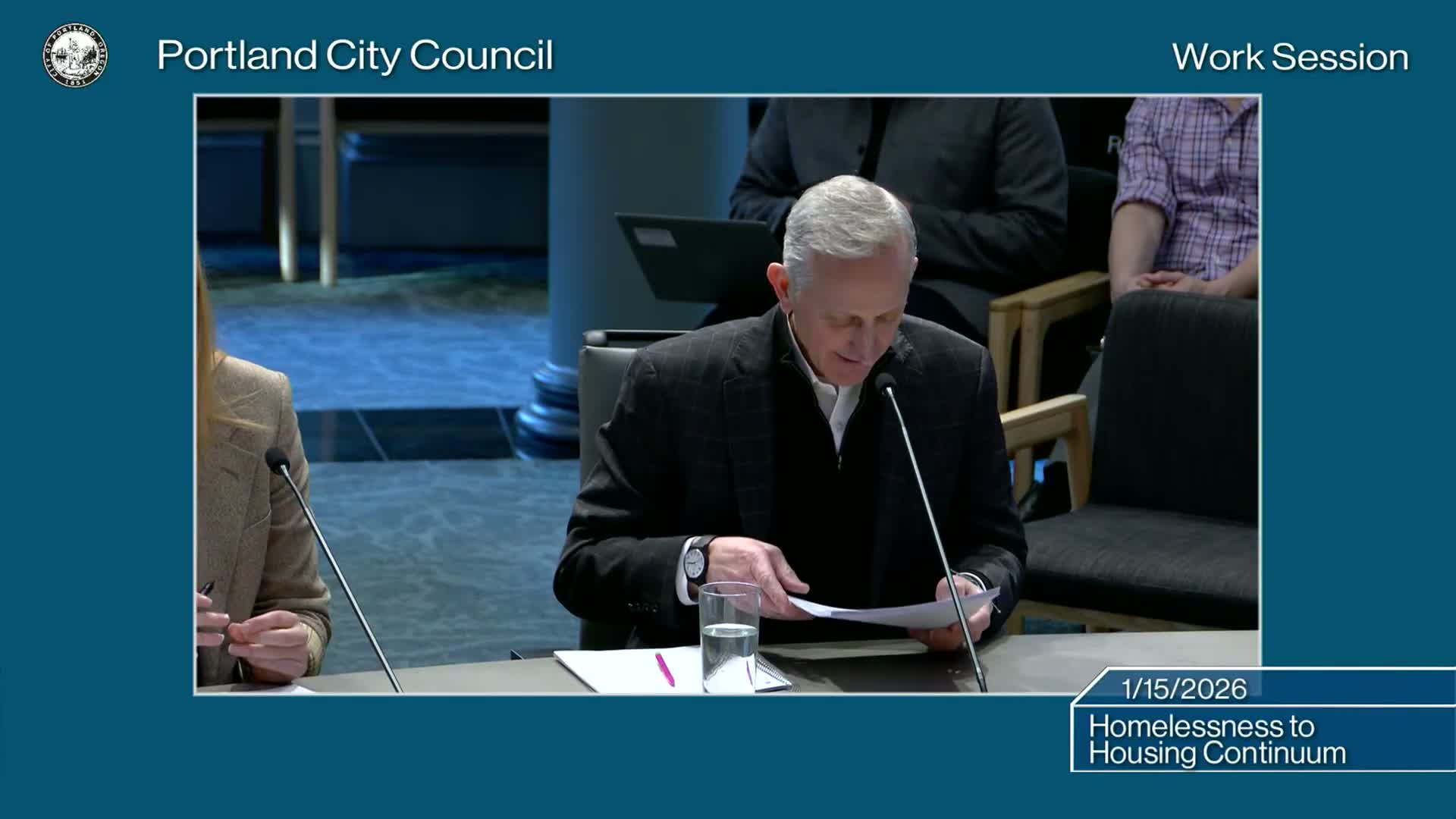
Summary
Mayor Keith Wilson told the council the city has met its target for overnight shelter beds and presented six goals — ending tent distribution, diversion and reunification, shelter improvements, rapid exits, sanitation/enforcement, and a long‑term housing production challenge — while staff offered utilization data and implementation details.
Mayor Keith Wilson told the City Council at a rescheduled work session that the city has met its stated goal to provide overnight shelter and outlined a six‑goal strategy to move people from emergency shelter into housing.
Wilson said the shelter expansion is a first step and must be paired with improvements across mental‑health, addiction and housing services. “In Portland, we’ve committed to providing a safe bed for every person every night to everyone who wants one, and we’ve achieved that goal,” he said during his presentation.
Why it matters: councilors and staff framed the session as the next stage of a homelessness‑to‑housing continuum. The mayor presented operational changes (including enforcement and towing for abandoned vehicles), harm‑reduction and diversion strategies, and a housing production challenge meant to translate the short‑term shelter gains into longer‑term units.
Key points from the presentation
- Shelter target reached and system focus: The mayor described the 1,500‑bed expansion as the administration’s immediate success and said continuous improvement is required across the system so the “tip of the iceberg” becomes permanent exits into housing. He said homelessness is fundamentally a housing problem: “Homelessness is a housing issue, full stop.”
- Six goals summarized: the mayor outlined goals that include (1) ending tent distribution by publicly funded organizations and requesting private groups share product information, (2) diversion and reunification to help people return to supportive family settings, (3) building an emergency shelter system and day‑center capacity, (4) adopting a rapid‑exit operational mindset, (5) restoring community safety, health and sanitation (including increased tagging/towing of derelict RVs), and (6) accelerating housing production and supply interventions.
- Portland Solutions data: Skyler Brucker Knapp, director of Portland Solutions, told councilors that of the 1,554 individuals served at alternative shelter sites in FY24‑25, 694 were identified as chronically homeless and that providers report higher rates of mental‑health and substance‑use acuity among shelter participants. Staff offered to supply more detailed per‑bed cost and utilization metrics on request.
- Rules and exemptions: staff explained a 120‑day shelter stay policy that is tied to case‑manager engagement; exemptions and extensions exist for people with severe behavioral‑health acuity and there is a multi‑step appeals process.
Quotes
Mayor Keith Wilson: “In Portland, we’ve committed to providing a safe bed for every person every night to everyone who wants one, and we’ve achieved that goal.”
Skyler Brucker Knapp, director, Portland Solutions: “Of the 1,554 individuals served in the fiscal year 24,25 at the alternative shelter sites listed, 694 were chronically homeless.”
Brandy Westerman, emergency humanitarian operations director: “There is an exemption process for folks who... have certain mental health acuity, or are not able to engage with their caseworker in the same way... In those cases those individuals can have their stay extended.”
Context and limitations
• Staff repeatedly offered to provide fuller data sets and breakdowns (per‑bed cost, extension counts and outcomes) and emphasized that some figures on slides posted to council materials were updated shortly before the session.
• Several numbers in the oral presentation were stated quickly and in some cases appeared garbled in the transcript; staff committed to follow up with written data for clarification.
What comes next
Council leaders scheduled follow‑up briefings and one‑on‑one meetings with the mayor’s office to refine housing and budget proposals. PHB and Portland Solutions staff offered to deliver more detailed cost and exit‑rate data as council prepares FY26 budget priorities.