
El Paso VA details tele‑town halls, community care billing and clinic plans
Get AI-powered insights, summaries, and transcripts
Subscribe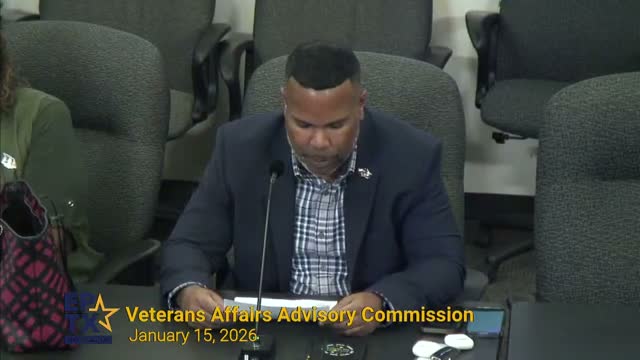
Summary
An El Paso VA representative briefed the Veterans Advisory Committee on revamped tele‑town halls, community care billing procedures (VA‑authorized care should carry no co‑pay), MyHealtheVet app use, clinic maintenance closures, upcoming outreach events and plans for an East Side urgent care.
An El Paso VA representative told the Veterans Advisory Committee that the VA has retooled its monthly veteran tele‑town halls to focus on the “top 20 questions” veterans raise and to deliver more educational programming. The update covered community care billing, laboratory procedures, pharmacy operations, vaccine availability and local clinic construction timelines.
The VA representative said the tele‑town hall changes were based on 2025 feedback and are intended to “best inform our veterans.” She urged veterans to track authorizations and renewals — “make sure that you are tracking your authorizations, request for renewals prior to 30 days” — and provided contact numbers for CCS (community care services) and emergency reporting.
On community care billing, the VA representative emphasized that VA‑authorized community care should not create co‑pays for veterans: “If the VA is sending you, you should pay no co pays.” The office walked through steps a veteran should take after receiving emergency care in the community, including calling the VA within 72 hours and saving documentation; the VA said its team will document contacts and follow up with urgent‑care providers.
The representative explained the CPO (community provider orders) program for labs: when a community provider requests laboratory work, veterans may bring the provider orders to the VA lab counter (third floor) and the VA will process and forward results to the community provider. She also recommended the MyHealtheVet app as a way to contact providers, request medication refills and access benefit letters, and gave phone numbers and an email for eligibility and dental questions.
Local operations and outreach were discussed: flu vaccines are available at the main facility (appointments not required), some vaccine drives were paused due to weather, and the Westside clinic was temporarily closed for maintenance with a projected reopening in about a week. The VA listed several upcoming events and open houses for January and said construction on the Las Cruces Women’s Health Clinic is on track for summer 2026 while a new regional health center is scheduled for 2029.
Commissioners pressed the VA on documentation and confirmation after emergency visits and on urgent‑care billing discrepancies; the VA said it documents all contacts and will send text, call and letter notifications and work with urgent‑care facilities to ensure billing is routed correctly. The VA also reported it is exploring an East Side urgent care for veterans, with early planning pointing to a possible 2027 opening.
The VA agreed to bring a Veterans Readiness and Employment (VR&E) briefing to a future meeting and left flyers and contact information for local services. The committee did not take formal action on the VA update; the briefing was informational and followed by Q&A.