Get Full Government Meeting Transcripts, Videos, & Alerts Forever!
Get email alerts on the Vision0 topic
No spam. Unsubscribe anytime.
SDOT briefs new STEPS committee on Vision 0 progress as preliminary 2025 data show about 25 street deaths
Summary
At the inaugural STEPS committee, SDOT presented preliminary 2025 crash data showing about 25 fatalities, flagged a rise in pedestrian deaths, described levy-funded Vision 0 deliverables and said near-miss and equity analyses will guide new cameras and shared streets rules.
Rob Sacca, chair of Seattle’s newly formed STEPS committee, opened the panel on Jan. 15 by saying traffic safety would be the committee’s first priority and invited the Seattle Department of Transportation to brief members on Vision 0, the city’s program to eliminate traffic deaths and serious injuries.
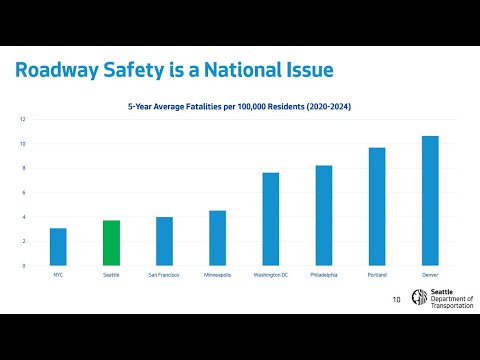
Interim SDOT Director Angela Brady and SDOT’s chief safety officer, Virnio Nemani, presented a Vision 0 refresher, 2025 preliminary crash statistics and a program roadmap for 2026. Nemani said the department’s early 2025 tally was “about 25 people who lost their lives on our city's streets last year,” and flagged a recent bicycle fatality and an uptick in pedestrian deaths after several years of decline. SDOT cautioned the numbers are preliminary and typically finalized at the end of Q1 when crash reporting is complete.
Why it matters: SDOT tied these numbers to levy-supported work that will fund safety interventions. Nemani said the Vision 0 team will receive $70,000,000 from the transportation levy over eight years to deliver safety redesigns on up to 12 corridors, traffic calming on more than 50 corridors, targeted work at more than 40 high-collision locations and leading pedestrian intervals at up to 280 intersections.
SDOT described a three‑pronged strategy: (1) a responsive program that uses police‑reported collision data to target high‑injury segments; (2) a proactive program that systemically spreads proven countermeasures (leading pedestrian intervals, speed management, enhanced crossings and improved lighting); and (3) capital project partnerships that incorporate safety in project design. Nemani noted the department has completed dozens of interventions in 2024–25, highlighted corridor and intersection examples and said the department is advancing projects on Renton Avenue South, Spring Street and Rainier Avenue in 2026.
Data, near misses and equity: Councilmembers pressed SDOT on data sources and local patterns. SDOT said the charts shown to the committee are based primarily on police‑reported collision reports from SPD and WSP because those records include specific locations and descriptive crash details that support engineering responses. Nemani acknowledged other sources — emergency department records and CAD data — can identify underreported incidents but lack consistent location or detail; SDOT said it is experimenting with targeted near‑miss data collection (short video counts and automated detection) at specific sites when needed.
New tools and state policy: SDOT said a recent federal Safe Streets and Roads for All grant ($25,500,000) is in the design phase and thanked the council for local legislation enabling automated safety cameras. The department also said it is preparing local implementation guidance and a safety‑and‑equity analysis required by a new state law before installing full‑time speed cameras, and intends to propose local legislation to implement "shared streets" (10 mph limits) allowed under recent state action.
Voices from the public: Clara Kanter of Seattle Neighborhood Greenways told the committee she had tracked crashes and urged councilmembers to champion a single high‑impact street redesign in each district, saying, "We just need the political will to make it happen." SDOT responded that many projects were community‑driven and described the engineering and liability considerations that guide timing and design of interventions.
Next steps: Chair Sacca asked SDOT to report back as projects move from authorization to construction and urged further briefings with partner agencies, including Sound Transit, for corridor‑level work on Rainier Avenue. The committee did not take formal policy action on Vision 0 in this meeting; SDOT said it will publish final data and implementation guidance in coming months and continue regular briefings.
Sources and limitations: The article is based solely on testimony and slides presented to the STEPS committee on Jan. 15, 2026. SDOT characterized the 2025 figures as preliminary and said final crash data will be complete at end of Q1.