Cheyenne panel approves prioritized projects for 6th‑penny sales tax after debate over roads, municipal remodel and Reid Avenue
Loading...
Summary
After a daylong Committee of the Whole review and several failed amendments, Cheyenne voted to approve the mayor’s prioritized list of projects for possible inclusion on an Aug. 18, 2026 1% special‑purpose (6p) sales tax ballot; council replaced a downtown allocation with $4 million for the Reid Avenue corridor and retained the municipal building remodel in the package.
CHEYENNE, Wyo. — The Cheyenne Committee of the Whole on Jan. 14 approved a mayor‑backed prioritized list of projects for potential inclusion on a 1% specific‑purpose sales‑and‑use tax ballot to be decided by Laramie County voters on Aug. 18, 2026.
Mayor Patrick Collins told the committee that the 6p sales tax has funded many large projects over the last 35 years and said the city was allocated $74,250,000 for the next ballot while the city’s original requests exceeded $150,000,000. "The 6p sales tax has had an amazing impact on our community over the years," Collins said, and he outlined priorities he asked council to consider.
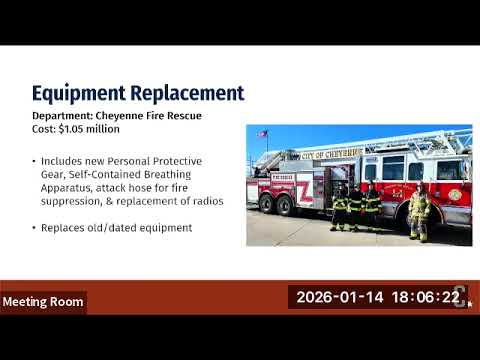
The mayor’s recommendations included: relocating Fire Station 2 to serve South Cheyenne (roughly $12 million); buying two engines and a ladder truck (about $5,023,364); $9 million for ongoing pavement management; $3.7 million for police digital equipment and storage (a subscription model the chief said would equate to roughly $740,000 a year); $459,340 for 90 sets of turnout gear and $599,947 to replace 50 portable radios; $6 million for Greenway maintenance and incremental additions; a $22 million municipal building remodel; and a $10.4 million outdoor replacement for Johnson Pool.
The meeting included more than an hour of public comment and council discussion about tradeoffs among those priorities. Resident John Thomas and local business owner Steve Melia both voiced support for the mayor’s package while urging careful stewardship of taxpayer dollars and urging prioritization of fire‑station and road repairs.
Vicky Nemechek of Public Works told council the municipal building’s mechanical systems, plumbing and elevators are long past their useful life and that ADA, safety and security upgrades are needed. "We've put new carpet in…it’s that lipstick on a pig," she said, urging comprehensive renovation.
Councilman Moody proposed a substitute motion that would have increased the streets maintenance line from $9 million to $20 million and restored Fire Station 6 funding while reducing the municipal building ask to keep totals balanced. That substitute drew sustained debate about contractor capacity, the risks of partially funding large remodels, and whether recurring or maintenance items belong on a special‑purpose ballot.
Director/Engineer Cobb warned the council that contractor capacity matters: he told members that while larger annual totals can be bid, the city's practical "sweet spot" for construction work is roughly $20–22 million a year and that some major projects require multi‑year phasing. Cobb also explained that some prior fifth‑penny and 6p funds are already programmed for projects such as Del Range/Yellowstone and other large capital work.
Several amendment efforts failed on voice votes: an amendment to the Moody substitute failed, the substitute itself failed, an effort to delete the $9 million streets line failed, and a motion to remove the police and fire technology items from the package also failed after members emphasized public‑safety needs and the subscription nature of the police technology purchase.
Council then approved one substantive change: by voice vote it replaced the $4 million downtown‑improvement allocation with a $4 million Reid Avenue corridor project. Director Cobb said the $4 million would fund a pedestrian promenade on the east side and basic park amenities at the north end while leaving larger architectural elements for later; he said more detailed design and railroad approvals remain necessary. The Federal Railroad Administration (FRA) grant related to crossing eliminations was discussed earlier in the meeting; council members noted a roughly $875,000 local match was pending the final grant agreement.
Following that substitution and further discussion, the committee voted to approve the resolution as amended. President Seagrave called for final approval; the motion carried with one recorded "no" vote from Doctor Rennie, and the mayor said staff will work with the county committee next week to finalize ballot language. Early voting for the Aug. 18, 2026 primary is scheduled to begin July 2.
What passed and what’s next
- The committee approved the mayor’s prioritized list for the 6p ballot as amended (resolution Number 17 as read at the meeting). The package preserves the municipal building remodel in the set of asks, keeps the police and fire equipment items, and swaps downtown improvements for a $4 million Reid Avenue corridor investment. - Staff and the county committee will draft final ballot language and return it to council; if placed on the countywide 6p ballot, projects will be funded pro rata based on the share of passed propositions and the competitive process the county and partners will use.
The committee’s action sets the administration’s recommended priorities for the county‑wide ballot process; the final decision for placement on the Laramie County 6p ballot proceeds through the county committee and the August 18, 2026 primary election.