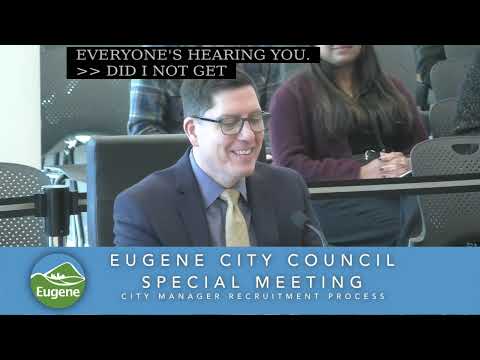
Assistant City Manager Matt Rodriguez presents continuity, partnership and cautious tech approach in Eugene city manager interview
Loading...
Summary
Matt Rodriguez, Eugene’s assistant city manager and a 21-year city employee, told council he would prioritize financial stability, regional partnerships and careful use of ALPR and AI; he cited local projects and described the city’s COVID-era homelessness response.
Matt Rodriguez, the city’s assistant city manager, told Eugene City Council members on Jan. 13 that he would prioritize financial stability, strengthen regional partnerships and proceed cautiously with emerging technologies if selected as city manager.
Rodriguez summarized two long-term partnership projects he helped lead — acquiring city hall and the downtown riverfront work with EWeb — and described working with Lane County and the city of Springfield to co-apply for federal discretionary funds. He said those cooperative efforts help the city deliver projects locally: “we are acting as the agency delivering the project because we are locally certified with ODOT and with FHWA to deliver federal projects.”
The candidate framed managing federal-local tensions as a central challenge. Asked about a federal administration whose policies might conflict with city values, Rodriguez pointed to recent litigation and uncertain grant language that threatened transportation funding and said the city joined a federal lawsuit to protect access to grants. He said council direction and a clear policy posture are essential when pursuing outside funds.
On homelessness and climate action, Rodriguez described operational experience from the pandemic-era unhoused incident command and said the city had stood up roughly 350 shelter beds and worked with nonprofits to keep services running after Lane County lost about half its shelter funding. He said the city must pursue creative funding and policy work with the legislature: “we have to be going after funds with partners, to bring it into our local community where we know we have a high level of need.”
Councilors pressed Rodriguez on automated license-plate readers (ALPRs) after months of public debate. Rodriguez acknowledged both the technology’s law-enforcement value and deep public mistrust tied to a vendor that shared data with federal authorities. “Council directed or recommended to the city manager that we turn those cameras off, which we did,” he said, and described staff removal of cameras until vendor obligations could be clarified. He recommended any reintroduction require explicit vendor commitments on compliance with Oregon sanctuary law and strong oversight through the police auditor and civilian review mechanisms.
On artificial intelligence, Rodriguez described an internal months-long process that led to a staged pilot of Microsoft Copilot and wrote policies: “we reviewed deployment of that technology. We then piloted it with a limited number of folks,” he said, arguing a careful rollout and human review are needed to manage risk and benefits.
Rodriguez also emphasized internal culture and communications: he asked the council to consider long-range financial planning and a strategic budgeting cycle linked to performance measures, and he said a successful first year as city manager would include stabilizing finances and communicating priorities across staff and the community.
He closed his interview with a personal statement about his history in Eugene and a pledge of commitment to the organization. Councilors thanked Rodriguez and moved on to the next candidate. The council scheduled deliberations and executive session the following day.
The council did not take a formal vote during the Jan. 13 session; interviews continue and an executive session has been scheduled for deliberation.