Get Full Government Meeting Transcripts, Videos, & Alerts Forever!
Get email alerts on the Sidewalks topic
No spam. Unsubscribe anytime.
Urbana BPAC presses city on sidewalk snow removal, accessibility for people with disabilities
Summary
Commissioners and residents described sidewalks and curb ramps blocked by plowing, highlighted gaps in enforcement and reporting, and asked staff for targeted outreach, a myth‑busting communications piece, and an ADA complaint intake process; staff said the city’s sidewalk snow‑removal ordinance requires property owners to clear adjacent sidewalks within 24 hours of a public‑works declaration.
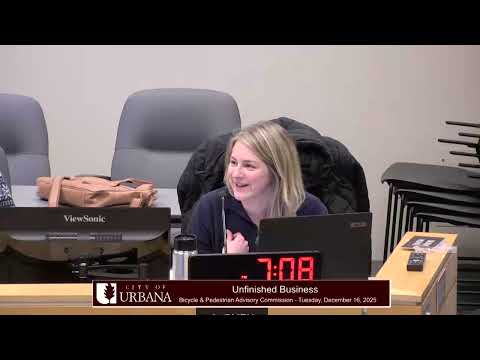
Members of the Bicycle and Pedestrian Advisory Commission spent a significant portion of their Dec. 16 meeting on sidewalk snow removal and accessibility, pressing staff for clearer enforcement, public outreach and targeted responses for people with disabilities.
Sarah Rand, a commissioner who uses a wheelchair, described multiple locations where plowing left curb ramps unusable and said the result forced her into the roadway: "I have encountered in at least 3 different places throughout Urbana, where the way that they got plowed ... the curb cuts are no longer accessible." That testimony framed much of the following discussion, where commissioners and staff discussed voluntary programs, contractor options and city enforcement.
City staff summarized the existing legal framework. "We have our snow ordinance in place," staff said, adding that "property owners must clear the sidewalk within 24 hours of the declaration by the public works director." Staff also described city‑maintained sidewalk maps for downtown routes, volunteer programs (the Snow Angels), and the possibility of putting a contractor 'on call' next season to respond to ramp complaints if budget allocations allow.
Commissioners heard from members who reported public confusion about liability and sidewalk clearing. One participant said many residents believe they could be sued for clearing their sidewalk; staff disputed that and recommended public outreach to correct the misconception. Commissioners proposed short‑term and medium‑term actions: a myth‑busting outreach message modeled on University of Illinois Facilities & Services communications listing clearing responsibilities and capacity; an ADA complaint intake form and prioritization of ramps for city crews; and a pilot program to match resident documentation (GoPro/bodycam or smartphone mapping) with RPC sidewalk assessments.
What comes next: Staff agreed to draft outreach language and to continue coordinating with the ADA coordinator on complaint intake and prioritization. Commissioners asked staff to explore the feasibility of redirecting contractor funds for an on‑call service next winter to address high‑priority ADA impediments.