
Vermont witnesses urge broader use of form-based codes and Act 181 exemptions to speed housing in growth centers
Get AI-powered insights, summaries, and transcripts
Sign Up Free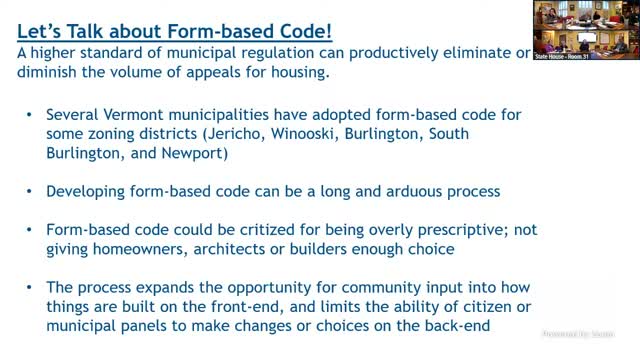
Summary
At a Jan. 15 hearing, Samantha Sheehan of the Vermont League of Cities and Towns outlined how form-based codes and Tier 1A/1B maps under Act 181 can reduce permit appeals and streamline housing in designated downtowns, while acknowledging trade-offs for public process and off-site builders.
Samantha Sheehan of the Vermont League of Cities and Towns told a legislative panel on Jan. 15 that form-based codes — prescriptive zoning that specifies building materials, window-to-wall ratios and other design details in advance — can shrink discretionary permitting and sharply reduce municipal permit appeals.
Sheehan said several Vermont municipalities have adopted form-based codes for parts of their downtowns and growth districts, citing Newport (adopted 2010), Burlington and South Burlington, Winooski, and Jericho as examples. She described Burlington’s downtown effort as a years-long process that began with HUD grant funding and produced a code the city adopted in 2017 and amended recently. "Since the passage of Act 181, that area has also been totally Act 250 exempt," she said, arguing the two tools together have been productive for building housing in those centers.
Why it matters: form-based codes move many design questions from case-by-case discretionary review to the zoning level, so a developer who meets the catalog of standards receives a straightforward yes-or-no permit decision. Sheehan told the panel that court data show about two-thirds of permit appeals target municipal permits; specificity in a form-based code reduces the opportunity for appeals, she said, and communities that have adopted the approach report fewer municipal-permit appeals and substantial permitted housing development.
How the Tier system works: Sheehan described the LERB-led process to identify Tier 1A and 1B areas under Act 181. Tier 1B offers an activity exemption up to 50 units; Tier 1A offers total Act 250 exemption for eligible growth centers that meet statutory criteria (municipal plan, Future Land Use areas, flood and river corridor protections, permanent land development regulations consistent with smart growth, and other requirements). Sheehan said regional planning commissions are submitting draft maps (Northwest, Chittenden, Rutland were named) and that LERB has begun receiving those regional plans.
Timing and scale: Sheehan outlined the multi-step process — regional map submission, a 60-day pre-application notice period with statutory stakeholder notifications and a public hearing, then RPC adoption and a final LERB determination — describing a minimum 75-day timeline for the statutory phases. She provided statewide scale estimates: the area currently eligible for Tier 1A exemption is "less than 3%" statewide, ranging from about 0.5% in some northeast counties to roughly 11% in Chittenden County, she said.
Trade-offs and next steps: Committee members and Sheehan discussed that adopting form-based codes requires lengthy public processes to reach consensus and may feel overly prescriptive to some homeowners and architects. Sheehan suggested mitigations including expedited public process options, model codes, technical planning support, and a minimum/maximum approach to reduce barriers for municipalities. Sheehan also said VLCT advocates extending Act 250 exemptions for downtowns and village centers through 2030 to align with housing goals.
What’s next: Several RPC draft maps are in the pre-application stage; municipalities such as Rutland that meet statutory municipal-plan and bylaw requirements can pursue Tier 1A applications. The panel closed the session after Q&A and thanked Sheehan for her testimony.