
Commission continues review of Franceschi Park reimagining after hours of debate on demolition, salvage and accessibility
Get AI-powered insights, summaries, and transcripts
Subscribe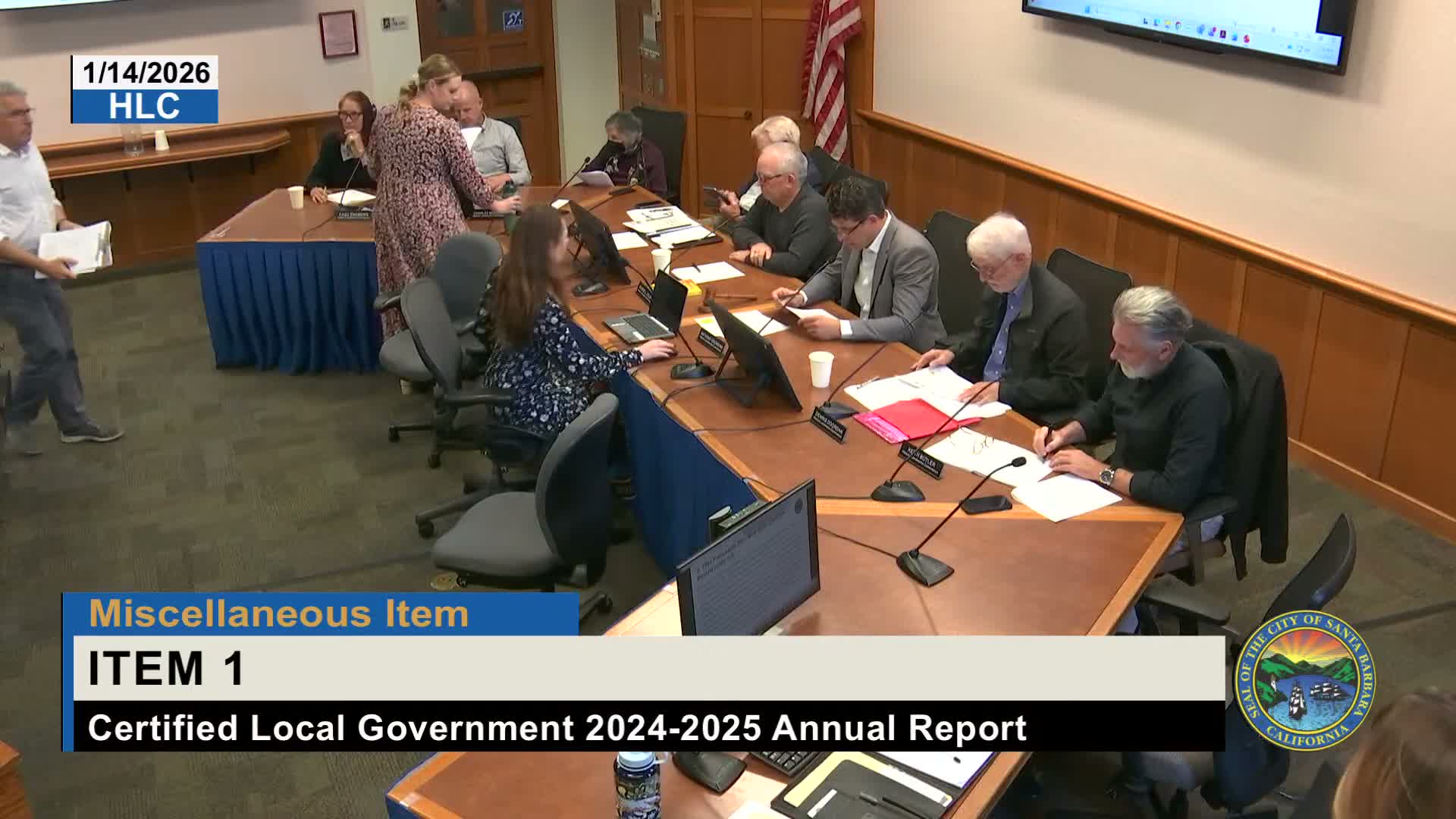
Summary
The commission continued an extended concept review of a proposal to remove the deteriorated Franceschi House and replace it with an interpretive terrace and ADA pathways. Staff said an EIR will analyze historic interiors and mitigation; public commenters urged a formal inventory and salvage plan for interior fixtures and medallions.
The Santa Barbara Historic Landmarks Commission continued its concept review of the Franceschi Park reimagining on Jan. 14 after a multi‑hour presentation, extensive public comment and detailed commissioner questioning.
Parks department staff and the project design team presented a scheme that would remove the existing Franceschi House—a designated historic resource—and replace its footprint with an interpretive terrace, accessible pathways, a new small parking area, retaining walls and landscape improvements. The project description notes demolition findings and project compatibility and major alteration findings will be required at a later stage. Staff told commissioners the project is at the second completeness review and that an environmental impact report will be required because the proposal includes demolition of a designated historic resource.
Public commenters were split but detailed in their concerns. Sherry Ray of the Pearl Chase Society asked the commission to "strongly recommend that an independent inventory of these features be required and a careful plan be developed for their recycling, reuse and repurposing by a qualified historian," citing stained glass, light fixtures, mantels, woodwork and marble elements inside the house. The Riviera Association and other neighbors expressed support for moving the project forward and preserving exterior medallions, arguing the existing structure is unsafe. Several commenters urged clear plans to select and place the roughly 85 exterior medallions; one commenter recommended prioritizing medallions that relate directly to Franceschi.
In response to questions from the vice chair, staff clarified that the city council had given direction to advance a project that proposes demolition but that a formal approval of demolition has not taken place; the environmental review process (EIR/initial study) will analyze interior and exterior historic resources and develop mitigation measures prior to any demolition. Holly Garson, project planner with the Parks and Recreation Department, said the environmental process will "explore many alternatives when it comes to historical resources" and that photographic and consultant documentation will feed mitigation and salvage planning.
Commissioners pressed on several specific topics: protecting and cataloging medallions and interior elements, feasibility of ADA access and restroom upgrades (the existing restrooms date from about 1950 and are not ADA‑compliant), the number and placement of medallions that can be accommodated in the proposed terrace footprint, and opportunities to provide stopping/viewing places along the new accessible path. Commissioners asked the project team to prioritize protecting materials that can be reused and to provide a defined plan for selection, safekeeping and future display of salvageable items.
After discussion, Commissioner Ullie moved—and a second was made—to continue the item indefinitely to allow the project team to refine the design and provide documentation and mitigation strategies, including a clear inventory and salvage strategy for interior and exterior historic materials. The motion carried by roll call with all commissioners voting in favor. No final, appealable decision on demolition or project design was made at this meeting; the commission’s continued review is intended to inform subsequent environmental review and future findings.