Get Full Government Meeting Transcripts, Videos, & Alerts Forever!
Get email alerts on the Urban Forestry topic
No spam. Unsubscribe anytime.
Land-use bureau proposes micro-forest feasibility study to boost canopy and stormwater resilience
Summary
Staff proposed a feasibility study for micro-forests (dense plantings around 5,000 sq ft) to mitigate urban heat and improve stormwater management on underused city parcels; board members urged linking study to tree-ordinance funding mechanisms and showing out-year implementation costs.
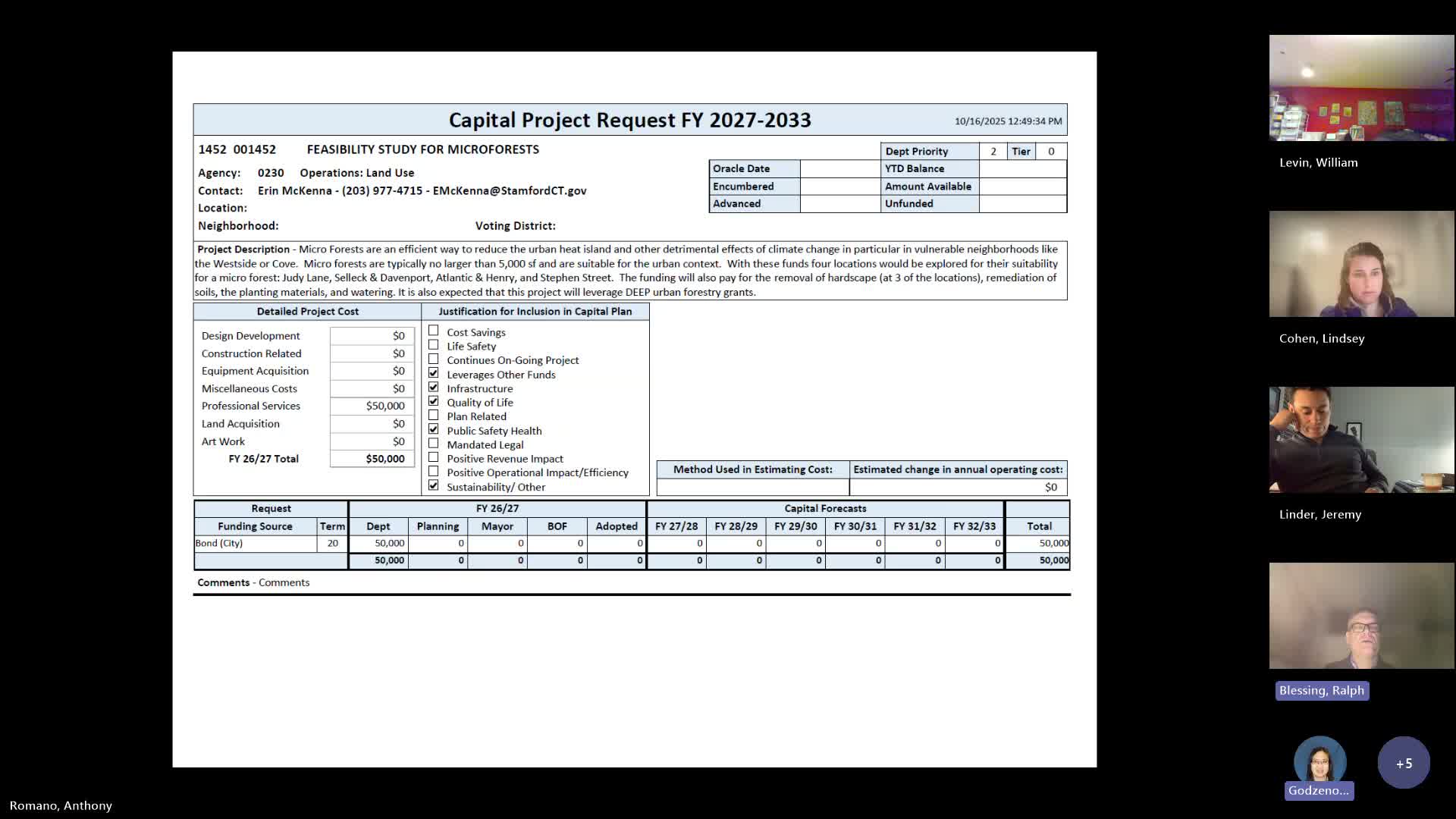
The land-use bureau proposed funding for a feasibility study and possible implementation of micro-forests ' small, dense tree plantings roughly 5,000 square feet in size ' intended to accelerate canopy growth and help with stormwater management.
Speaker 7 said micro-forests could be prioritized in areas with high impervious surface such as the East Side, South End and waterfront neighborhoods and noted that some candidate sites are leftover city-owned parcels rendered unsuitable for sale after street realignments. "They mature faster and grow faster so that the benefits of having trees come much earlier," Speaker 7 said.
Board members cautioned that the city is concurrently considering a tree ordinance and potential new funding mechanisms. Representative Goldberg (referenced by Speaker 7) and Speaker 8 encouraged the land-use bureau to coordinate with the ordinance process and to include implementation costs in the out-year forecast if grants are secured. Speaker 7 told the board the study will assess site soil needs, remediation and likely grant opportunities and that the bureau has already consulted colleagues in Norwalk and Bridgeport.
The board generally supported the study subject to clearer scope definition, out-year cost estimates and linkage to other urban-forestry funding sources.