Get Full Government Meeting Transcripts, Videos, & Alerts Forever!
Get email alerts on the Cip Financing topic
No spam. Unsubscribe anytime.
Yavapai County work study explores bond options to fund $78 million in sample projects
Summary
Stifel representatives briefed the Yavapai County Board of Supervisors on financing tools — excise-tax pledged bonds, general obligation bonds and certificates of participation — showing scenarios for a hypothetical $78 million package and outlining a 10–12 week issuance timetable under ARS 11-3-91.
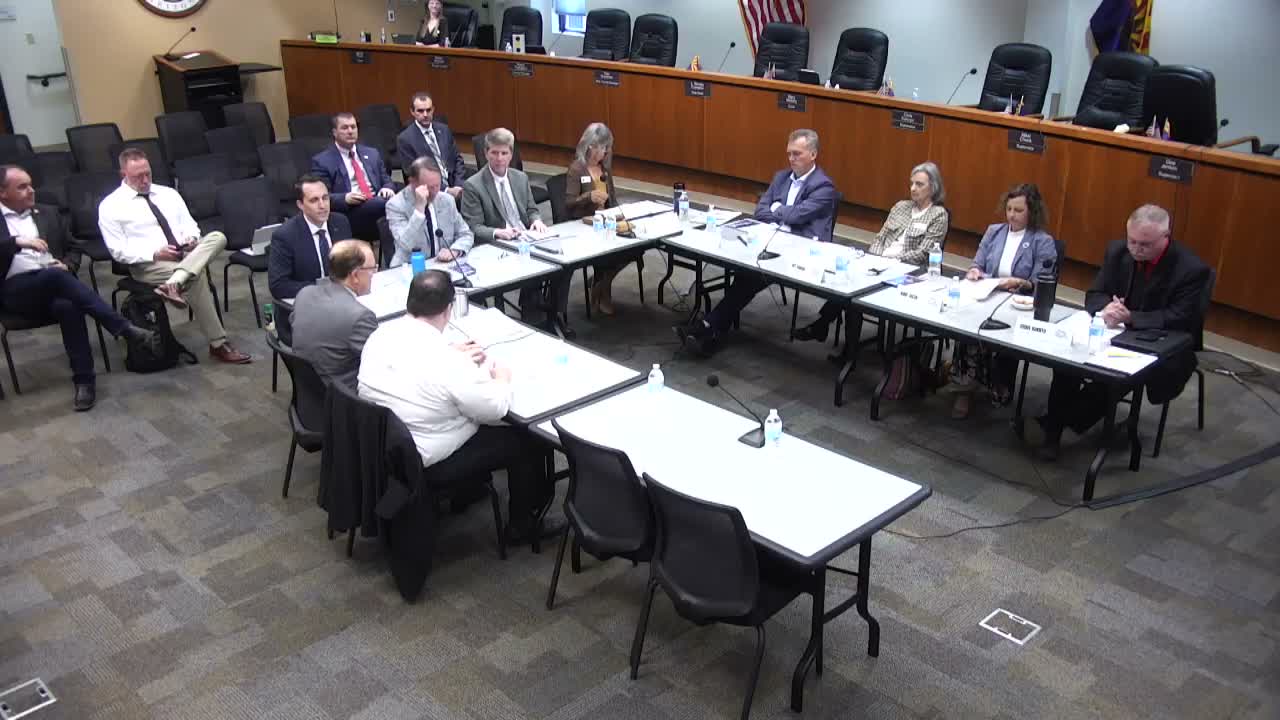
YAVAPAI COUNTY — The Board of Supervisors heard a staff-led work study presentation on municipal financing options Thursday as outside advisors outlined how the county might fund capital improvements without immediate tax increases.
Grant Hamill, managing director at Stifel, described the financing tools available to Arizona counties and walked supervisors through sample structures for streets, public safety, parks, water and administrative facilities. "These are the Arizona county financing options for traditional public infrastructure projects," Hamill said, listing revenue bonds, general obligation (GO) bonds, pledged-revenue (excise-tax-backed) bonds and special districts as typical vehicles.
Why it matters: The board is considering how to fund a multi-project capital program while limiting risk to property taxpayers. Hamill noted GO bonds require voter authorization at a November election and are limited by the state constitution to 15% of a county's net assessed limited property value. Using Stifel's rounded figures, Hamill estimated Yavapai County's net assessed limited property value at about $4,000,000,000 and the county's GO bonding capacity at a little over $600,000,000.
Under the pledged-revenue approach, a county need not hold a bond election but must hold a public hearing. Hamill said pledged revenue can include general excise tax receipts, net state shared revenues, vehicle license tax and PILT (payments in lieu of taxes). "That basket of revenues is what you are providing investors as the security with which to pay back those bonds," Hamill said.
Presenters used a hypothetical $78 million financing to illustrate amortization choices. Jack Lieber, director at Stifel, showed a 15-year scenario at an illustrative 4.5% interest rate producing roughly $7.2 million in annual debt service and strong coverage ratios; longer amortizations reduced annual payments but raised lifetime interest costs. "We can structure the debt service in any way the county... to meet their goals," Lieber said, noting flexibility in principal schedules.
Comparative context: Hamill cited recent Arizona examples: Yuma County issued pledged-revenue bonds in 2022 totaling about $60 million (about $68 million of projects financed), while Pinal County closed an excise-tax-backed issuance this month of roughly $183 million with a 30-year maturity.
Process and timing: Stifel recommended a staged approach starting with a board work session to identify projects and costs, drafting a resolution and notice under ARS 11-3-91, public hearings and a preliminary offering statement before applying for credit ratings — a process the presenters estimated could take about 10–12 weeks from initiation to sale.
Board response and next steps: Supervisors asked about tax treatment for bond purchasers and local outreach; Hamill and Lieber said the bonds for the projects outlined would be both state- and federally tax-exempt for in-state purchasers and advised staff would circulate the public hearing notice and proposed resolution if the board wishes to proceed to formal consideration. No motions or votes occurred during the work study.
The work study also included an extended briefing on pension funding options and was expected to return to financing strategy at a later board session.