Get Full Government Meeting Transcripts, Videos, & Alerts Forever!
Get email alerts on the Land Use topic
No spam. Unsubscribe anytime.
Board fails to secure supermajority for rezoning that applicants said would create two family parcels
Summary
The Board of Supervisors considered rezoning case 25-19 to split a 3.38-acre parcel into two 1.69-acre lots. Staff said state law allows multiple accessory dwelling units on lots over 1 acre; neighbors warned of falling water tables, traffic and irrigation impacts. Motions to deny and to approve failed to produce a final approval under the supermajority requirement.
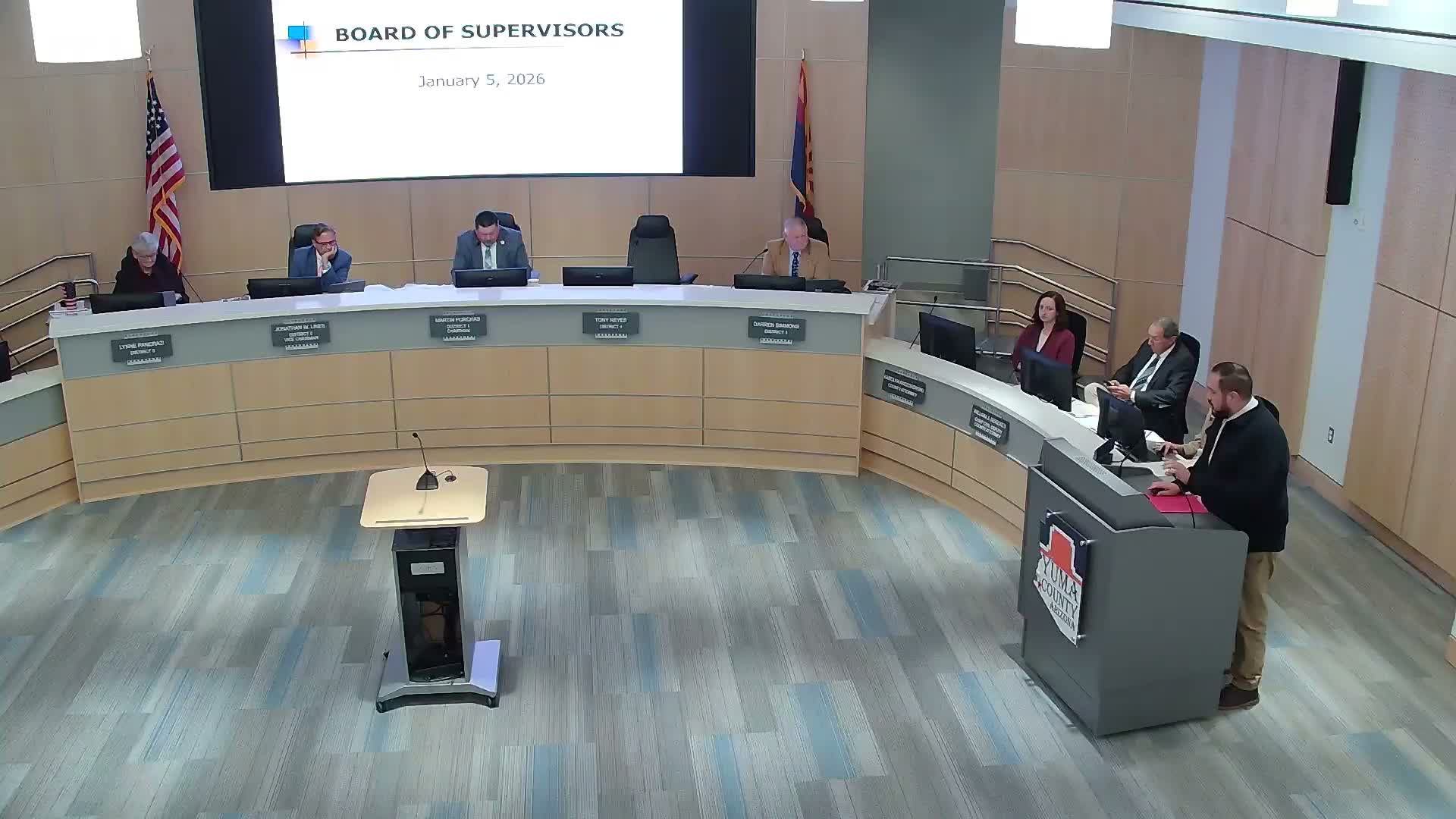
The Yuma County Board of Supervisors considered rezoning case 25-19 on Jan. 5, a request to change a 3.38-net-acre parcel from Suburban Ranch 4-acre minimum (SR-4) to Suburban Ranch 2-acre minimum (SR-2) to create two 1.69-acre lots for family homes. Richard Binguia, senior planner, said 12 letters of opposition were received and the Planning and Zoning Commission recommended denial.
The public hearing drew multiple neighbors who described the area’s original character as large-acreage lots used for horses, raised concerns about irrigation and road erosion, and warned of reduced well levels. David Daniels told the board he has "had to lower my pump 40 feet in the last couple years" and said additional adjacent wells would further affect the neighborhood. Other speakers described potential traffic increases, irrigation difficulties and the risk of creating precedent for future splits.
A central technical point in board deliberations was Arizona’s recent accessory-dwelling-unit law. Staff explained the state permits a primary dwelling plus an attached ADU and a detached ADU by right and allows an additional ADU for parcels over one acre; on parcels over one acre that can amount to four dwelling units under state allowances, and the county’s ability to prohibit ADUs is limited to regulation of some development standards.
During deliberations supervisors debated whether denying the split would be a case-by-case exercise or effectively attempt to lock in a local land-use outcome despite state law. A motion to deny the rezoning was made and seconded but failed to produce the votes required to finalize a denial. A subsequent motion to approve the rezoning received three 'aye' votes (Supervisor Reyes, Supervisor Lyons and Chairman Porches) and two 'nay' votes (Supervisor Pankrazi and Supervisor Simmons). Legal counsel told the board that approval requires a supermajority; because the required number of affirmative votes was not reached the motion to approve failed and the rezoning did not pass.
What’s next: No rezoning was approved at the meeting. Staff noted that creating six or more lots triggers subdivision regulations under state law, and that future proposals in the area will be subject to the county’s notification and review processes.