Get Full Government Meeting Transcripts, Videos, & Alerts Forever!
Get email alerts on the Land Use topic
No spam. Unsubscribe anytime.
Yavapai supervisors approve Black Canyon City travel center with conditions after heated public debate
Summary
After hours of testimony from residents and developers, the Yavapai County Board of Supervisors approved a permanent, transferable use permit for a multi-component travel center in Black Canyon City, adding conditions including hours limits and screening to address water, light and traffic concerns.
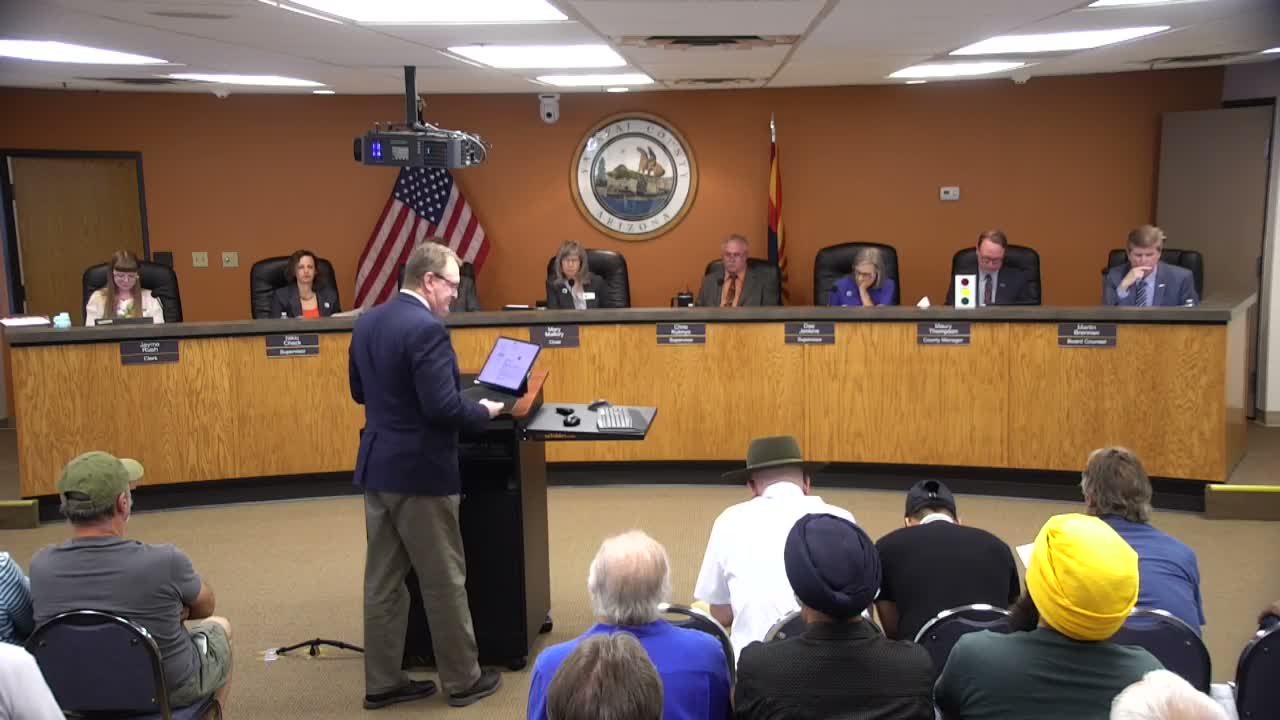
The Yavapai County Board of Supervisors on Aug. 20 approved a permanent and transferable use permit for a multi-component travel center in Black Canyon City, after lengthy testimony from neighbors, planners and the project team and a board debate that produced several added conditions.
The project from the applicants, represented in the meeting by architect John Riddell and developer Vikram Takar, would build a convenience store with a fast-food restaurant, fuel dispensers, EV charging and small kiosk retail across four parcels totaling roughly 22 acres. Development Services staff told the board the site straddles C2 and R2 zoning and that a use permit was the appropriate path because of pending comprehensive-plan amendments.
The board’s decision followed months of citizen participation and an uptick of correspondence in the days before the meeting. Planner BJ Ratliff said the record as of the morning of Aug. 20 included dozens of letters and petitions both for and against the project; he summarized common concerns among opponents as water availability, traffic and lighting and said proponents emphasized added services and local tax revenues.
Residents described local water shortages and safety risks on narrow local roads. Aliyah Shalene, a Black Canyon City business owner who said her family has run a restaurant on I‑17 for years, argued the community needs “growth that makes sense for our community” and urged caution on a large travel center sited near homes.
The applicants responded to specific concerns in the hearing. Architect John Riddell said the project team worked for about a year with ADOT and county public-works staff to locate an entrance that would meet state and county design requirements and that fuel tanks would be an above‑ground, walled system designed to reduce the risk of groundwater contamination. Developer Vikram Takar told the board the business would not operate 24 hours and that "it will shut down at 10 P.M.," with illuminated signs and most lights turned off after closing except for necessary security lighting.
Board members pressed for enforceable protections for neighbors. Supervisor Jenkins proposed — and the board adopted — additional conditions requiring hours of operation and screening: the board added limits on operating and lighting hours (to be reflected in permit conditions) and required landscaping and screening to separate the commercial operations from adjacent residences, with certificate-of-compliance review periods. The permit also includes signage allotments and a condition requiring that the use comply with county, state and federal regulations; staff added a two‑year certificate-of-compliance trigger.
The board approved the permit unanimously. County staff and the applicant will implement the conditions through the building-permit and compliance processes. If the applicant seeks any future expansion or changes to the approved uses, Planning & Zoning review or an amendment to the use permit will be required.
What’s next: the county will enforce the conditions through permitting and the certificate-of-compliance process; building permits, fire‑marshal review and state water approvals remain prerequisites to construction.