Get Full Government Meeting Transcripts, Videos, & Alerts Forever!
Get email alerts on the Special Districts topic
No spam. Unsubscribe anytime.
Mountain Club residents win formation of Domestic Water Improvement District to pursue water system upgrades
Summary
After residents testified about aging two‑inch piping, loss allowances and lack of hydrants, the Yavapai County Board unanimously adopted Resolution No. 2168 on Oct. 15 to establish the Mountain Club Domestic Water Improvement District, enabling access to loans and grants for replacement and fire‑suppression improvements.
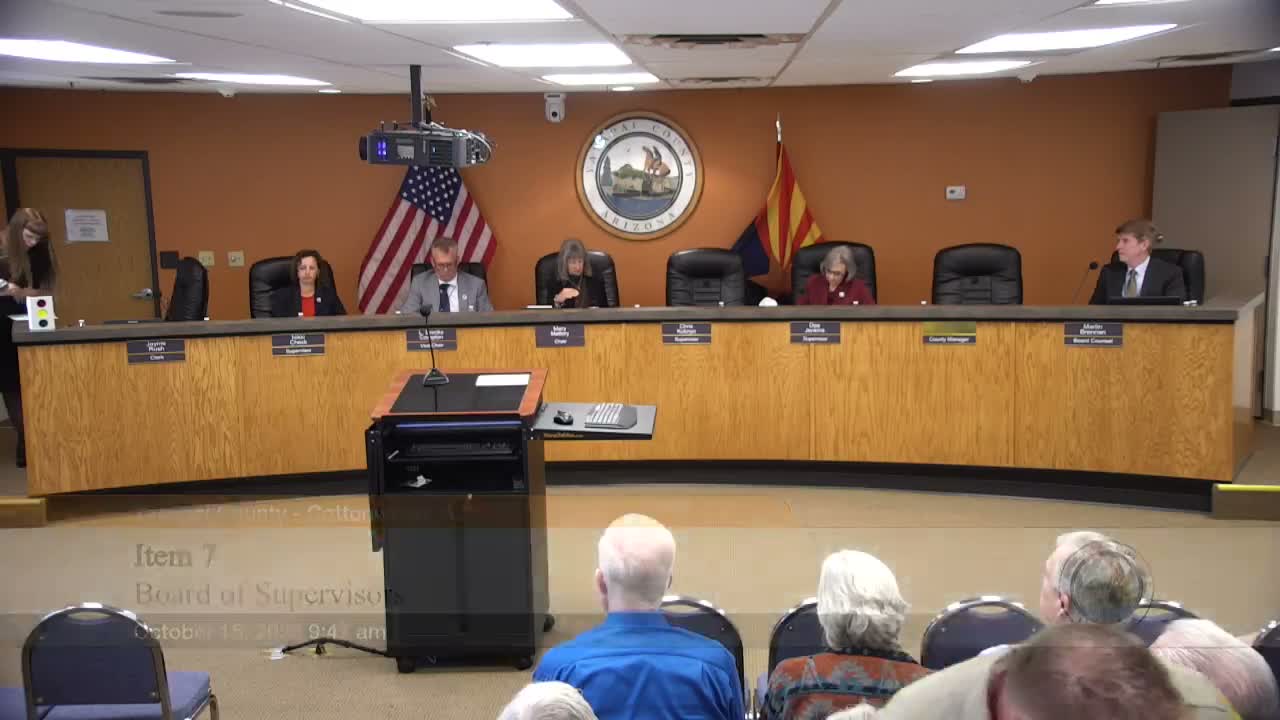
The Yavapai County Board of Supervisors voted unanimously Oct. 15 to establish the Mountain Club Domestic Water Improvement District, a special district designed to give the Mountain Club community access to low‑interest loans and grants to repair and replace aging water infrastructure.
Jamie Rush, the clerk of the board, told the supervisors the petition met Arizona statutory thresholds — signed by 59% of property owners by number and 56% by property area — and that notice had been mailed to 4,400 property owners within the proposed boundaries. The clerk said the board must find the petition meets statutory signatory and public‑convenience criteria before issuing an order of establishment.
Mountain Club residents and volunteers described longstanding infrastructure problems. Gloria McConnell, president of the Mountain Club Water Solutions Committee, said many distribution pipes are two inches in diameter, preventing installation of standard fire hydrants; she and other residents said the community does routine leak repairs but requires structural upgrades and access to grant programs such as WIFA and USDA loans that a domestic water improvement district would enable.
Residents noted grant eligibility challenges tied to the Mountain Club’s nonprofit classification and median household income metrics, and said the DWID structure would broaden funding options and enable more robust fire suppression. Kent Erwin, a retired civil engineer and 20‑year resident, described the community as historic and in need of external funding to undertake a system overhaul.
One speaker raised cost and governance concerns and suggested further professional oversight would be needed; the clerk reported three letters of opposition were filed before the hearing citing costs and potential conflicts of interest. The board weighed public input and the statutory findings, and Vice Chair Compton moved to approve the resolution. The motion passed unanimously, and the clerk noted initial board members named in the petition.
Next steps include formalizing the district’s paperwork, initiating the assessment and financing processes, and pursuing eligible state and federal funding programs to design and implement system upgrades.