Get Full Government Meeting Transcripts, Videos, & Alerts Forever!
Get email alerts on the Broadband topic
No spam. Unsubscribe anytime.
Yavapai County details ARPA and BEAD broadband buildout; vendors report near‑term completions but BLM permit delays remain
Summary
County broadband manager told the Board the ARPA‑funded phase has moved most projects into construction, with Cox, Sparklight and WECOM as principal contractors; a BEAD award managed by WECOM aims to reach ~22,437 unserved locations but federal permits are delaying a small number of homes.
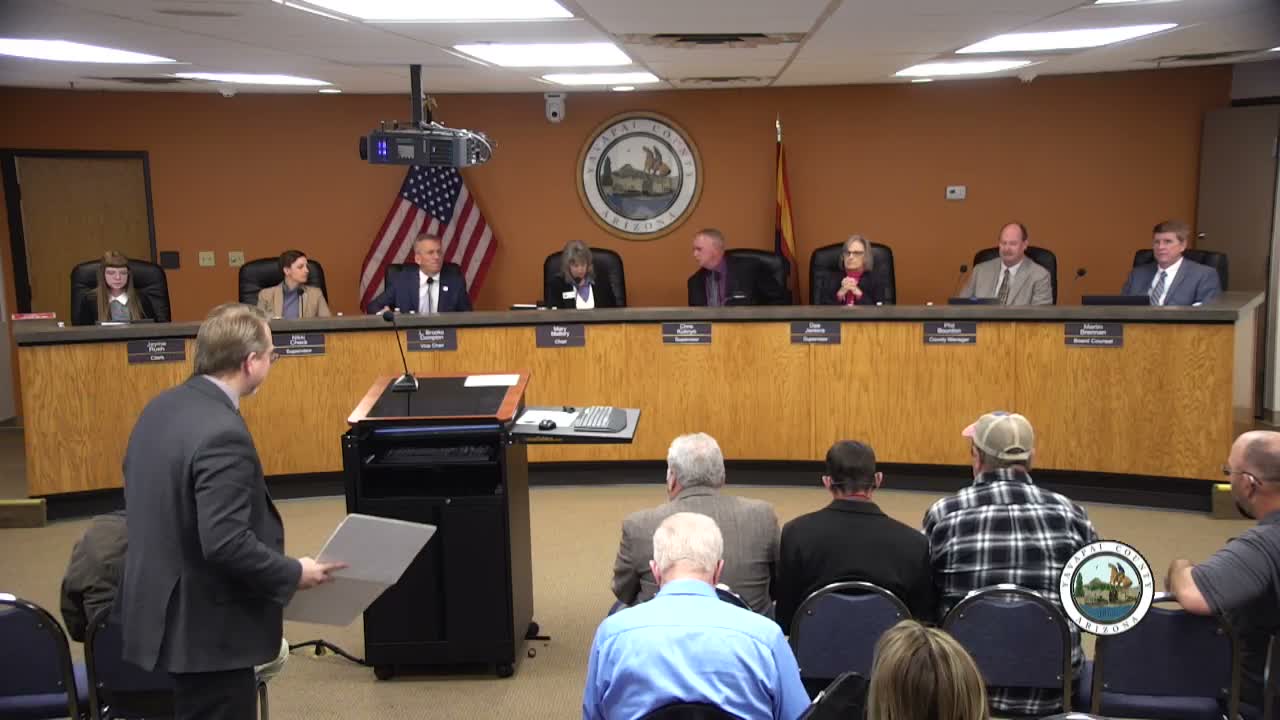
Corey Christians, Yavapai County librarian and the county’s broadband project manager, told the Board of Supervisors on Nov. 19 that a multi‑year push combining E‑Rate, ARPA and BEAD funding has put the county on track to expand fiber service across many rural communities.
Christians said the county’s earlier middle‑mile buildout (initiated in 2017 and completed by Sparklight for schools and libraries) put Yavapai ahead of much of the state. The Board dedicated ARPA funds to last‑mile projects in 2021; after RFP returns the county committed roughly $16 million of ARPA funds to enable private providers’ builds. “Cox Communications received almost $3,800,000 in funds. WECOM received about $8,000,000. Sparklight received exactly $5,000,000,” Christians said, describing those awards and the contractors’ additional private investment.
The county’s ARPA contracts require fiber‑to‑the‑premises connections capable of at least 1 Gbps upload and download, he said. Christians added that some builds are nearing completion: “Black Canyon City is very near completion” and projects such as Cordes Lakes and Beaver Creek are active with hundreds of subscribers already signed up.
Christians flagged two important constraints. First, some projects are delayed by permitting. He said Cox’s work to reach about 37 homes on the far side of a national monument remains pending because the Bureau of Land Management has not issued a needed permit after about a year and a half of review. Second, he said BEAD (the federal Broadband, Equity, Access and Deployment program) has awarded county work to WECOM to deliver a larger countywide build. “WECOM was awarded those funds for the county. They’re going to have about a $210,000,000 buildout for the entire county over the next three to five years,” Christians said, adding that BEAD is intended to reach roughly 22,437 unserved and underserved locations in Yavapai County.
Supervisors pressed for timing and risks. Christians said the ARPA‑funded contracts are largely on schedule and noted that providers have matched county funds with substantial private investment (roughly two to three times the county contribution in many projects). On the BLM permit he said the county is monitoring progress and will work with the provider and federal agencies. “All of our projections show that they will be done,” he said when asked whether ARPA deadlines could be met, acknowledging the permit as the outstanding issue for a small subset of homes.
Why it matters: the presentation lays out how federal, state and local funding are being coordinated to bring high‑speed fiber to rural Yavapai communities. The Board emphasized monitoring timetable risks and continued intergovernmental coordination as the county transitions from ARPA to BEAD construction.
What’s next: county staff will continue tracking provider progress and permit status and report back to the Board; supervisors asked staff to keep an eye on ARPA spending deadlines and BEAD coordination as the build moves toward completion.