Get Full Government Meeting Transcripts, Videos, & Alerts Forever!
Get email alerts on the Municipal Judge Hiring topic
No spam. Unsubscribe anytime.
Erie council interviews three finalists for municipal judge; moves to executive session on contract
Summary
Erie Town Council on Feb. 18 interviewed three finalists for municipal judge — Bradley Malone, Amanda Bailhash and Whitney Stark — heard each candidate’s experience and judicial philosophy, and recessed into executive session to discuss contract terms. No appointment was announced.
Erie — The Erie Town Council held a special meeting on Feb. 18, 2025, to interview three finalists for the municipal judge position and to receive staff briefings on next steps. Mayor Moore opened the meeting and Court Administrator Danielle Trujillo explained that the current presiding judge, Judge Ablau, will leave in April 2025 and that staff reviewed 12 proposals, interviewed four applicants and invited three finalists to present to the council.
Bradley Malone, who told the council he started his legal career 16–17 years ago as a deputy district attorney in Jefferson County, described a background that includes prosecutorial work, managing civil litigation in the Arvada city attorney’s office and service as a relief judge in Thornton. "Our state courts are the best place to keep violent offenders off the street," Malone said, adding that “the municipal courts are the most important tool that we have in the criminal justice system to keep people from becoming violent criminals in the first place.” He told councilors he would serve on a part‑time basis while maintaining a private practice and teaching as an adjunct.
Amanda Bailhash, 19 years in practice and currently a municipal judge in multiple jurisdictions, framed her judicial philosophy around procedural fairness — understanding, neutrality, voice and respect — and emphasized collaboration with outside agencies. She described use of co‑responder or crisis response units to help defendants access housing, identification and benefits and said those cross‑agency programs can reduce recidivism. "How a person is treated in court is more important than the outcome," Bailhash said, describing community court and treatment‑court approaches she has used to monitor individuals and connect them to services.
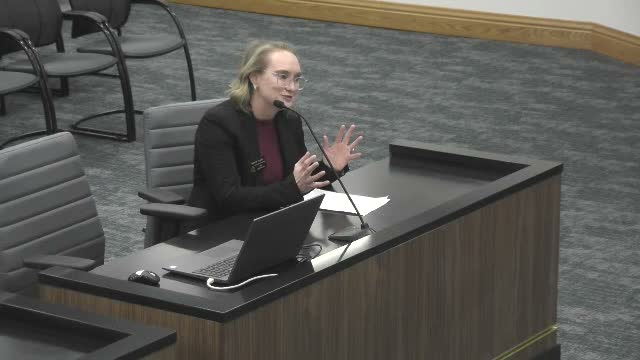
Whitney Stark, an assistant municipal judge in Fort Collins and part‑time magistrate in Denver, described a docket that includes criminal, traffic and juvenile matters and duties as marijuana licensing authority. Stark said she prioritizes transparency in decisionmaking and clear recordkeeping so parties understand why the court ruled as it did. She cited programs Fort Collins and Denver have piloted — municipal drug court and partnerships with health providers — as possible models Erie could adapt.
Council members asked each candidate about juvenile cases, use of restorative justice, victims’ rights, recusal and conflicts in a small community, and how each would fit Erie into an existing schedule of part‑time judicial duties. Malone emphasized role modeling and early intervention in juvenile cases; Bailhash discussed checklists and recusal procedures when personal relationships arise; Stark emphasized outreach to prosecutors and officers and written policies that promote procedural fairness.
Trujillo told the council there would be no appointment at the meeting and that staff would follow up with candidates by email. The council then moved into an executive session under Colorado law to determine positions and instruct negotiators regarding the municipal judge contract. No public announcement followed that night.