Get Full Government Meeting Transcripts, Videos, & Alerts Forever!
Get email alerts on the Budget Reserves topic
No spam. Unsubscribe anytime.
Erie officials outline 2025 budget, reserves and staffing assumptions
Summary
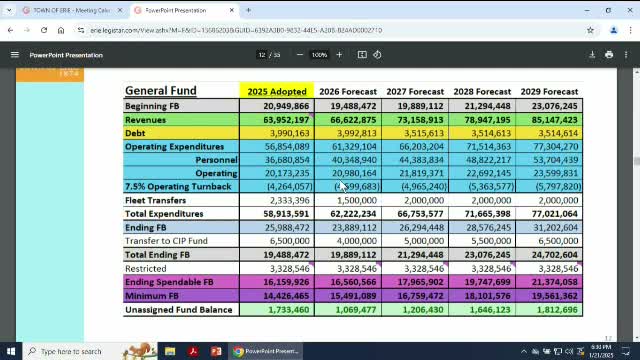
Town Manager Malcolm Fleming presented Erie’s 2025 budget framework, explaining a 25% minimum reserve (TABOR 3% + emergency 12% + stabilization 10%), projected transfers to the CIP, and assumptions on revenue and personnel costs driving the five-year forecast.
Town Manager Malcolm Fleming told the council that staff had structured the 2025 budget around a conservative financial forecast and a multi-component 25% minimum reserve. "We maintain that 25% of operating expenditures as a reserve," Fleming said, noting the reserve includes TABOR’s 3% requirement, an emergency reserve intended to cover disaster responses and a stabilization reserve intended to smooth economic downturns.
Fleming outlined the mechanics that drive the general fund forecast: revenues of roughly $63.9 million, operating expenditures near $58.9 million and planned transfers (about $6.5M in the adopted budget) from the general fund to the capital improvements fund to finance one-time projects. He explained how historical departmental 'turn back' (unspent appropriations) is built into the forecast and used conservatively in the town’s projections.
On personnel, staff described a combined approach for salary adjustments: a base market adjustment plus performance-based elements. Fleming noted an insurer change (from Cigna to Kaiser) produced benefit savings and a cap on next-year increases, which staff used to adjust benefit assumptions in the forecast. Councilors asked for additional detail, including FTE comparisons to similar jurisdictions and the percentage of employees who meet expectations vs. exceed them; staff agreed to supply those data and further analysis.
Fleming also reviewed the town’s capital-funding approach: transfer of excess operating revenue to a CIP fund to finance large, "chunky" capital projects, and emphasized council direction will drive which projects are prioritized.