Get Full Government Meeting Transcripts, Videos, & Alerts Forever!
Get email alerts on the Police Facility Financing topic
No spam. Unsubscribe anytime.
Erie council weighs policing facility financing: COPs now or a bond vote later?
Summary
Councilors debated using certificates of participation (COPs) to finance a proposed police facility immediately versus asking voters to approve a bond. Staff said COPs cost slightly more over time but avoid a risky ballot fight; councilors pressed for clear trade-off numbers and community polling.
Erie town officials spent much of their Jan. 21 study session debating how to pay for a proposed police facility, weighing a near-term borrowing option that avoids a public vote against a lower-cost, voter-backed bond that could be uncertain at the ballot box.
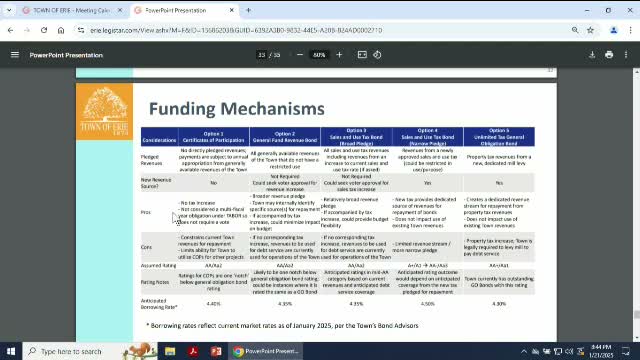
Town Manager Malcolm Fleming told council that financial advisers estimate borrowing costs this year of about 4.4% for certificates of participation and roughly 4.3% for an unlimited-tax general-obligation bond. "If you bond, you get a dedicated revenue source, and so that 65,000,000 is still there for other projects," Fleming said when explaining the trade-offs in structure and timing. He added staff’s modeling showed the extra net interest cost of a COP compared with a bond on a $40 million to $65 million issuance would be on the order of several hundred thousand dollars over the life of the debt — an amount that, in his view, is roughly comparable to one year of construction inflation.
Mayor Moore pressed the fiscal framing to council: "The total cost at 4.3% would be $65,000,000. . . that means we're taking $65,000,000 from the future, and then we're committing it to the police station," he said, underscoring concerns about opportunity cost for other community priorities.
Councilors voiced split views. Some said COPs are a pragmatic way to move forward if community support for a bond is uncertain. Others warned that COPs resemble a lease arrangement and carry different ownership and risk implications; one councilor asked bluntly, "What do we do if they say no?" noting that a failed ballot measure would require a fallback plan.
Council members also asked staff for more granular information: the current balance and incoming receipts for the police-facilities impact fund; a full, all-in cost comparison (principal, interest, fees and any lease or ownership terms); how debt service would affect annual budgets and other planned capital projects; and refined polling to measure voter appetite for various ballot scenarios. Fleming committed to returning with a detailed comparison and scenarios, including the effects of refundability and construction-cost escalation.