Get Full Government Meeting Transcripts, Videos, & Alerts Forever!
Get email alerts on the Land Use topic
No spam. Unsubscribe anytime.
Grand Junction adopts ordinance to implement state 'turf' ban, revise landscape rules
Summary
The City Council on Dec. 3 adopted ordinance No. 5283 to implement Colorado's ban on nonfunctional turf and revise municipal landscape, buffering and screening rules. The change, narrowly approved 4–2, clarifies irrigation standards, limits turf substitutions and aligns local code with state law.
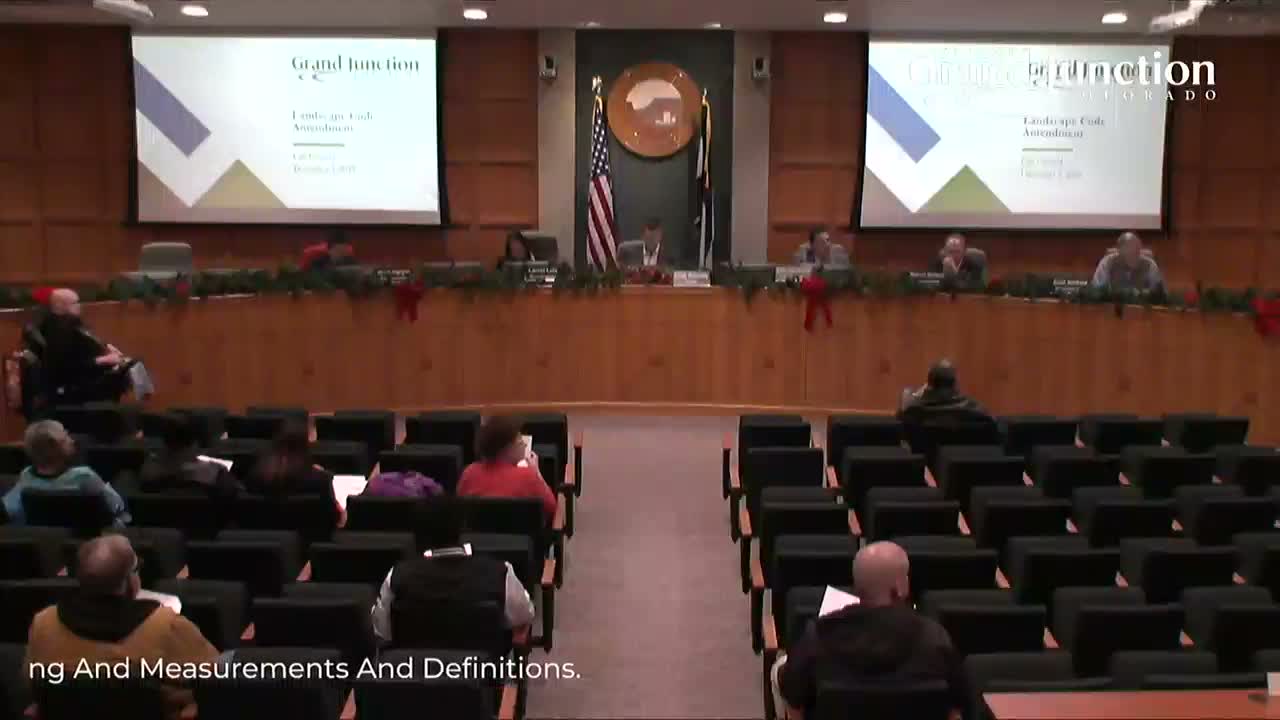
Grand Junction — The City Council voted 4–2 on Dec. 3 to adopt ordinance No. 5283, amending Title 21 of the Grand Junction Municipal Code to implement Colorado laws restricting the installation of nonfunctional turf and to revise local landscaping requirements.
Principal Planner Tim Laerbach told the council the amendment updates chapters 21.07 (landscaping, buffering and screening) and 21.14 (measurements and definitions) to prohibit nonfunctional turf on commercial, institutional, industrial and certain multi‑unit properties, and in rights of way, parking lots and medians. ‘‘State legislation signed into law in 2024 and 2025 requires that local governments restrict the installation of nonfunctional turf no later than 01/01/2026,’’ Laerbach said during his staff presentation.
The ordinance narrows existing exemptions, adds a local definition of ‘‘functional artificial turf’’ to allow recreation uses, and clarifies that irrigation plan certification (an existing local requirement) applies to required landscape plans. Laerbach said the code also provides flexibility where recent reductions in front setbacks made the previous street‑frontage landscape requirements impractical.
Why it matters: the changes are intended to lower municipal and private water demand by reducing high‑water‑use turf and ensuring irrigation systems are zoned by plants’ water needs. Laerbach said the Planning Commission recommended approval 5–1.
Council debate focused on scope and cost. Council members asked whether the state threshold for multi‑unit properties applied locally; Laerbach clarified the turf prohibition applies to multi‑unit residential properties with 13 or more dwelling units, ‘‘consistent with the statewide ban.’’ Council members also sought confirmation that the irrigation designer certification is a local code requirement becoming effective Dec. 21, not a state statute.
Council member Ballard voted against the ordinance and said he was concerned about potential cost impacts on housing affordability, especially for smaller multifamily projects. Laerbach and others responded that the turf provisions implement the state mandate and that the amendment was written to be minimally compliant, while folding in needed clarifications on setbacks and irrigation practice.
The ordinance passed on final reading with the following roll call: Ballard — No; Balfus — Yes; Lutz — Yes; Wynne — Yes; Van Dyke — No; Mayor Kennedy — Yes.
The ordinance becomes part of the municipal code and is intended to take effect in time to meet the state's installation restriction date of Jan. 1, 2026. The council directed staff to continue coordination on implementation details and to monitor any remaining compliance questions.
Sources: staff presentation by Tim Laerbach; Planning Commission record; City Council roll call on Dec. 3.