Get Full Government Meeting Transcripts, Videos, & Alerts Forever!
Get email alerts on the Union Depot topic
No spam. Unsubscribe anytime.
Grand Junction council hears Union Depot restoration pitch; staff directed to pursue FRA grant application
Summary
Developers presented a $6.34 million plan to restore Grand Junction's Union Depot and asked the city to serve as the applicant for a Federal Railroad Administration grant (application due Jan. 7). Council gave staff direction to return in December with a resolution authorizing application and a subrecipient agreement.
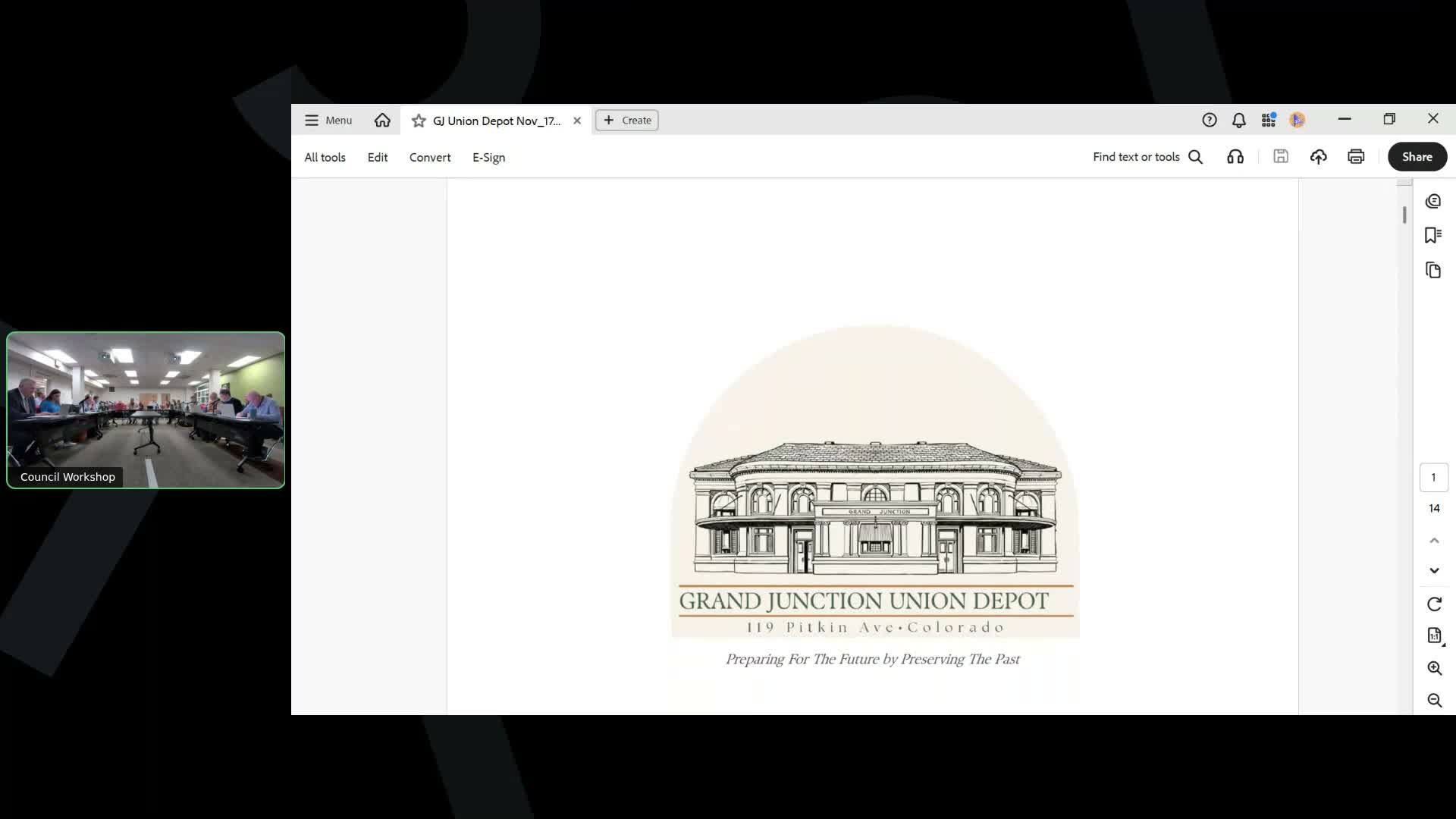
Dustin, a co-owner of the Union Depot redevelopment team, told the Grand Junction City Council workshop on Nov. 17 that the group is seeking the city's help to apply for Federal Railroad Administration funding to restore and reactivate the historic Union Depot at 119 Pitkin Avenue.
The project team described a scope of about $6,342,000 and an 80/20 funding split: roughly $5,073,000 from federal sources and $1,270,000 expected from private match. "This money has been appropriated through the Federal Railroad Administration," Dustin said, adding that the FRA pool for eligible projects is "a pool of money of just over 5,000,000,000" and that the application deadline is Jan. 7. The team said it expects construction documents to be complete by Dec. 15 and anticipates a decision on awards by next summer if the application is successful.
Why it matters: the proposal would return Amtrak to a restored Union Depot, create ground-floor restaurant and retail space, activate a trackside patio and a public social lounge, and add space for tenant improvements; the team said Amtrak has budgeted $6 million for platform improvements in Grand Junction by 2029 and has provided a letter of support. Developers also described a prelease with Amtrak for three 20-year operating terms and grant awards already received from History Colorado and other local sources.
Council and staff questions focused on financial risk and the city's role. Staff grant supervisor Chloe Labrey explained that the city must be the official applicant for the federal grant and noted safeguards: the match must be secured and committed prior to submission and the city can decline an award if terms cannot be met. John Shaver, the city attorney, cautioned that "you can paper it upfront and anticipate that everything is gonna go well," and warned that enforceability and remedies if the project defaulted would need careful documentation.
The developers detailed fundraising and match strategies: private investor commitments, a bank loan under review at AMB Bank (President Vance Wagner identified as evaluating a loan), a $500,000 catalyst grant pledged by the Downtown Development Authority to be used as match, and pending applications to History Colorado for up to $250,000. The team said they have invested over $1 million since acquiring the property in 2016 and that a local 501(c)(3) friends group has raised about $130,000 in private donations to support the work.
Council direction and next steps: councilors expressed broad support for the restoration concept and for the city to participate as applicant, subject to staff confirming match commitments and the legal terms of a grantee/subrecipient agreement. Staff said they will bring a resolution to a regular council meeting in December authorizing the city manager to apply for the FRA grant in partnership with the Grand Junction Union Depot and will return final subrecipient agreement terms prior to grant execution should the award occur.
The council did not take a vote on the grant application tonight; the next formal step is a resolution and authorization at a future regular council meeting in December.