
Developer seeks approval for 60,500‑sq‑ft light‑industrial and R&D building at 20 Barefoot Road
Get AI-powered insights, summaries, and transcripts
Subscribe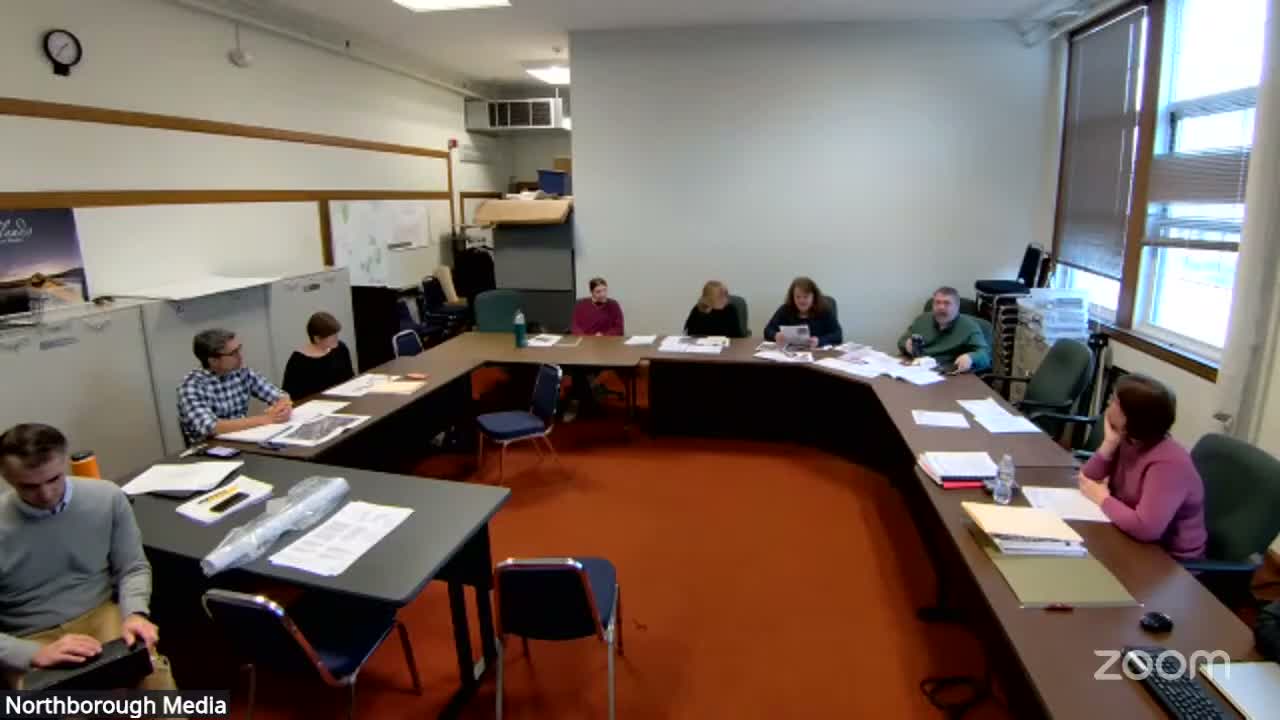
Summary
Quentin Park of McQuarrie Development presented plans for a single‑story, roughly 60,500‑square‑foot manufacturing, R&D and office building at 20 Barefoot Road in Northborough. The Design Review Committee discussed landscaping, parking, a reduced front buffer and pedestrian access and scheduled a site walk before final comment to the Planning Board.
Quentin Park, a principal with McQuarrie Development, told the Design Review Committee on Jan. 15 that his firm proposes a single‑story, institutional‑quality manufacturing, research and office building at 20 Barefoot Road, describing it as “a single story proposed building of approximately 60,500 square feet.” He said the project is infill in an industrial zone near the I‑290/Solomon Pond interchange and that loading would be located behind the building to shield it from public view.
Park said utilities will be placed underground, the site will include native stormwater planting and mitigation, and the applicant does not intend to change the total number of parking spaces. On specific materials, he said the primary facade will use Kingspan Optimo insulated metal panels and that the entry and patio will be paved with Unilock Artline pavers set in sand and gravel rather than concrete.
The proposal includes deliberate landscaping to screen the building. Katarina, the project landscape designer, described a promenade of hawthorn trees, a row of Princeton elms to provide separation between 20 and 30 Barefoot, and native rain‑garden plantings for stormwater function. Park said the design minimizes turf and uses drought‑resistant species in parking islands to reduce maintenance and provide year‑round visual interest.
Several zoning issues drew extended discussion. Park acknowledged the parking‑area landscaping falls below the town’s 10 percent proxy — “we’re somewhere around 6%, 7%” — and asked the committee to consider the intent of the rule in light of the overall planting and conservation land adjacent to the site. He also requested the committee’s support for a 15‑foot front buffer in lieu of the bylaw’s 20 feet, saying a roughly 10‑foot retaining wall and grade change provide comparable visual screening.
Committee members pressed on operational issues including bike parking, trash handling and signage. Park clarified that five bike racks represent 10 bike positions and said the applicant will move some bike parking to the building front for visitor access. He told the committee the team is studying dumpster location and will provide alternate placement in the next submission and will submit a traffic memo addressing truck routing at the interchange.
The applicant and committee also discussed sidewalks and the town’s Complete Streets goals. Park said he supports pedestrian infrastructure in general but warned that a private sidewalk that terminates abruptly on an industrial road could create safety issues without a broader town plan. Town staff noted the Complete Streets prioritization exists but that town funding is limited; committee members suggested applicant‑funded frontage improvements could still advance the town’s goals.
Next steps: the committee and applicant agreed to conduct an on‑site walk to review grading, buffering and circulation before drafting a formal letter of comment to the Planning Board. Park said the application will proceed to Planning Board site‑plan review, where subdivision and site engineering will be reviewed in greater detail.