Get Full Government Meeting Transcripts, Videos, & Alerts Forever!
Get email alerts on the Police Station topic
No spam. Unsubscribe anytime.
Dallas council directs staff to pursue remodel of city‑owned building as police station option
Summary
After a multihour discussion of five designs and financing approaches, the council voted 8–1 to direct staff to further pursue Option 5: remodel the city‑owned Itemizer Observer building into a new city hall and convert the existing 1936 City Hall into a police station, funded initially by an interfund loan and a fee on the city bill.
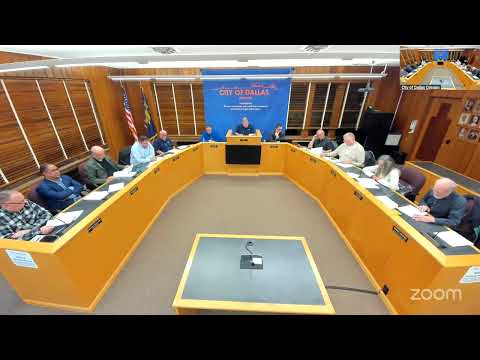
City councilors in Dallas voted 8–1 on Jan. 6 to direct city staff to pursue Option 5 — a plan to remodel the city‑owned Itemizer Observer (IO) building for administrative offices and convert the existing 1936 City Hall into a police station over time.
City staff presented five options for addressing the council’s prior decision to seek a new police facility. The new‑build options ranged from a two‑story L‑shaped design that had been presented to voters in 2025 (estimated at approximately $18.4 million with a 2027 construction schedule) to smaller two‑ and three‑story block buildings produced after a value‑engineering process (estimates ranged roughly from $14.3 million to $17.1 million). Staff also identified revenue‑bond financing (a fee on the city bill) as an alternative to a general‑obligation property tax bond; projected fees to support new construction (Options 2–4) were roughly $13–$15 monthly per bill payer under the staff debt schedules included in the packet.
Option 5, which the council ultimately directed staff to explore further, repurposes the IO building for non‑police city operations and stages renovations to the existing City Hall to meet police department needs. Dahlke Construction provided an initial estimate of about $1.3 million to renovate the IO building; staff said a conservative high‑end figure for the IO work would be under $2.0 million and estimated roughly $2.5 million in upfront costs when seismic analysis, structural work and initial architectural design were included. To pay upfront costs, staff proposed using an interfund loan (borrowing from city funds) and then establishing a fee on the city bill to create a steady revenue stream for longer‑term renovations. Staff estimated that fee could start at $5 and escalate to $8 over several years, with the $8 figure described as a long‑side estimate; by contrast, fees tied to new construction options were estimated at approximately $13–$15.
Councillors debated the tradeoffs at length. Councillor Shane called Option 5 “a no brainer,” saying it reduced cost and offered flexibility, while Councillor Holzapel (Holzapol) said Option 5 should be a fallback and urged putting Option 3 — a three‑story shell with two floors completed — before voters so the public could choose a new build. Several councilors pressed staff for clearer debt‑service numbers, payment timelines and whether a fee could be crafted with a sunset. Staff pointed to the packet’s attachment B, which modeled a 20‑year revenue‑bond schedule and showed an annual debt service around $1.25 million for certain build options; staff also noted the existing public safety fee on the city bill is $12.83 and currently generates about $1.125 million annually.
Concerns about operational needs and victim privacy also surfaced in debate. Councillor Schilling described configuration problems in current facilities — for example, interview areas and evidence storage that split staff across multiple floors — and urged faster action. Councillor Barrientos, who has prior experience as a police officer, described victims being interviewed in common areas as an occasionally recurring problem that the council should address.
The motion to ‘‘direct staff to proceed with further exploration of Option 5’’ was moved by Councillor Shane and seconded by Councillor Briggs (motion introduced at the Jan. 6 meeting). The council conducted a roll‑call vote: Councillor Piave — Yes; Council President Briggs — Yes; Councillor Barrientos — Yes; Councillor Blosser — Yes; Councillor Fitzgerald — Yes; Councillor Holzapel — No; Councillor Jansz — Yes; Councillor Schilling — Yes; Councillor Shane — Yes. The motion passed 8–1. City staff said it will return with a report on next steps on Jan. 20.
Staff also advised that if the council chooses to pursue an option that would be placed on the May 2026 ballot, the council must pass a referral resolution by Feb. 27 to meet county deadlines; staff said they can refine fee amounts and debt terms once the council narrows its preferred option and directs further analysis.
What’s next: staff will prepare an interim report for the council’s Jan. 20 meeting outlining engineering and financing steps, and a seismic evaluation for the 1936 City Hall was estimated to take about six months once funded and contracted.