Get Full Government Meeting Transcripts, Videos, & Alerts Forever!
Get email alerts on the Police Station Value Engineering topic
No spam. Unsubscribe anytime.
Dallas council reviews value‑engineering options for proposed police station; mass‑timber 3‑story scheme trims construction estimate
Summary
Consultants presented three value‑engineered designs for a proposed Dallas Police Department station — a full 3‑story mass‑timber build, a 3‑story with the third floor shelled for future finish, and a reduced 2‑story option — with projected construction costs escalated to a 2027 start and no decision taken at the work session.
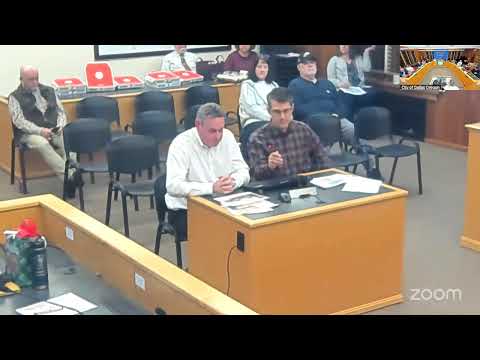
Consultants presented three value‑engineered design options for a proposed Dallas Police Department station at a Dec. 15 City Council work session, outlining trade‑offs between upfront cost, future flexibility and long‑term maintenance. Councilors did not vote; the presentation was framed as fact‑finding ahead of any future ballot decision.
Mackenzie architect Jeff Humphreys and Swinerton Construction’s CM/GC Andy Dykeman told the council the team re‑examined options after a May bond measure to fund a new station failed. Humphreys summarized the prior L‑shaped, two‑story scheme and said the original project forecast had been “between a 15.5 and a $17,200,000 range.”
The consultants said the most efficient revised form is a three‑story building on Court Street with parking behind the structure. In their construction‑cost comparison, the full 3‑story option’s construction estimate was presented at about $13.3 million; a 3‑story option with the third floor delivered as a shelled space was shown at about $12.4 million construction cost; and the reduced 2‑story option was shown near $11 million for construction. When consultant and owner fees, permitting and other owner costs were added, presenters gave all‑in totals of a little over $17 million for the full 3‑story option, about $16 million for the shelled third floor option, and about $14.14 million for the 2‑story option.
“We are carrying 4 and a half percent” annual escalation in the model, Dykeman said when a councilor asked about inflation assumptions. The consultants said those figures assume construction would start in 2027; they cautioned that delays beyond the April 2026 code‑cycle change could add further escalation — roughly $450,000 to $700,000 depending on the option. Dykeman also said adopting a mass‑timber design (cross‑laminated timber panels) can reduce tariff exposure because much of that material can be sourced locally.
The presentation noted operational trade‑offs: the original rotated two‑story design offered more roof area for photovoltaic arrays and partially covered parking but required more complex structural work and mechanical ventilation for enclosed parking. The 3‑story mass‑timber approach reduces exterior envelope area (which may lower maintenance costs) and preserves parking counts with parallel parking on the street, but deeper floor beams limit window daylighting and raise some programmatic height concerns. Delivering the third floor as a shell lowers initial outlay and preserves future growth capacity, but consultants warned the later fit‑out will be costlier because of escalation, possible code changes and required tenant improvements.
Presenters gave a rough schedule tied to a potential ballot: a ballot in May 2026, design starting in June 2026, permit and construction beginning in mid‑2027, and turnover in 2028. No formal direction or action was taken by the council during the work session.
Next steps noted by consultants and staff include continued refinement of estimates, further review of program needs versus space reductions, and ongoing evaluation of phasing strategies (including the shelled third floor). The council will consider the consultants’ findings as staff refines a path forward and determines whether to place a renewed bond measure on a future ballot.