Get Full Government Meeting Transcripts, Videos, & Alerts Forever!
Get email alerts on the Camping Ordinance Revision topic
No spam. Unsubscribe anytime.
Astoria council asks staff to draft options to tighten camping enforcement and explore sanctioned site
Summary
At a Dec. 8 work session, city staff, police and service providers reviewed enforcement data and shelter capacity; council directed staff to draft ordinance changes for escalation of penalties, pursue circuit-court prosecution options, study private-property temporary camping, and assess feasibility of a concentrated sanctioned site like Seaside’s Stepping Stones.
Estrella City Council members met Dec. 8 to review Astoria’s camping ordinance, hear service-provider perspectives and give staff direction on next steps for enforcement and alternative shelter models. City staff and police presented data showing a marked rise in prohibited-camping calls and citations this year and described operational strain on enforcement and parks crews.
Chief Stacy Kelly, the city’s police chief, said prohibited-camping calls rose from 419 to 521 (a 24% increase) and citations rose from 103 to 200 (a 94% increase) comparing Jan.–Nov. 2024 with Jan.–Nov. 2025. “This isn’t working,” Kelly said, arguing that citation-only enforcement has produced no durable change among a small group of roughly “10 to 12” service‑resistant individuals and that officers are burning out on repeated contacts.
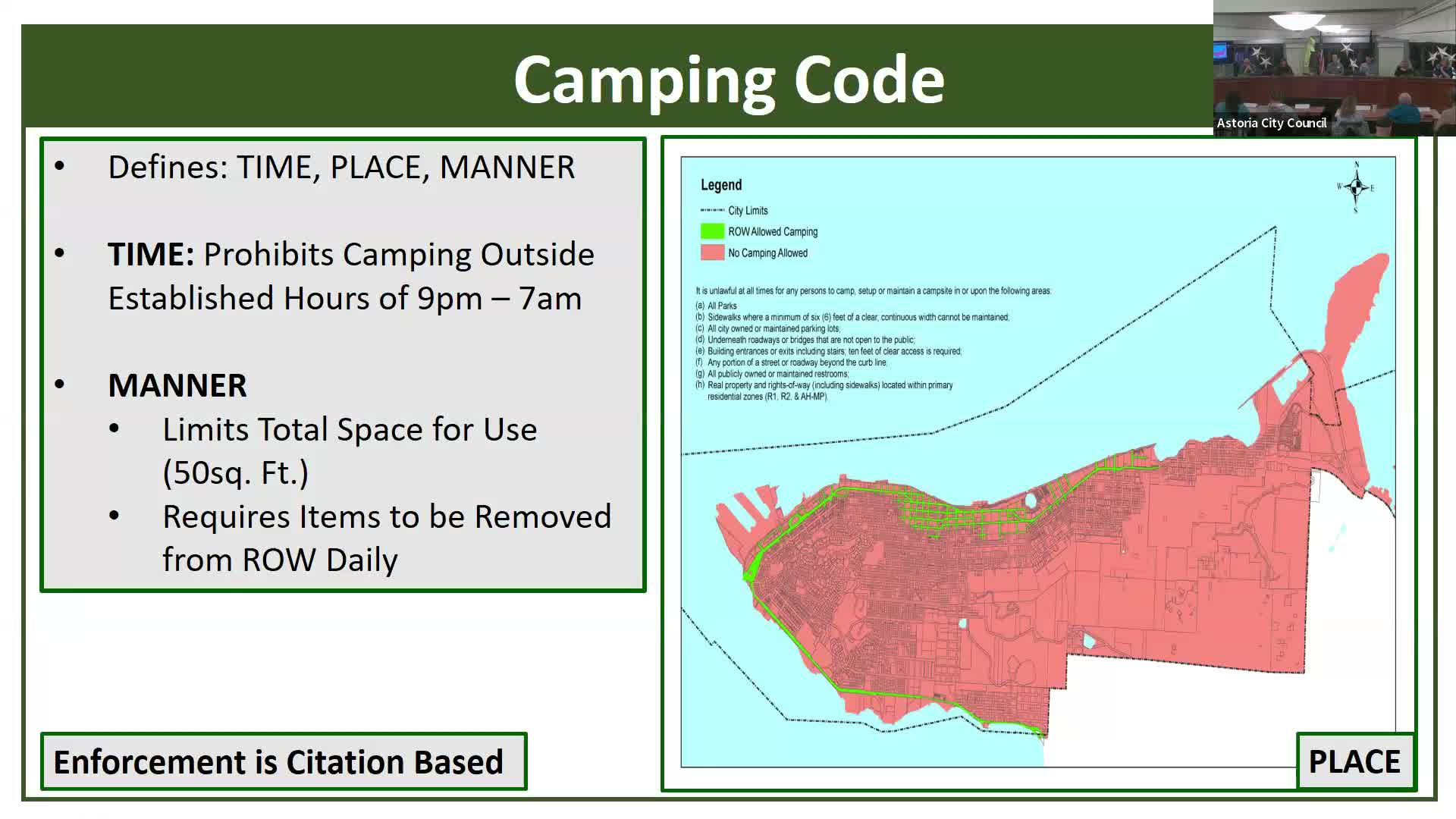
Ryan Quigley, assistant to the city manager, summarized the code’s time–place–manner approach: the ordinance currently forbids camping outside designated areas between 9 p.m. and 7 a.m., limits personal space to about 50 square feet per person and requires daily removal of items from the right of way. Quigley also outlined local resources: Clatsop Behavioral Health’s housing and mobile response services, Clatsop Community Action’s shelter and outreach teams, Lifeboat Services’ low‑barrier nightly shelter, Helping Hands Reentry’s regional facilities and a city-funded emergency cold-weather shelter funded at $20,000 (active Dec. 1–Mar. 1 when temperatures fall to 32°F).
Service providers urged a mix of compassion and alternatives. “Issuing a citation to somebody who’s experiencing homelessness makes no sense,” Susan Perdeman Hartel, deputy director at the harbor, told the council, arguing citations clog courts and don’t address housing needs. Shaira Marillah Simmons, executive director of Clatsop Behavioral Health, said a 32‑unit project (the Baker Building) could begin leasing in January but would only modestly reduce unsheltered numbers and that many people need persistent outreach and time to engage with services.
Several presenters pointed to Seaside’s Stepping Stones model as an example. Kenny Hansen, street outreach manager at Clatsop Community Action, described Stepping Stones as a low‑barrier, site‑based program with assigned tent sites, daily staff engagement and partner services, which staff and providers said produces higher engagement than dispersed outreach alone.
Councilors discussed a range of policy options and converged on four staff assignments rather than voting on ordinance language at the session: (1) draft options to escalate enforcement penalties with a progressive structure that could lead to municipal criminal violations after repeated citations; (2) pursue an agreement with the circuit court to process more serious cases without creating a new municipal‑court FTE; (3) study and publicize the existing code language that allows temporary camping on private property (safe‑parking or congregate options) and explore outreach to property owners and nonprofits to pilot that authority; and (4) evaluate the feasibility, likely costs and siting of a concentrated sanctioned site (a stepping‑stones or tiny‑home village), including the possibility of a council tour of Seaside’s site.
Staff said they would return with legal and fiscal analysis, draft ordinance language and feasibility work in early 2026. No formal votes or ordinance amendments were taken at the Dec. 8 work session.
The council closed the session by thanking providers and noting the complexity of the issue; members emphasized urgency but also the need for workable, sustainable options that do not overburden providers or staff.