Get Full Government Meeting Transcripts, Videos, & Alerts Forever!
Get email alerts on the Utility Assistance topic
No spam. Unsubscribe anytime.
Council reviews six‑month utility assistance pilot; staff propose $26,250 pilot with CCA administration
Summary
City staff proposed a six‑month utility assistance pilot starting in October, budgeted at $26,250 ($25,000 for credits; $1,250 for CCA administration). Assistance levels are household‑size indexed; staff will report pilot metrics in March to assess whether a permanent program or rate adjustments are needed.
City staff presented a proposed six‑month utility assistance pilot that would begin in October if council approves it at the regular Oct. 6 meeting. Staff recommended partnering with Community Care Alliance (CCA) to administer applications and deliver direct bill credits.
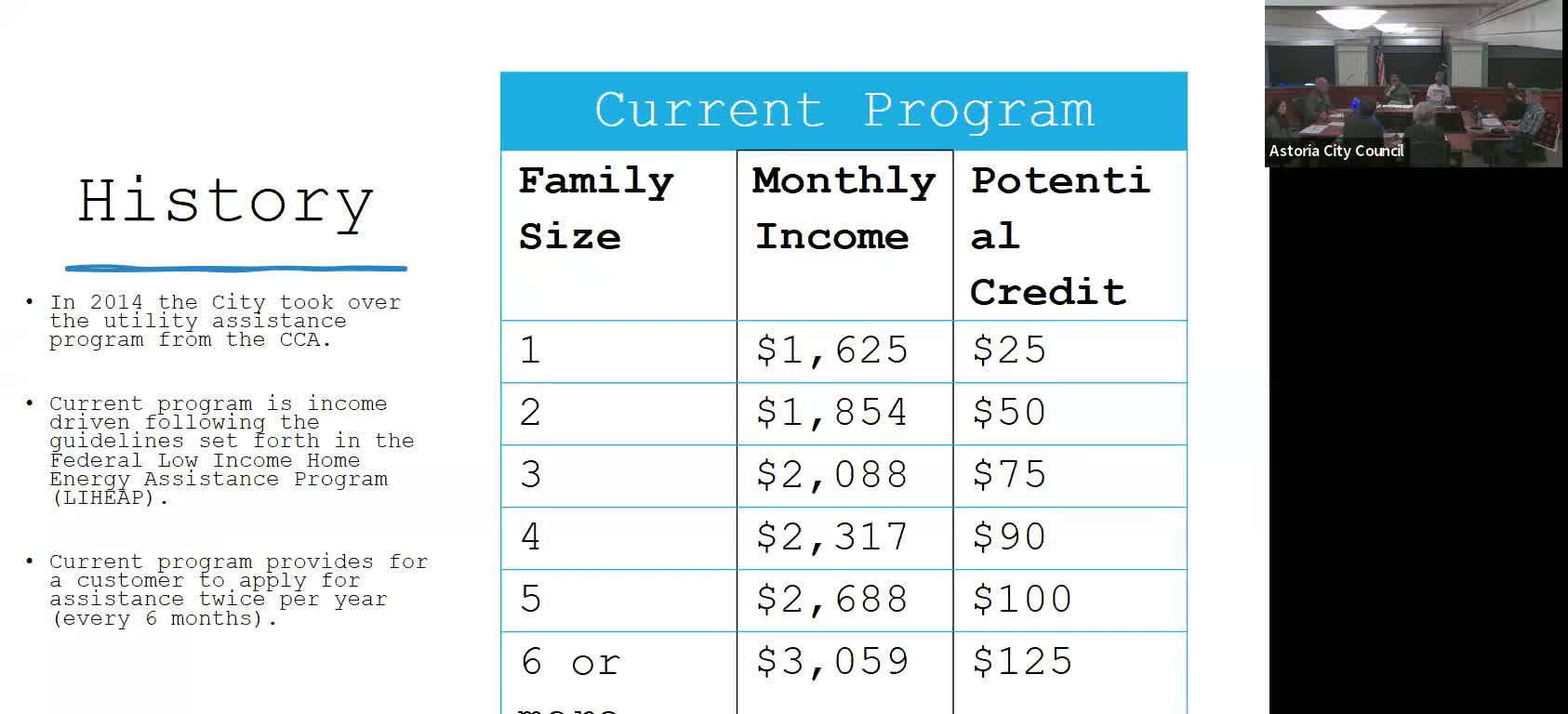
Ryan, the staff presenter, said the pilot budget would be $26,250: $25,000 for disbursements and $1,250 for CCA administration. Assistance would be based on household size and approximate 10% of average household consumption under current FY 25–26 metrics (sample credits: one‑person household $17; two‑person $23; three‑person $30; four‑person $37; five+ $43). Eligibility would be income‑based (household income at or below 30% of Clatsop County area median income). Applicants would apply through CCA, which would provide the city a monthly list of eligible accounts; the city would then apply direct credits to utility bills.
Councilors raised immediate constituent concerns about the CSO portion of current bills and asked whether the credit would apply to the overall bill (staff: yes). Members discussed an opt‑in roundup/donation feature; staff said current billing software cannot perform automatic roundup donations but that voluntary donations or fundraisers could be solicited in the near term. Staff also noted the pilot fits within existing budgeted funds (previously set aside for assistance) and that pilot outcomes will inform whether rate changes or additional budget allocations are needed.
On likely users, staff and councilors said the demographic most likely to use the program includes seniors and lower‑income households that receive utility bills directly; staff estimated roughly 480–530 eligible households in the community based on housing needs analysis and census metrics. Ryan said the pilot will provide data on community need, household sizes served, and administrative practicality; staff will return in March with metrics to inform the FY 26 budget and potential permanent program design.
If council approves the pilot on Oct. 6, staff said they will advertise the program, publish an application on the city website and work with CCA to begin direct credits for November billing cycles.