Get Full Government Meeting Transcripts, Videos, & Alerts Forever!
Get email alerts on the Csoplans topic
No spam. Unsubscribe anytime.
Astoria staff present CSO integrated plan, seek regulatory extension and funding path
Summary
Public Works Director Jeff Harrington told the Astoria City Council the combined sewer overflow (CSO) integrated plan asks for additional time and funding flexibility from DEQ to complete remaining projects, including a major Upper Town phase; staff estimate roughly $20 million remains and outlined next steps toward adoption and permit integration.
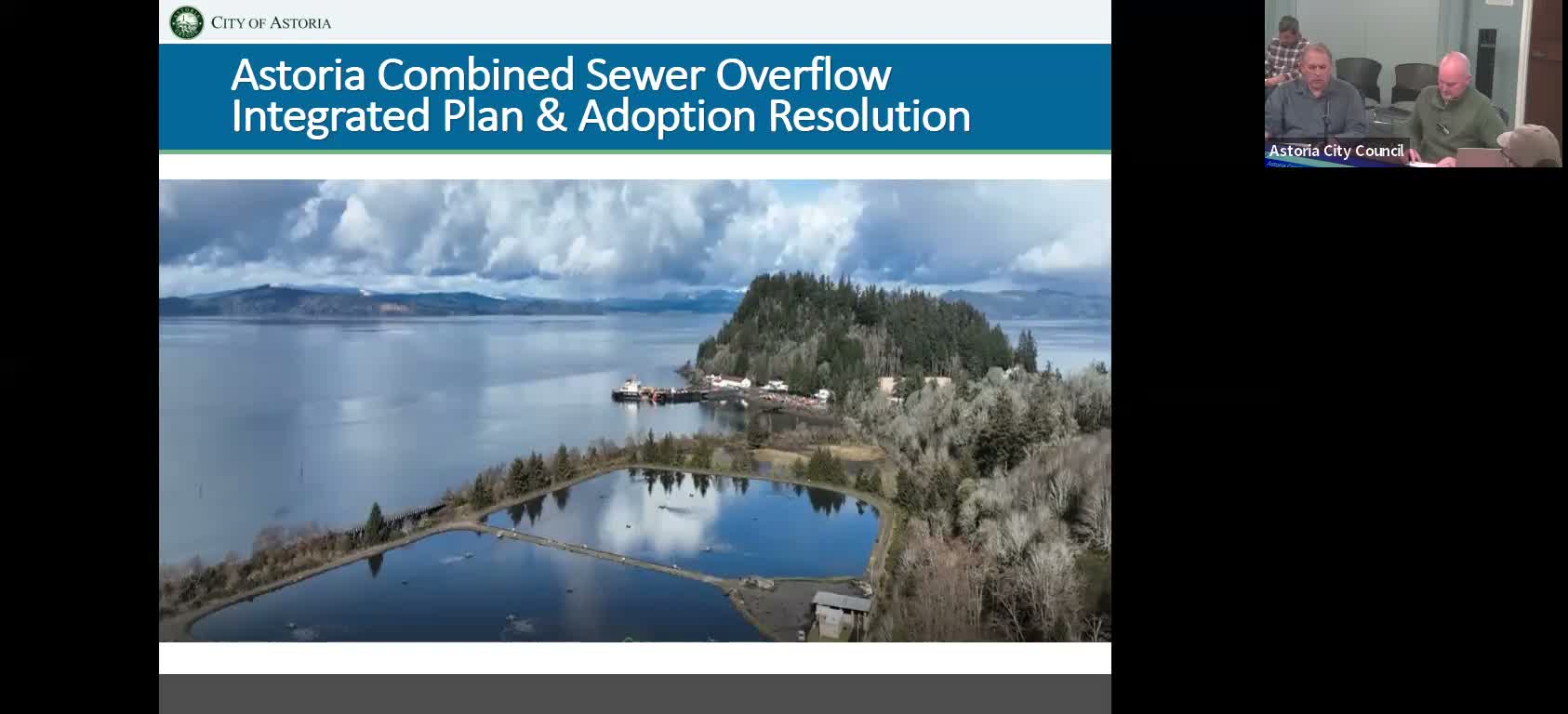
Astoria Public Works Director Jeff Harrington told the City Council the Astoria Combined Sewer Overflow integrated plan seeks regulatory accommodation to finish the city’s long-running CSO work and avoid dramatic rate shocks for residents. Harrington said the city built its combined sewer system in 1975 and later faced a DEQ stipulation to reduce overflows; the integrated plan documents work done, remaining needs and a schedule to meet regulatory obligations.
Harrington described five project phases and said 38 outfall locations remain controlled across the city. The largest remaining component is Phase 5 — an Upper Town package along Irving Avenue from roughly 23rd to 38th Street — that staff estimate will require a large, multi‑million dollar project. Harrington said the city has spent about $29 million in loans and $3 million in grants to date and has roughly $20 million of work left to complete the CSO program.
The plan combines separation (adding new storm or sanitary piping to keep flows separate) and storage (for example, a roughly 1,000,000‑gallon storage facility at Tapula Field) and aims to protect the Columbia River/Youngs Bay while managing debt and infrastructure priorities. Harrington said the integrated plan would become part of the city’s National Pollutant Discharge Elimination System permit after council adoption and submission to DEQ.
On finances, Harrington said city staff are exploring a multi‑year approach that uses loan payoffs to seed a stormwater utility fund rather than immediately adding heavy loan burden to ratepayers. “Give us a break. Give us some time to catch up on some other things,” Harrington said, urging incremental steps that would avoid a projected large CSO surcharge spike if major new borrowing were taken now.
Councilors asked when current debts would reach major payoff milestones; staff said 2026 is the first year when more substantial principal and interest will retire and that those scheduled payoffs create decision points each budget cycle on whether reduced CSO surcharges should be redirected into a stormwater program, used to offset rate increases, or split across utilities. Harrington also flagged equipment and monitoring needs (city has budgeted about $200,000 this year to replace half of monitoring devices and expects a similar amount next year).
Next steps: staff said DEQ review is underway, the integrated plan will be brought to council for adoption at the Oct. 6 meeting, and, if adopted, staff will submit the plan to DEQ and incorporate it into the city’s permit. Council members and staff discussed pursuing grants — including potential FEMA eligibility for projects that also reduce landslide risk — and phasing work to improve grant competitiveness.
The presentation did not include a formal motion or vote; staff will return to council with an adoption ordinance and refined financing proposals on Oct. 6.