Get Full Government Meeting Transcripts, Videos, & Alerts Forever!
Get email alerts on the Social Services topic
No spam. Unsubscribe anytime.
Denver Human Services outlines GIVE program emergency supports, asks for ongoing donations
Summary
Denver Human Services told the mayor and council its GIVE program provides emergency goods and neighborhood 'Give on the Go' services, is staffed by two full-time employees supported by volunteers, and continues to accept donations to address increased need after November EBT delays.
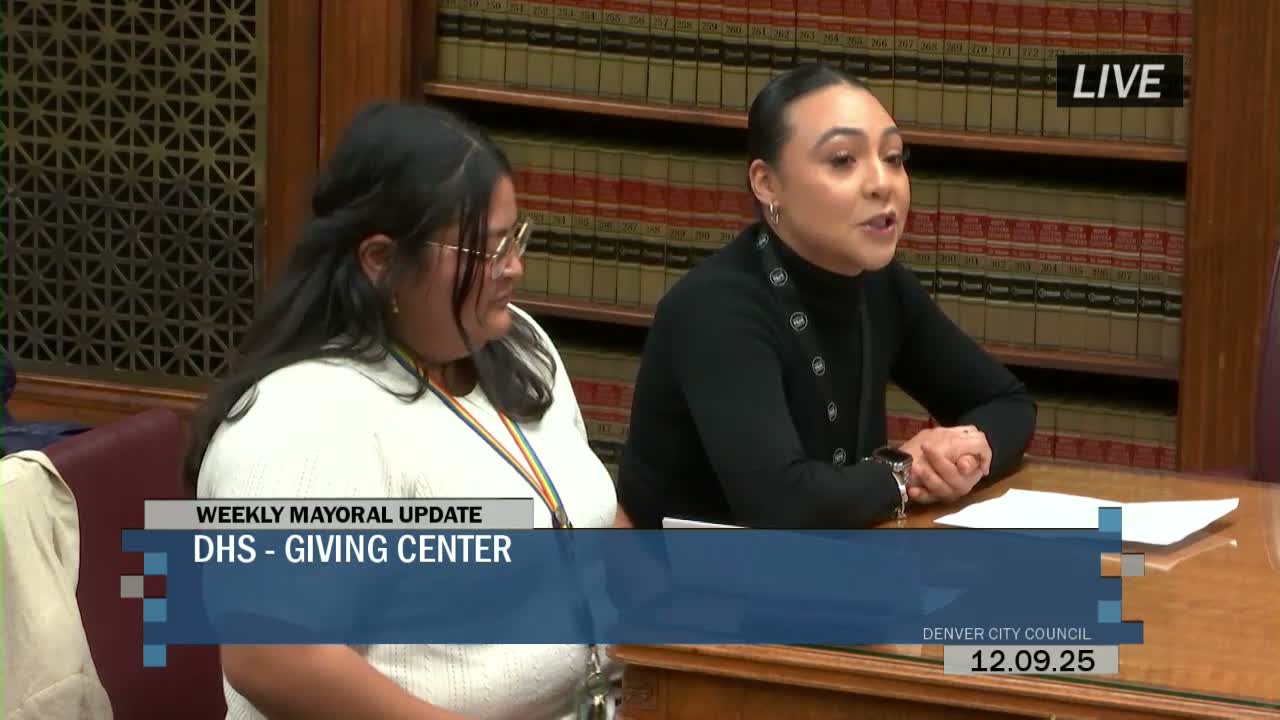
Denver Human Services presented an overview of its GIVE program on the Denver mayor and city council’s weekly meeting, describing how the program fills short-term gaps for residents facing hardship and asking for continued community donations.
Celia Leal, identified in the transcript as the GIVE Center supervisor, said the GIVE program “plays a crucial role in Denver Safety Net, providing a compassionate response and emergency relief to those facing a hardship.” Leal said the program is composed of two teams—the Give Donations team and the GIVE Center—and operates year-round donation intake, three large drives (hygiene, school supplies and a holiday gift drive) and ad-hoc drives to respond to emerging needs.
The program, the presenters said, provides emergency food boxes, hygiene supplies, diapers for all ages, clothing including winter coats, menstrual products and document fee waivers for Colorado identification, birth or death certificates. Leal and Eileen Elrado, who the transcript identifies as overseeing GIVE donations, said staff also run a care-portal used by child-welfare and child-support teams to request items for families, and operate neighborhood 'Give on the Go' distributions for quick, targeted support.
DHS described a recent internal food drive triggered by November delays in EBT benefits that, according to presenters, exceeded its 1,000-item goal. The presenters reported large distributions across program activities; the transcript lists quantities including roughly 18,600 snack items and 37,000 hygiene items. DHS staff noted the program accomplishes this work with two full-time employees plus volunteers and community partners.
During questions, Councilmember Jimmy Torres asked whether the program provides mobility aids such as wheelchairs. DHS replied that occasional donations include such items but that the program does not actively advertise distribution of mobility devices because safety and suitability are difficult to verify; instead, DHS connects residents to community partners who can loan or provide devices at low cost.
Council members praised staff and asked DHS to provide materials the council can share with constituents. Eileen Elrado confirmed in the meeting that GIVE is still accepting donations—items and monetary gifts (the program maintains an Amazon wishlist and uses donations to shop for unlisted needs)—and that volunteers remain essential to operations. Leal and Elrado encouraged residents and organizations to contribute through the program’s stated channels.
The presentation concluded with the council thanking DHS; later in the meeting the council moved to executive session for unrelated legal and real estate matters.