Get Full Government Meeting Transcripts, Videos, & Alerts Forever!
Get email alerts on the Transportation Demand Management topic
No spam. Unsubscribe anytime.
Denver council members weigh tougher transportation demand rules to curb "overparking"
Summary
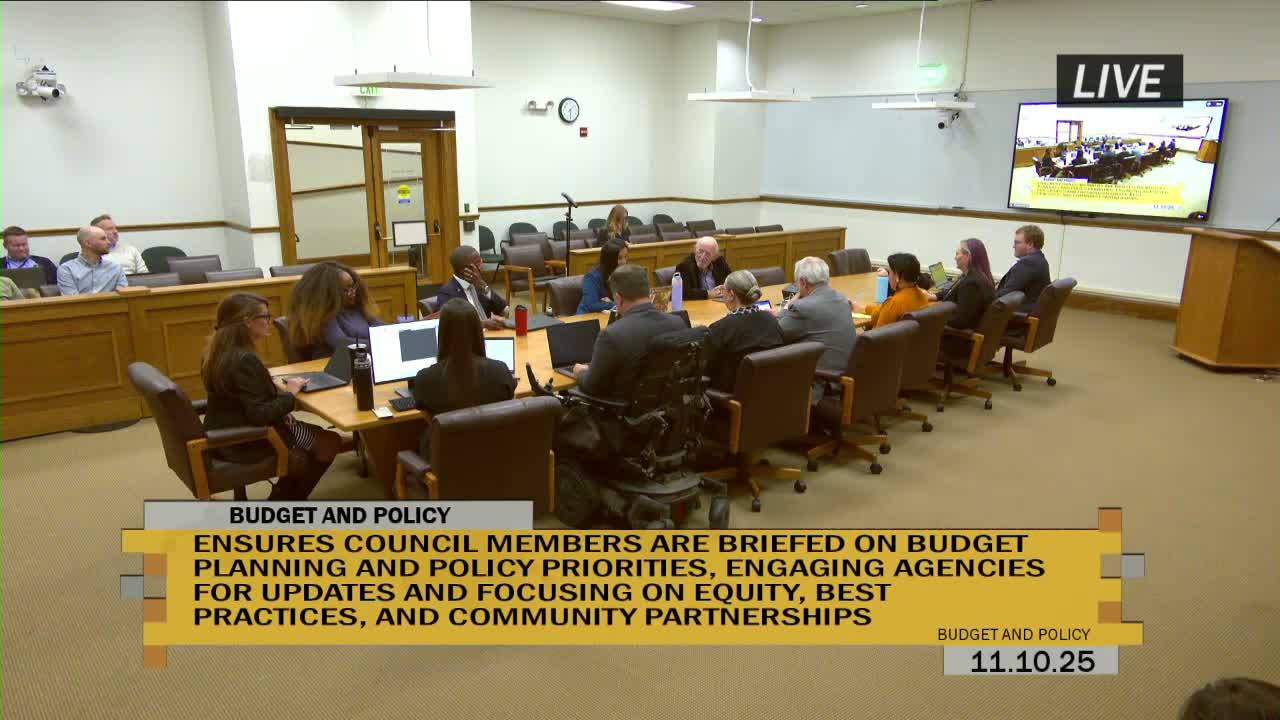
At the Nov. 10 Budget & Policy Committee, Councilwoman Amanda Sawyer asked colleagues to consider tightening the city's Transportation Demand Management program to target developments that build far more parking than needed, including a potential fee on extra parking spots and options for targeted enforcement and consultant research.
DENVER ' At a Nov. 10 meeting of the Denver City Council's Budget & Policy Committee, Councilwoman Amanda Sawyer outlined concerns that some developers continue to build far more parking than the city needs and asked colleagues whether the city's Transportation Demand Management (TDM) ordinance should be tightened to produce better outcomes.
"We have an over parking problem in Denver," Sawyer said, arguing that some projects build many more spaces than are required and that excess parking raises housing costs and worsens safety for pedestrians and bicyclists. She cited development examples presented by CPD showing large gaps between required and built parking and said the city's 2021 TDM ordinance now faces new enforcement challenges after changes in state law.
Sawyer described the menu of compliance options under the TDM ordinance ' such as transit passes, car-sharing requirements and bike facilities ' and warned that some options can meet the ordinance on paper without actually reducing single-occupancy vehicle trips if people do not use the benefits. "If you buy the eco passes, you fulfill the ordinance, but that doesn't mean people use them," she said.
As a policy idea, Sawyer proposed a fee for extra parking spaces: "The idea I had was to consider a parking fee for extra spots," she said, adding that fee revenue could help address infrastructure wear, safety risks and disincentivize overbuilding. She also said she would be willing to use part of her office budget to hire a consultant to analyze how fees or context-specific rules might work.
Nathan Pope, a planner at the Department of Transportation & Infrastructure who manages the TDM program, said DOTI has been updating rules and procedures and is "excited to work with you all on this topic," but that staff are still refining implementation strategies to ensure TDM measures are more than check-the-box solutions.
Councilmembers raised several concerns during Q&A. Councilmember Alvidrez asked whether parking sales (developers selling or leasing spaces) and the coupling of parking to affordable units had been studied, noting that in some projects parking revenue subsidized affordable units. Paul Cashman asked whether overbuilding is driven by financing requirements or a market to sell parking. Councilmember Chris Hines highlighted accountability gaps, saying developers have sometimes promised car-share spaces or bicycle parking that were not installed after occupancy, leaving enforcement with limited remedies.
Several members recommended more research and targeted, context-sensitive solutions rather than sweeping citywide maximums. Councilmember Quinn urged caution: because trend lines show downward parking rates overall, Quinn suggested deferring parking maximums and favored market-oriented or fee-based approaches to avoid reintroducing complex zoning calculations.
Next steps: Sawyer asked staff to return more detailed options and said she would partner with councilmembers interested in pursuing consultant-funded research. DOTI and CPD committed to follow-up with district-specific information about TDM coverage and enforcement. The committee moved on to the next agenda item without a formal vote on ordinance language.