Lifetime Citizen Portal Access — AI Briefings, Alerts & Unlimited Follows
Denver DOTI asks committee to approve reprocurement of $600M on-call contract capacity amid council oversight questions
Loading...
Summary
DOTI sought committee approval to reprocure two on-call contract categories — professional services and large civil construction — totaling up to $600 million in maximum capacity over three years; councilmembers pressed DOTI on oversight, mini‑bid transparency and MWBE goal setting.
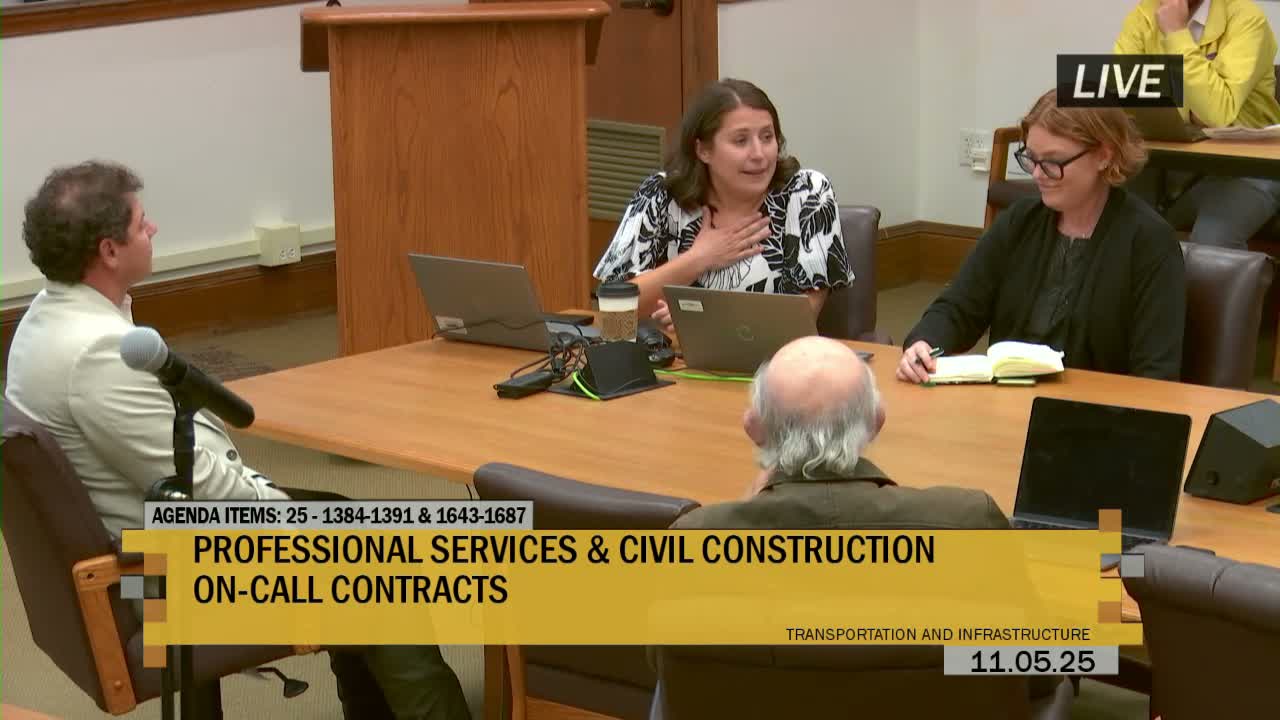
Denver’s Transportation and Infrastructure Department (DOTI) asked the City Council’s Transportation and Infrastructure Committee on Nov. 5 to approve reprocurement of two categories of on‑call contracts that together carry roughly $600 million in maximum capacity for a three‑year term, with options to extend.
In an overview, DOTI legislative liaison Elena McWhirter told the committee, “Any action today does not obligate the funds that you'll see today,” saying the on‑call structure creates pre‑vetted pools of consultants and contractors to provide technical expertise over multi‑year capital programs. DOTI staff said the professional services package includes 14 categories and roughly $206 million in capacity, and the single large‑construction on‑call totals $400 million (eight firms at $50 million each).
Why it matters: Council members framed the vote as a question about democratic oversight and equitable contracting. Councilman Chris Hines said he remains “concerned about the lack … of council oversight,” citing a past instance where bond funds for a $7 million trail project were assigned to an on‑call vendor and left dormant for 18 months. He asked whether DOTI intends to continue awarding strategic projects via on‑call task orders rather than separate competitive RFPs.
DOTI officials defended the approach as a tool to speed delivery while preserving annual budgetary control and offered several transparency measures. Jennifer Williams, an infrastructure engineer, said DOTI received 99 proposals for the professional‑services categories and selected 45 firms (including 10 MWBE prime firms and 12 new firms). DOTI pointed councilmembers to a new “do business with DOTI” dashboard that lists upcoming mini‑selections for task orders and to quarterly on‑call reports the department distributes to council.
On MWBE goals, the city’s compliance manager, Erin Croak, said goal levels “are set based on availability in the marketplace” and the NAICS codes firms hold. Council members pressed DOTI on how MWBE goals were set for construction work (one civil contract showed a 12% goal) and whether past MWBE performance was part of the award criteria. DOTI said responsiveness, firm qualifications and past performance are considered in selection committees, and that task‑order level reviews check MWBE participation on individual assignments.
What council asked for: Multiple members requested written follow‑up — a memo explaining the mini‑bid/mini‑selection process, a side‑by‑side memo showing prior on‑call firms and utilization versus the newly awarded firms, and regular committee briefings on anticipated on‑call projects tied to bond spending. Councilman Kevin Flynn specifically asked DOTI to provide a clear description of how the mini selection works and to consider quarterly committee updates.
What happens next: The committee discussed but postponed certain items to a Nov. 19 date‑certain meeting. DOTI said actual spending still requires annual budget line items (PRJ codes) and that the $600 million figure is a non‑obligating ceiling used to ensure capacity across the years.
Ending: DOTI urged the committee to approve the procurement so staff can issue notices to proceed for the large civil contracts and have professional‑services agreements ready to execute in January 2026; council members said they expect additional memos and briefings on process, MWBE accountability and district notifications before substantive task orders are executed.