Get Full Government Meeting Transcripts, Videos, & Alerts Forever!
Get email alerts on the Eviction Legal Assistance topic
No spam. Unsubscribe anytime.
Denver committee advances eviction legal-aid contracts as filings climb
Summary
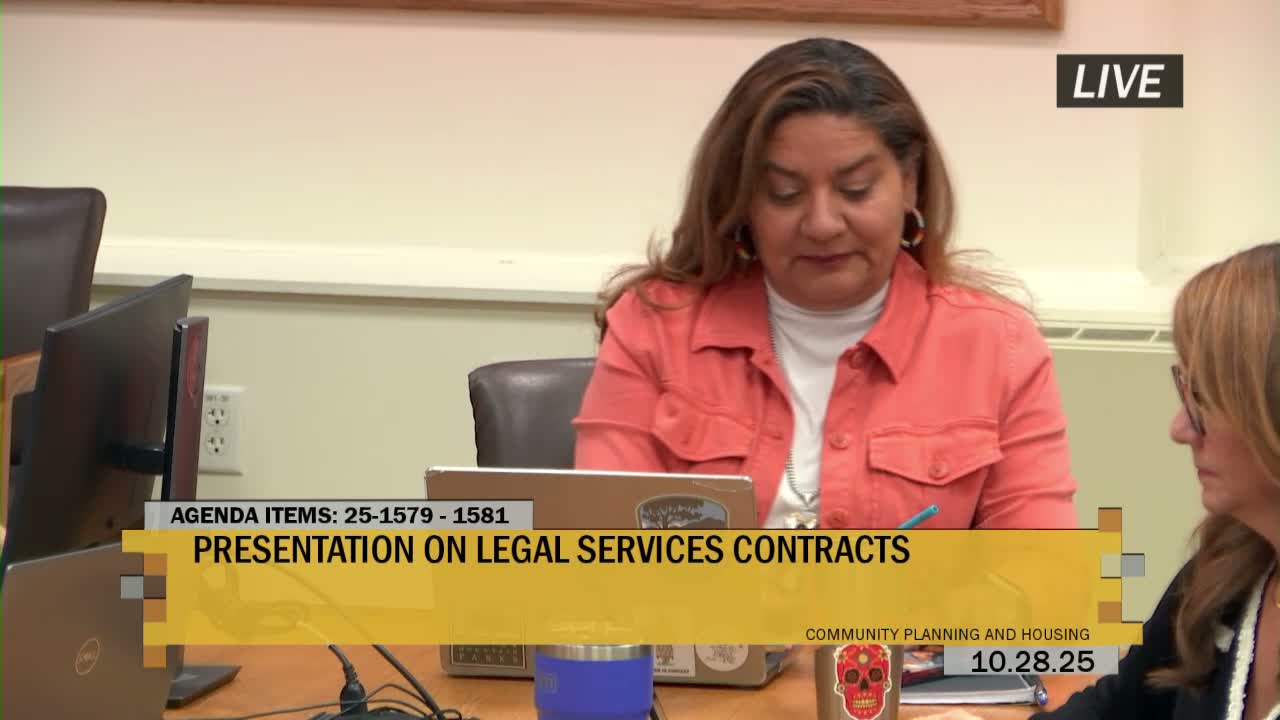
The Community Planning and Housing Committee advanced three HOST eviction-legal-assistance contracts and heard staff report rising eviction filings, concentration among repeat filers, and limits set by Colorado law on mandatory mediation.
Denver’s Community Planning and Housing Committee advanced contracts this week intended to expand eviction legal assistance as city officials described rising post-pandemic eviction filings and targeted strategies to help repeat filers.
Melissa Tati, director of Stability and Prevention at the Department of Housing Stability (HOST), told the committee the program serves Denver households at or below 80% of area median income and provides both limited help (information and form assistance) and full court representation. “It is for households, who have an income at or below 80% of the area median income and those who are Denver residents,” Tati said.
Tati said HOST served more than 3,300 households with eviction legal assistance in 2024 and that through September 2025 the program had spent about 77% of a $2.5 million allocation and served over 2,600 households to date. She also flagged research showing that between January 2022 and January 2024 roughly 22,000 eviction filings were recorded in Denver, and that about 1,500 households produced more than three filings each — roughly 7% of households but about 23% of filings. HOST said those “serial filers” are a priority for targeted, wraparound interventions.
The committee reviewed three three-year contracts resulting from a recent procurement. Tati gave the following contract summaries as presented to the committee: Colorado Legal Services — $1,168,737 (three years), anticipated ~300 households per year; Community Economic Defense Project (doing business as the community firm / RCEDP) — $2,768,062.50 (three years); Colorado Poverty Law Project — reported in the presentation at about $2,000,983 (three years). Tati said a contract with Colorado Affordable Legal Services will be brought to the council soon.
Council Member Sawyer asked about the per-eviction cost; Tati said an average is “about $800 to $900” per household now, up from under $700 in a prior report, in part because HOST is providing more full representation in court and adding staff. Sawyer also raised whether state law changes had raised filing counts without increasing actual evictions; Tati said Colorado’s eviction process is governed by state law and, based on advice from the city attorney and HOST’s practice, mandatory mediation cannot currently be required by the city — it can only be offered on an optional basis.
The committee moved the eviction-contract item forward by consensus; the chair noted no formal roll-call vote was required at that moment.
What it means: HOST officials said the city is trying to combine legal aid with upstream prevention (true-up applications before filings) and wraparound services to reduce repeat filings. Data gaps remain for limited-representation cases, and staff said longer-term housing outcomes for program participants are not consistently tracked for the eviction legal-assistance line item.
Next steps: HOST will bring the remaining contract (Colorado Affordable Legal Services) back for council consideration and provide follow-up information requested by committee members, including geographic maps of filings and further program-level data.