Get Full Government Meeting Transcripts, Videos, & Alerts Forever!
Get email alerts on the Residential Rental Licensing topic
No spam. Unsubscribe anytime.
Committee advances ordinance to align rental-license fines with health-code penalties
Summary
Denver’s Finance & Business Committee heard a proposal to amend the residential rental licensing code to allow civil penalties up to $5,000 per violation per day, aligning Excise & Licenses’ maximum with the Department of Public Health & Environment. Supporters said the change will deter large bad-actor landlords; landlord groups warned small owners could be disproportionately harmed. The committee voted to advance the measure to full council.
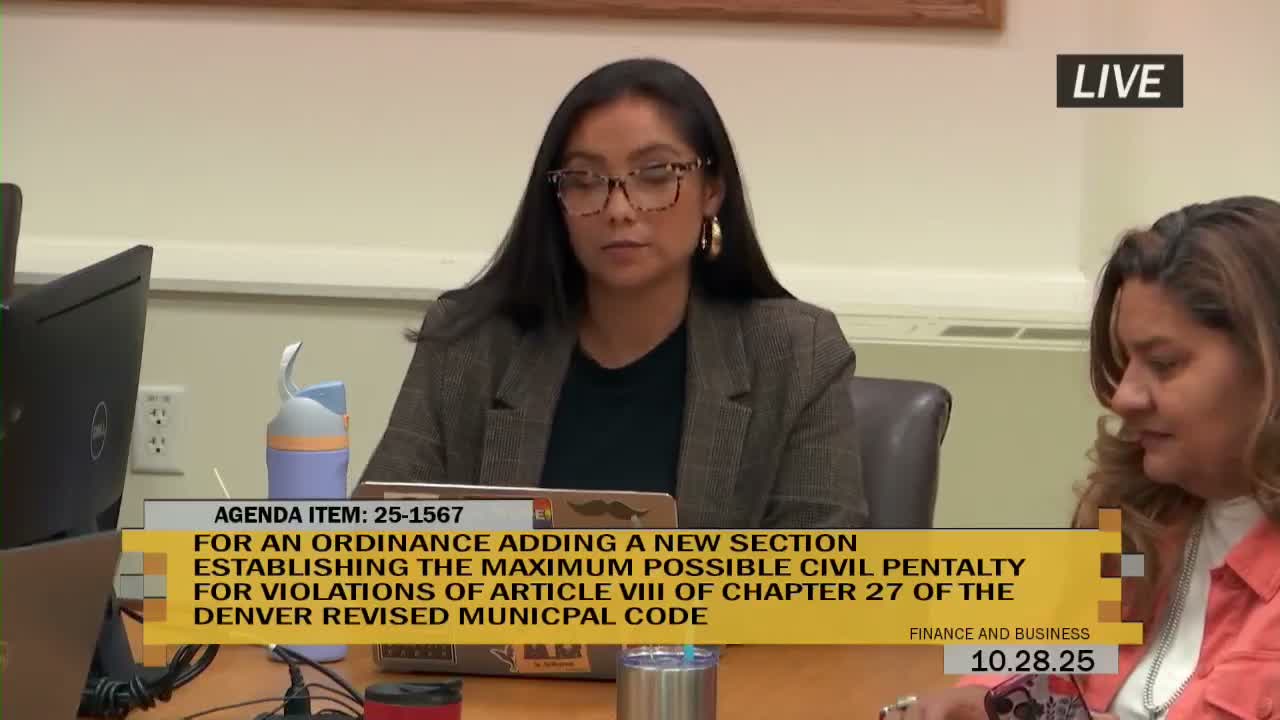
Denver — The Finance & Business Committee on Oct. 28 advanced an ordinance that would allow the Department of Excise and Licenses to assess civil penalties of up to $5,000 per violation per day for residential rental-license violations, aligning the licensing code’s maximum with penalties already available to the Department of Public Health and Environment (DDPHE).
The ordinance would add a new section to Article 8 of Chapter 27 of the Denver Revised Municipal Code specifying that violations are subject to a civil penalty not to exceed $5,000 per violation per day, that citations may be cumulative, and that the city may place a lien against property for unpaid penalties. Staff said the change would be applied in a scaled enforcement model that begins with warnings and progresses to higher fines only after repeated noncompliance or for particularly egregious violations.
Why it matters: Excise and Licenses staff told the committee that the residential rental licensing program grew faster than expected and that, as of Oct. 20, 2025, the city had 27,712 active residential rental licenses covering about 203,000 units. Under the current default fine schedule in Chapter 2 of the municipal code, the highest licensing fine available is $999. DDPHE, which enforces Denver’s health and sanitation code (Chapter 24), can impose fines up to $5,000 per violation. Staff argued the discrepancy can create inconsistent outcomes for the same habitability problems and limits the city’s leverage against operators who repeatedly fail to fix costly problems.
Supporters and concerns: Tenant advocates and housing attorneys urged the change. Olivia Sanders of the East Colfax Community Collective said higher penalties will “create a higher incentive for landlords to come into compliance.” Jordan Kotler, a housing attorney with the Colorado Poverty Law Project, told the committee the current $999 ceiling gives large owners “very little incentive to comply” and that increasing penalties could help the city recover enforcement costs.
Landlord groups and individual small owners urged caution. Amy Cesario, government affairs chair for the Denver Metro Association of Realtors, said DMAR learned of the proposal only that week and asked for more stakeholder engagement, clearer violation criteria and robust education so small owners are not blindsided. Andrew Hamrick, general counsel for the Apartment Association of Metro Denver, warned that because the proposed maximum would be computed on a daily basis, a problem that takes weeks to correct could generate very large fines and potentially undermine small-owner businesses.
Key implementation points: Staff emphasized that the department intends to start with notices of violation and warnings, then escalate fines only after repeated outreach and failure to comply. Legal counsel clarified that a failure to obtain a residential rental property license is counted as one violation per property (one license per property) rather than one violation per unit. Appeals would remain available to anyone disputing a citation, and the ordinance language retains an appeal process.
Council action: Councilman Hines moved, and Councilwoman Stacy Gilmore seconded, to advance the ordinance to the full City Council. The committee did not request a roll-call vote and indicated by consensus that it would move forward to the council floor.
Next steps: The item will appear on the City Council floor for further consideration; staff said they will continue outreach and report back to council through the program’s annual update due by July 1.