Get Full Government Meeting Transcripts, Videos, & Alerts Forever!
Get email alerts on the Office Restructure topic
No spam. Unsubscribe anytime.
Denver committee hears ONS briefing as programs consolidate, data system replaces paper amid budget cuts
Summary
The Health & Safety Committee received an Oct. 22 briefing from the Office of Neighborhood Safety (ONS) on the consolidation of safety programs into the Office of Social Equity and Innovation and the rollout of a centralized digital data system; council members pressed staff for an organizational chart and written budget clarifications ahead of November hearings.
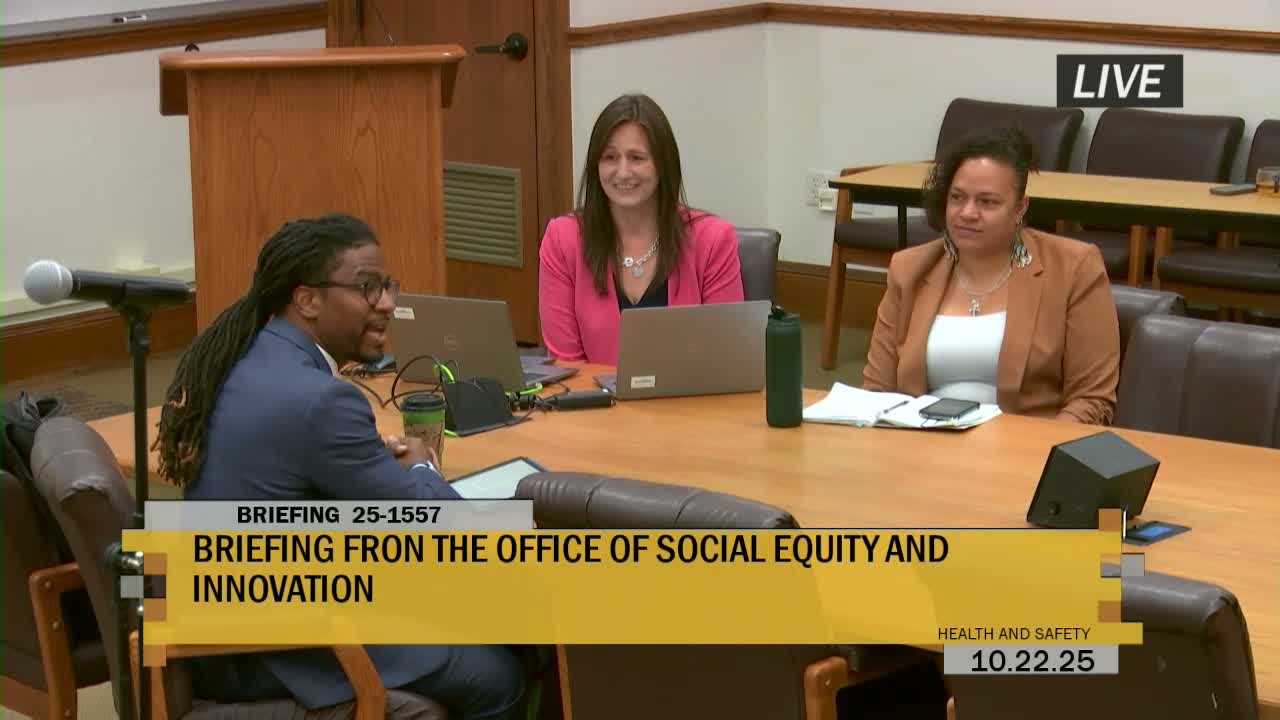
Daryl Watson, chair of the Denver City Council Health & Safety Committee, heard a briefing on Oct. 22 from the Office of Social Equity and Innovation about the newly created Office of Neighborhood Safety and efforts to modernize program data systems.
Ben Sanders, executive director of the Office of Social Equity and Innovation, told the committee the Office of Neighborhood Safety was formed when the mayor moved programs out of the Department of Safety into OSEI earlier in the year. "We did not receive at OSEI an office of neighborhood safety. We were not given an office of neighborhood safety. We were really excited to receive a set of programs, and we were then tasked with creating from that set of programs an office of neighborhood safety," Sanders said, stressing the work is new and developed over the past 15–16 months.
Why it matters: Council members said the consolidation has implications for contract management, program scope and the pending 2026 city budget. Amanda Sawyer (District 5) pressed staff to explain why the current org chart differs from the May 2024 presentation (Legistar item referenced in the meeting materials) and asked who manages contracts transferred during the reorganization.
Zach McDade, OSEI director of data and evaluation, described replacing pen‑and‑paper casework with modern digital systems across program areas and said those systems have both saved staff time and begun producing programmatic insight. "On Stefan's program alone, his data system has saved the equivalent of more than half of an FTE every single month," McDade said. He said ONS is mapping program outcomes to the social determinants of health to move from measuring outputs to measuring long‑term client outcomes.
Council members sought written clarifications before the council’s November budget hearings. Council member Amanda Sawyer said the presentation provided useful context but asked ONS to provide a clearer hierarchy and a written explanation of where specific contracts now live. Jess Ridgeway, executive director of the Office of Children’s Affairs, said out‑of‑school‑time and early childhood contracts remain with her office while many intervention contracts are managed by ONS.
Budget and staffing constraints framed several answers. Sanders said 2025’s budget reductions and layoffs required ONS to re‑examine core services and to partner with other agencies to preserve programming. Staff pledged to send written clarifications to council members and to provide follow‑up briefings.
Next steps: ONS will provide a written org chart and contract clarifications before the November budget discussion; the committee scheduled additional briefings for program areas (including GAIN) in November.