Get Full Government Meeting Transcripts, Videos, & Alerts Forever!
Get email alerts on the Public Defense Ompd topic
No spam. Unsubscribe anytime.
Denver municipal public defenders tell council Aid Center closure and immigration advisements are straining services; bodycam access curtailed
Summary
The Office of the Municipal Public Defender told the Health & Safety Committee that the Aid Center closure and a surge in immigration advisements are increasing barriers for clients, and that a July 2024 change to Axon access is limiting the office's ability to review body‑worn camera evidence. Councilmembers requested follow‑ups and scheduled further briefings.
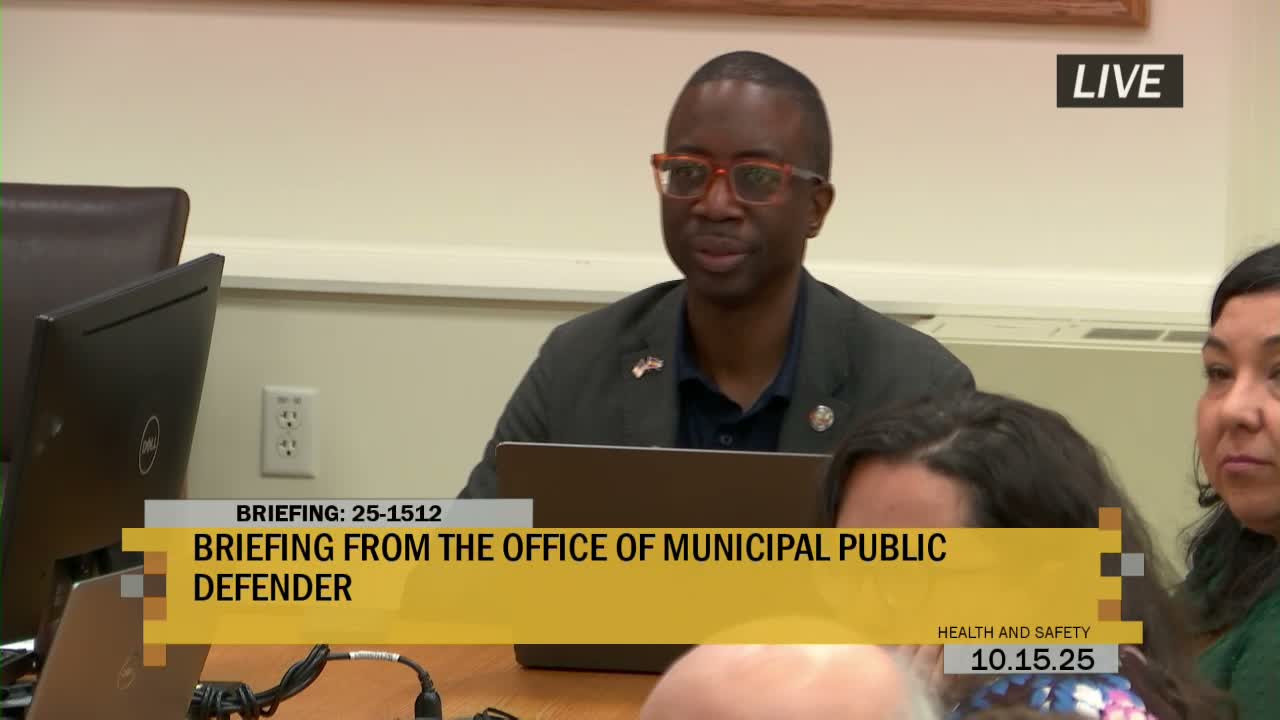
The Office of the Municipal Public Defender (OMPD) briefed the Denver City Council Health & Safety Committee on the scope of its work and the challenges it faces, saying recent operational changes have made representation and reentry supports harder to deliver.
"People experiencing homelessness are 11 times more likely to be arrested than housed individuals," OMPD Director Colette said, and she told the committee that "nearly 40% of our municipal court cases involve people that are experiencing homelessness," emphasizing that many of the cases are low‑level offenses such as trespass, open container and minor property crimes.
Colette described OMPD's holistic courtroom model: lawyers work alongside a client‑support team that provides behavioral‑health navigation, peer specialists, case management and outreach court services. The office operates multiple municipal courtrooms and runs "outreach court" twice a month at public venues, plus biannual "Fresh Start" warrant‑clearing events to reduce legal barriers to housing and employment.
Eleanor Hardy, an OMPD lawyer who addressed immigration issues, said some municipal pleas now carry immigration consequences and OMPD pays outside immigration specialists to advise clients. "There are certain pleas that carry immigration consequences," she said, describing how fast‑moving changes in administrative immigration law affect plea options and client advisals.
OMPD also raised the operational impact of the Aid Center's closure. Colette said the center had been a one‑stop site where clients could retrieve mail, access lockers and kennels, obtain IDs and meet service providers; its loss has forced more people into OMPD's lobby and increased failures to appear. "Since the Aid Center closed, our office...became like a second aid center," Colette said, adding the office reduced public hours to manage increased demand while preserving attorney work time.
The office reported a dramatic rise in immigration advisements—OMPD described about a 300% increase over the past year—and warned that changes in immigration policy mean formerly "safe" municipal pleas can now render clients ineligible for immigration benefits.
Councilmembers also heard that, beginning in August, the City Attorney's Office began filing motions challenging applicants' indigency forms and requiring OMPD to "litigate poverty," diverting attorney time to eligibility disputes.
On evidence access, OMPD said a July 2024 change to how the City Attorney shared Axon (body‑worn camera) material removed OMPD's in‑Axon case‑file access. Previously OMPD could view synchronized multiple cameras, GPS metadata and other Axon tools; now the office receives download links only and cannot open the case within Axon, limiting review and increasing duplicative downloads. Colette said she has sought a stakeholder meeting with the City Attorney's Office and Denver Police Department to restore functional access.
Councilmembers thanked OMPD for the briefing and asked for follow‑up. Chair Daryl Watson said Dr. Sanders will brief the committee on the GAIN program next week and that a comprehensive GAIN presentation is planned for November. Colette said she has requested stakeholder meetings on Axon access and welcomed council help in convening partners to address the Aid Center gap.
Next steps: the committee scheduled additional briefings (GAIN and children's services) and OMPD indicated it would pursue stakeholder talks with the City Attorney's Office and Denver Police Department about Axon access. The meeting adjourned after consent items were noted.