
Lewis County commissioners authorize settlement talks in Gather Church case as public comment divides over needle-exchange ordinance
Get AI-powered insights, summaries, and transcripts
Subscribe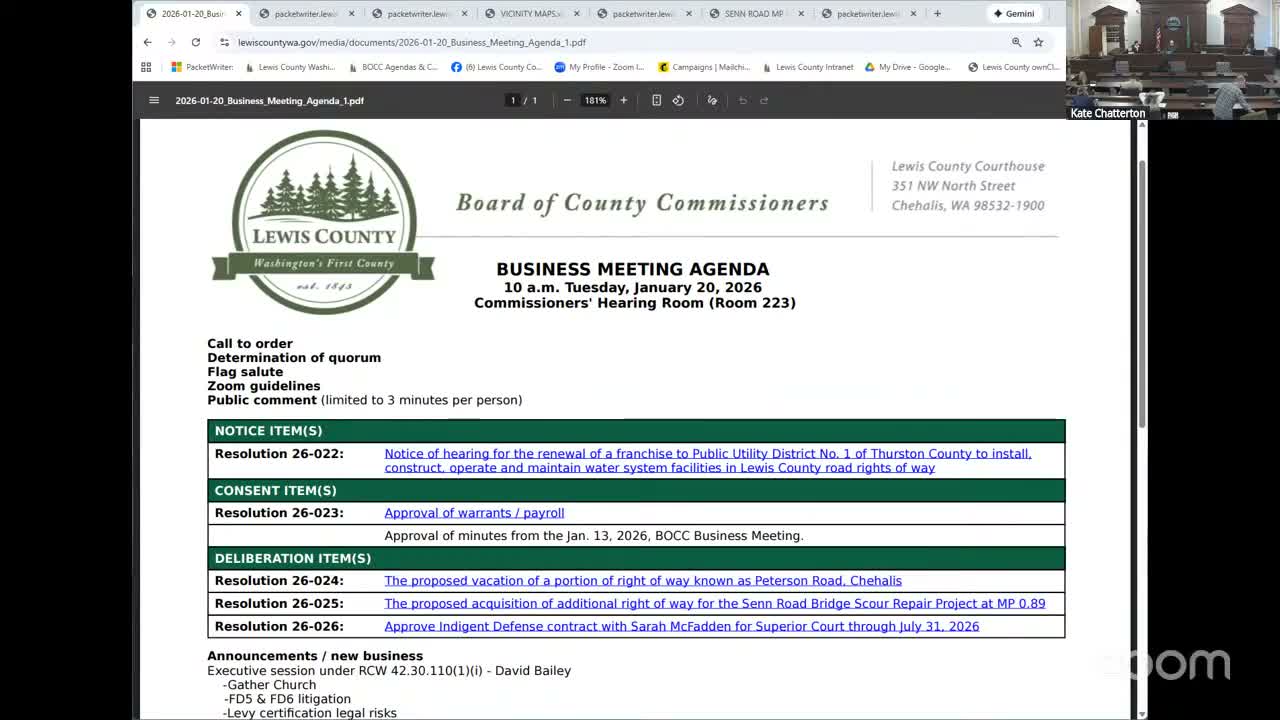
Summary
After an executive session on litigation, the Lewis County Board of Commissioners voted 3-0 to authorize settlement discussions in litigation involving Gather Church and to add a hearing for a related ordinance. Public comment that followed sharply split residents over ordinance 13-54, which restricts mobile needle exchanges.
Presiding Commissioner opened the Jan. 20 meeting of the Lewis County Board of County Commissioners and confirmed the board had met in executive session to discuss litigation involving Gather Church, litigation with Fire Districts 5 and 6, and levy-certification legal risks.
Following the closed session, the board approved, by a 3-0 vote, a motion to grant settlement authority in the Gather Church ACLU litigation and separately voted 3-0 to engage in settlement discussions and/or mediation in the fire district cases. An unidentified commissioner also moved and the board approved a request to add a notice of hearing for proposed ordinance 13-72 — described by commissioners as related to the Gather Church matter — to the Jan. 21 director’s meeting.
Why it matters: Gather Church has challenged county restrictions on mobile syringe services, and the ordinance at the center of public debate — county ordinance 13-54 — remains the subject of ongoing litigation. The board’s actions authorize county staff and counsel to pursue negotiated resolution rather than immediately continuing the case to trial, and the added hearing signals the county plans further administrative proceedings.
Public comment that followed centered on ordinance 13-54 and mobile syringe services. David de la Vega, introduced himself as a resident of Unalaska and said he supported the ordinance “on theological, humane, and civic grounds,” arguing that “providing needles to addicts without interceding toward recovery enables and encourages self-destructive behavior.”
Don Miles, a Chehalis resident who said he is 21 years clean, told commissioners accountability and faith helped his recovery and said, “I find needles at parks all the time…What about our children?”
Several speakers urged the county to retain or enforce limits on mobile exchanges. Elizabeth Rohr, a retired teacher from Toledo, said Gather Church’s plan to operate a mobile needle exchange “flies in the face of our community’s wish to enforce needle exchange and harm reduction regulations” and argued the county ordinance contains parameters intended to protect parks, schools and libraries.
Other residents urged maintaining syringe services. Dan Meekoff of Packwood read a letter supporting Gather Church and cited research he said shows syringe services “help prevent transmissions of infectious diseases without increasing drug-related or other crimes.” Rainier Wagner, who described himself as a former long-term user from Chehalis, said he contracted hepatitis C when clean needles were unavailable and that “green needles are necessary so the disease doesn’t spread.”
During public comment, Ray Chapman Wilson of Centralia asked how much taxpayers have spent defending ordinance 13-54, noting a federal court had allowed Gather Church to resume mobile exchanges temporarily. He said syringe service programs are “time tested and proven to stop the spread of disease.”
What the board decided: The board’s votes recorded on the Jan. 20 agenda included (a) approval of settlement authority for the Gather Church litigation, (b) approval to engage in settlement discussions or mediation in the fire district litigation, and (c) direction to staff to add a hearing on a proposed ordinance (13-72) related to the Gather Church matter to the Jan. 21 director’s meeting. Each motion carried on a recorded voice vote of 3-0.
Next steps: The county scheduled further administrative proceedings and staff were directed to publish notices required for the hearing on ordinance 13-72. The litigation remains active and the board’s settlement-authority vote does not announce any final outcome to the lawsuits.