Get Full Government Meeting Transcripts, Videos, & Alerts Forever!
Get email alerts on the Climate Funding topic
No spam. Unsubscribe anytime.
Fort Collins unveils 15‑year strategic funding plan to target climate investments
Summary
City staff presented a strategic funding plan to prioritize the climate portion of the 2050 tax, utility efficiency funds and disposal‑bag fees across 13 OCF "big moves," using a 15‑year projection window and a two‑year update cadence to feed the 2027 budget cycle.
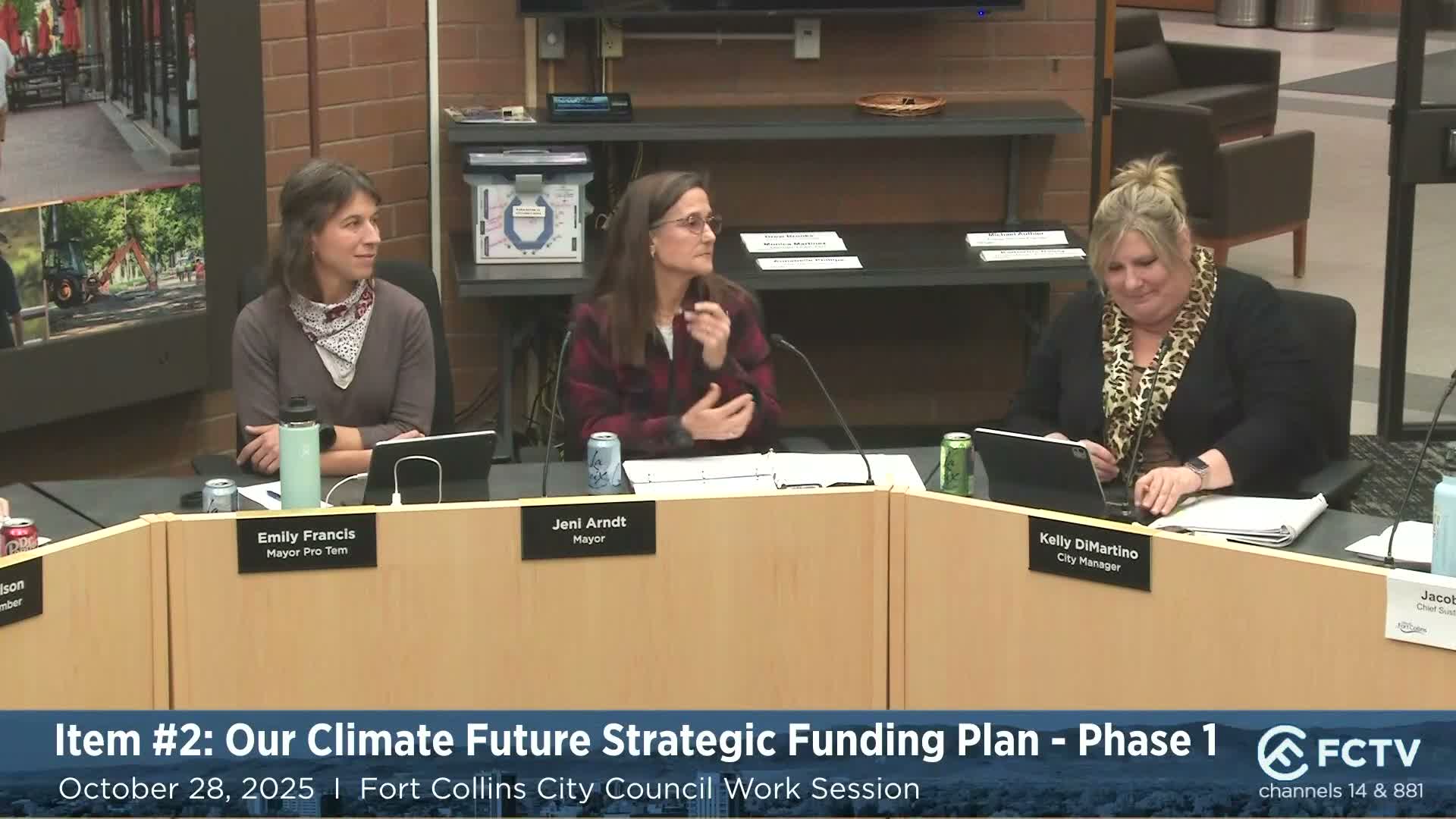
Fort Collins staff on Wednesday laid out a 15‑year strategic funding plan intended to guide investments tied to the city’s Our Climate Future goals, including how to prioritize spending of the climate portion of the 2050 tax.
Chief Sustainability Officer Jacob Castillo told council the plan is intended to "organize, prioritize and sequence the existing and emerging actions so that city leadership can resource the work effectively." He said staff will use the plan to recommend allocations that align with council priorities and the city’s two‑year budget cycle.
The plan identifies three core near‑term funding sources: the climate portion of the 2050 tax, remittance fees from disposable bags, and utility electric ratepayer funding dedicated to energy efficiency and renewables. Grant Stumpf, lead specialist in Environmental Services, said staff used a 15‑year projection horizon "to give ourselves enough of a strategic runway" for capital and long‑lead projects while retaining a rolling two‑year update to inform the biennial budget.
Staff presented a prioritization framework that scores candidate projects by strategic impact, people‑centered outcomes, local return on investment, and interconnection with other council priorities. Grant Stumpf used a composting‑facility example to show how pilot investments and capital savings could be sequenced: a 12–14 month residential and business pilot (funded with 2050 tax revenue) would test operations, then capital funding could be reserved over several years to bid a larger regional facility if warranted. Honore DePuy, manager in Environmental Services, told council a feasibility study estimates a full composting facility at roughly $15–$25 million and noted a separate capital improvement ballot measure could provide $7 million toward that need.
Council members pressed staff on timing and urgency. Several asked why the funding plan began after the 2050 tax passage; staff replied the project started post‑ballot to avoid planning before revenue existed and that the initial 2024 investments were already being spent across the big moves. Staff said the next phase of the strategic funding plan will return in Q1 as a more fleshed‑out product to feed the 2027 budget discussions.
Staff will also continue to refine projected revenue and allowable uses, and to identify grant opportunities and other non‑tax sources to stretch dollars. Castillo closed by asking for council feedback on the process; council members generally supported the framework but requested clearer allocation examples, faster learning cycles on pilots, and public reporting on how investments map to measurable OCF outcomes.
What’s next: staff said phase 2 will be completed in the first quarter of next year and that the plan will be updated regularly to align with the biennial budget process.