Get Full Government Meeting Transcripts, Videos, & Alerts Forever!
Get email alerts on the Annexation topic
No spam. Unsubscribe anytime.
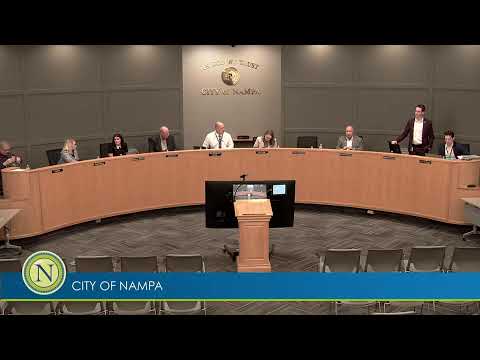
After Heated Public Comment, Council Approves RS4 Annexation with Conditions, Caps Units at Eight
Summary
Following more than a dozen public witnesses raising compatibility and parking concerns, the Nampa City Council approved annexation and zoning to RS4 for an enclave parcel near Lake Lowell with conditions capping development at eight single‑family lots (six aligned to neighboring western lots, two flexible north lots) and requiring four additional off‑street parking spaces.
The Nampa City Council voted 4–1 to annex a small enclave parcel and rezone it to RS4, but only after extracting conditions intended to address neighbor concerns about compatibility, parking and lot width.
The proposal before council was a concept for up to 12 lots; that concept drew strong opposition from residents who said the layout was too dense and incompatible with existing RS6 and RA lots in the area. More than a dozen citizens testified during the public hearing, citing expected overflow parking, narrow lot widths, potential two‑story homes looking into existing backyards, and a history of the site’s neglect. Roxy Kasarjan, whose family lives across the street, said: "We are not against growth. We are against growth that is incompatible, unsafe and not in line with the character of our neighborhood." (public comment)
Staff noted the property is infill, served by nearby utilities on Lake Lowell Avenue, and that the RS4 zone falls within the comprehensive plan’s medium‑density residential designation. Kristy Watkins, the city’s principal planner, told council the concept plan proposes lot sizes that fit RS4 standards and a density of about 5.82 dwelling units per acre, inside the medium‑density range.
Council deliberation centered on whether to deny the annexation, to approve and leave details to the applicant, or to approve with specific constraints. Members sought protections for neighbors: alignment of the six west lots with existing lot lines to avoid 'stacked' lot backs, additional off‑street parking for guests, and a firm maximum unit count. Councilmember Griffin urged more clarity about setbacks and a commitment to deed provisions where appropriate.
Councilwoman Jangula moved an amended approval that specified a maximum of eight units, with six lots aligned to the western boundary, two flexible northern lots, and four additional guest/parking spaces; the motion was seconded and passed 4–1 (Rodriguez opposed). The record notes the preliminary plat and building plans will return to the Planning & Zoning Commission for detailed review, during which compliance with the annexation conditions will be enforced.
What happens next: The developer must submit a preliminary plat addressing the council’s conditions. That plat goes to Planning & Zoning with public notice and an opportunity for further public testimony; staff said the council’s conditions can be incorporated into a development agreement.